Moonlighting in India: How Companies Can Detect and Prevent It
Why Moonlighting Has Become a Serious Hiring Risk
Moonlighting is no longer a fringe issue limited to freelancers or gig workers. In India, it has quietly become one of the biggest workforce risks for companies hiring in remote and hybrid models. Employees taking up second jobs without disclosure — sometimes with competitors — is now a reality across IT, startups, BFSI, and even senior roles.
The challenge is not just ethical. Undisclosed moonlighting creates direct risks around data security, conflict of interest, productivity loss, and breach of employment contracts. Many organizations only discover the issue after client escalations, performance drops, or compliance failures — when damage is already done.
What Moonlighting Actually Looks Like in Practice
Moonlighting is often misunderstood as someone doing harmless side work after office hours. In reality, the most damaging cases involve full-time employees secretly working for another company during the same working hours or holding parallel employment in competing organizations.
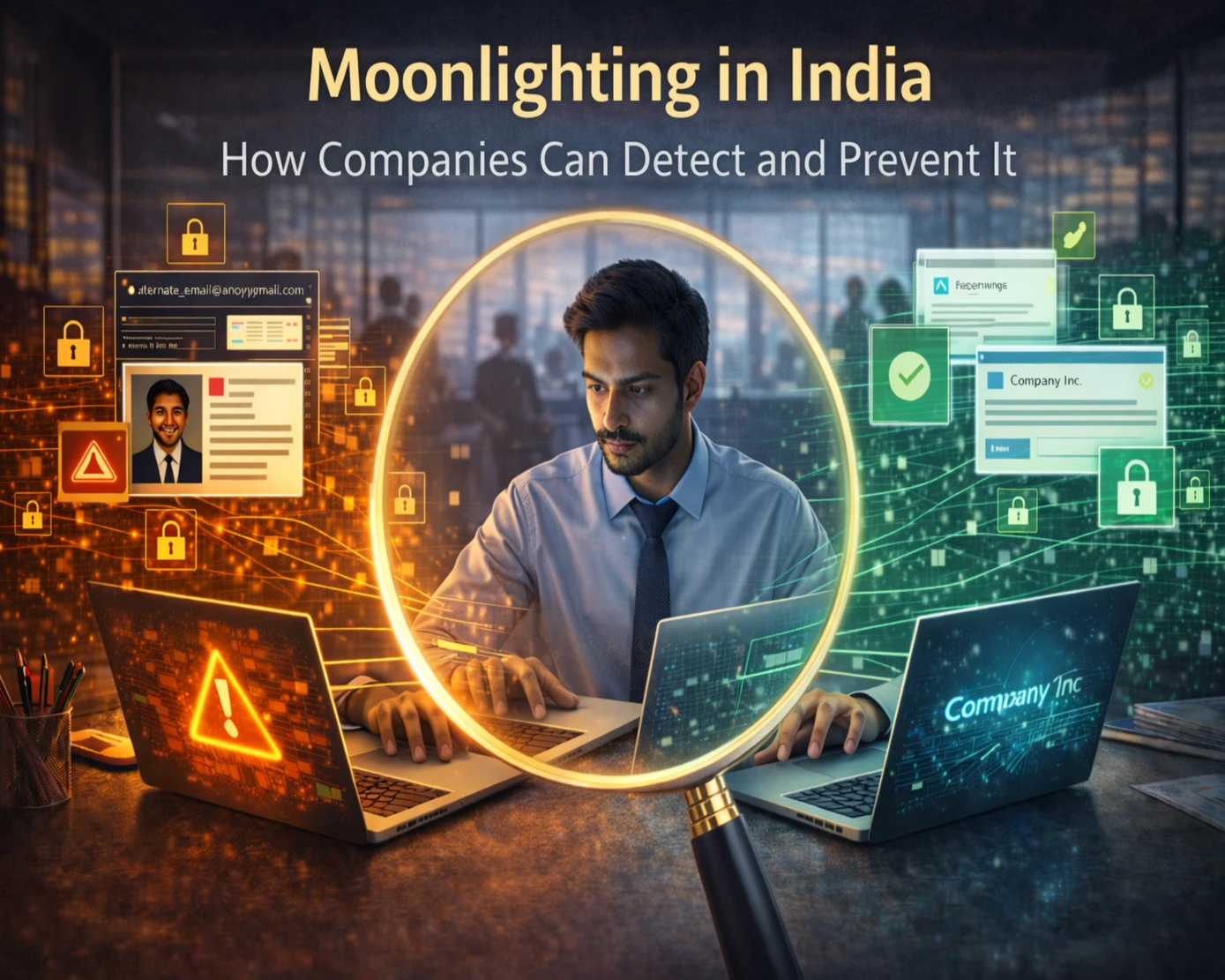
Some employees use multiple laptops, alternate email IDs, or freelance platforms under different identities. Others join startups remotely while still employed elsewhere. In more serious cases, individuals hold overlapping employment in companies serving the same clients or industries, creating direct conflicts of interest.
Why Companies Are Struggling to Detect Moonlighting
Traditional hiring and monitoring processes were never designed for a remote-first workforce. Interviews, references, and resumes cannot reliably reveal parallel employment. Even managers may not notice issues immediately, especially when teams are distributed across locations.
Many HR teams rely on declarations in offer letters or employment contracts, assuming honesty. However, without verification, these declarations remain unchecked. This is why moonlighting often goes undetected for months — until performance, confidentiality, or compliance is compromised.
The Real Risks of Undisclosed Moonlighting
Moonlighting is not just a policy violation. It introduces multiple layers of risk for organizations.
From a data security perspective, employees working for multiple companies may expose confidential information, codebases, or client data — intentionally or unintentionally. From a legal standpoint, breach of exclusivity clauses can lead to disputes, termination challenges, or reputational damage.
Operationally, moonlighting affects productivity, accountability, and team trust. Employees splitting focus across jobs often fail to meet expectations, miss deadlines, or disengage — creating hidden performance issues that managers struggle to explain.
How Background Verification Helps Detect Moonlighting
Background verification has emerged as one of the most effective tools to detect and prevent moonlighting — especially during hiring and role transitions.
Employment verification helps identify overlapping tenures, inconsistencies in joining and exit dates, or undisclosed current employment. Reference checks often reveal behavioral patterns or concerns that resumes do not disclose. In some cases, verification uncovers shell companies or unverifiable employers used to mask parallel work.
For remote and senior roles, role-based verification frameworks add an additional layer of protection by aligning checks with access level and risk exposure.
Preventing Moonlighting Through Structured Hiring Controls
Detection alone is not enough. Prevention requires clarity, consistency, and enforcement.
Clear employment contracts that define exclusivity expectations are essential. However, these must be supported by verification at hiring and during critical role changes. HR teams should communicate moonlighting policies transparently and reinforce them through onboarding and periodic compliance communication.
Companies that adopt role-based background verification reduce risk without creating mistrust. The objective is not surveillance, but accountability — ensuring that employees entrusted with access and responsibility are fully committed to the organization.
Handling Moonlighting Cases Professionally
When moonlighting is detected, response matters. Knee-jerk terminations without investigation can create legal and reputational issues. A structured approach — reviewing evidence, offering clarification opportunities, and aligning action with policy — protects the organization and preserves fairness.
Documentation from background verification reports plays a crucial role in making these decisions defensible and consistent.
Why Leadership Must Treat Moonlighting as a Risk Issue
Moonlighting is not an HR inconvenience — it is a leadership risk. CEOs and founders are ultimately accountable for data breaches, client trust, and governance failures. Treating moonlighting casually sends the wrong signal internally and externally.
Organizations that proactively address moonlighting through verification, policy, and leadership oversight protect not just productivity, but long-term credibility.

Final Thought
Moonlighting is a symptom of how work has changed — but unmanaged, it becomes a serious business risk. Companies in India can no longer rely on trust alone in a remote-first world.
Background verification, combined with clear policies and professional handling, allows organizations to detect moonlighting early, prevent conflicts of interest, and protect data, clients, and culture. For HR leaders, recruiters, and founders, the goal is simple:
Hire with clarity, not assumptions.
Leave a comments