Every organization wants to make informed decisions before placing trust in a person, a business partner, or a vendor. Whether it's hiring a new employee, onboarding a strategic supplier, or entering into a business partnership, decisions made without proper verification can expose the organization to financial loss, compliance issues, and reputational damage.
This is where two terms are often used interchangeably—background verification and due diligence. Although they share the common goal of reducing risk, they are not the same process. One focuses on validating the information provided by an individual, while the other involves a broader investigation into people, organizations, finances, legal exposure, and operational risks.
Understanding the distinction helps HR leaders, procurement teams, compliance professionals, and business executives apply the right process at the right time instead of assuming that one can replace the other.
Why People Confuse Background Verification and Due Diligence
The confusion usually arises because both processes involve collecting information before making an important decision. In many organizations, the words "verification" and "due diligence" are casually used to describe any type of background check.
However, their objectives are different.
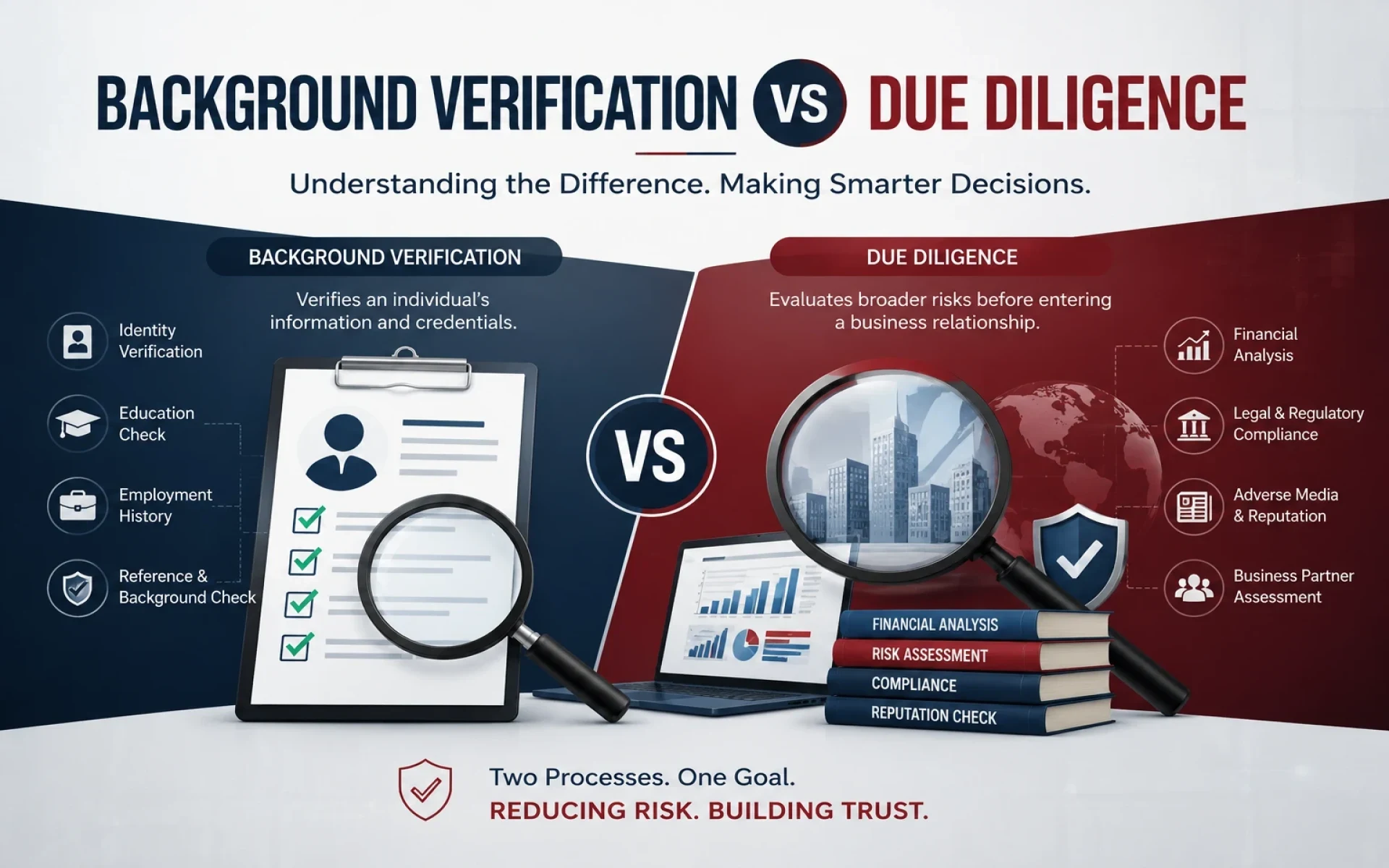
Background verification is designed to confirm whether the information provided by an individual is accurate. Due diligence goes a step further by evaluating potential risks that may not be immediately visible through standard verification processes.
Think of background verification as validating facts, while due diligence is about understanding the bigger picture before committing to a business relationship.
What Background Verification Focuses On
Background verification is primarily associated with hiring and workforce management. Its purpose is to establish whether a candidate's credentials and personal information are genuine.
Depending on the role, the verification process may include identity validation, employment history, education verification, address verification, professional certifications, criminal record checks where legally applicable, and reference verification.
The objective is straightforward: ensure that the organization is hiring someone based on verified information rather than assumptions.
For HR teams, background verification provides confidence that the candidate has represented themselves honestly throughout the recruitment process.
What Due Diligence Covers
Due diligence has a much wider scope. Instead of focusing only on an individual's credentials, it evaluates overall risk before entering into a significant relationship.
Organizations conduct due diligence when:
-
Selecting business partners
-
Evaluating vendors and suppliers
-
Reviewing acquisition targets
-
Assessing investment opportunities
-
Appointing senior executives
-
Entering strategic alliances
The process may include financial analysis, litigation history, regulatory compliance, adverse media research, sanctions screening, beneficial ownership verification, operational capability assessment, and reputation analysis.
Its goal is not only to verify information but also to identify hidden risks that could affect future business decisions.
Why Modern Organizations Need Both
One of the biggest mistakes organizations make is believing that background verification alone eliminates all risk.
Imagine hiring a senior executive. Background verification may confirm education, previous employment, and identity. However, it may not reveal ongoing litigation involving businesses they own, financial irregularities connected to previous companies, or adverse media reports affecting their professional reputation.
Similarly, vendor due diligence cannot replace employment verification because it does not validate an individual's employment records or academic credentials.
The two processes complement one another rather than compete.
The Growing Role of Due Diligence in Hiring
Hiring itself is becoming more sophisticated.
Organizations recruiting for board members, CXOs, finance leaders, compliance officers, and employees handling critical infrastructure are increasingly combining traditional background verification with executive due diligence.
Leadership roles involve influence beyond operational responsibilities. They affect investor confidence, regulatory compliance, corporate governance, and organizational reputation.
As responsibilities increase, verification requirements naturally become more comprehensive.
Choosing the Right Process for Different Situations
Every hiring or business decision carries a different level of risk.
A standard employee joining an operational role may only require comprehensive background verification. A Chief Financial Officer, strategic investor, or international vendor may require enhanced due diligence in addition to traditional verification.
The scope should always reflect the level of responsibility, access, and business impact associated with the individual or organization.
Risk-based verification is far more effective than applying the same process universally.
Why This Difference Matters for Leadership
For business leaders, understanding this distinction is more than a matter of terminology.
Using the wrong process can leave critical risks undiscovered. On the other hand, applying extensive due diligence where simple verification is sufficient increases cost and slows decision-making unnecessarily.
An effective governance framework ensures that every hiring or partnership decision receives an appropriate level of scrutiny based on its potential impact on the organization.
This balanced approach strengthens compliance, improves decision quality, and builds long-term trust with clients, investors, and stakeholders.
Final Thought
Background verification and due diligence share a common purpose—reducing uncertainty—but they achieve it in different ways.
Background verification confirms whether an individual's claims are accurate. Due diligence evaluates broader risks that may influence long-term business decisions.
Organizations that understand where each process fits are better equipped to hire confidently, build stronger partnerships, and protect their reputation in an increasingly complex business environment.
Background verification tells you whether key claims can be confirmed. Due diligence helps you understand the wider risks behind the relationship.
Verify Facts. Understand Risk. Make Confident Decisions. CaseXpert helps organizations combine background verification and due diligence to validate people, businesses, and critical information before important decisions. Talk to our verification specialists or send an enquiry to get started.