Most companies treat background verification as a one-time event: verify the candidate before they join, file the report, and move on.
But a background check only confirms what was true and verifiable at a particular point in time. Employees change roles, responsibilities evolve, circumstances change, and new risks can emerge long after the original verification was completed.
That is where employee background re-verification comes in.
Re-verification means conducting a fresh, targeted background check on an existing employee when there is a legitimate business, regulatory, contractual, or role-based reason to do so. In 2026, it is becoming an increasingly relevant part of workforce risk management, particularly for employees working with sensitive data, finances, regulated activities, or high levels of organisational authority.
However, re-verification needs to be handled carefully. Done without a clear purpose, appropriate legal basis, transparency, or proper data handling, it can become intrusive and create employee-relations and compliance concerns.
The objective is not to investigate employees indefinitely. It is to ensure that the level of assurance remains appropriate to the level of trust and responsibility an employee currently holds.
Why One-Time Verification Is Not Always Enough
Pre-employment verification provides a snapshot of a candidate's identity, qualifications, employment history, and other relevant information before they join.
It does not automatically remain current throughout an employee's career.
An employee who was verified three or five years ago may subsequently:
- Move into a more sensitive position
- Receive access to confidential or financial information
- Take on a regulated responsibility
- Obtain new professional qualifications
- Develop new conflicts of interest
- Become subject to circumstances that were not relevant or known at the time of hiring
This does not mean that every employee becomes a new verification case every few years. Rather, it highlights an important risk-management principle: the need for verification should reflect the employee's current role and risk exposure, not simply the date of their original background check.
For low-risk roles, a one-time check may be sufficient. For high-trust roles, however, an outdated verification may no longer provide meaningful assurance.
When Does Employee Re-Verification Make Sense?
Re-verification should be risk-based and purpose-driven, rather than automatically imposed on the entire workforce.
Common situations where an additional check may be considered include:
1. Promotion to a High-Trust Role
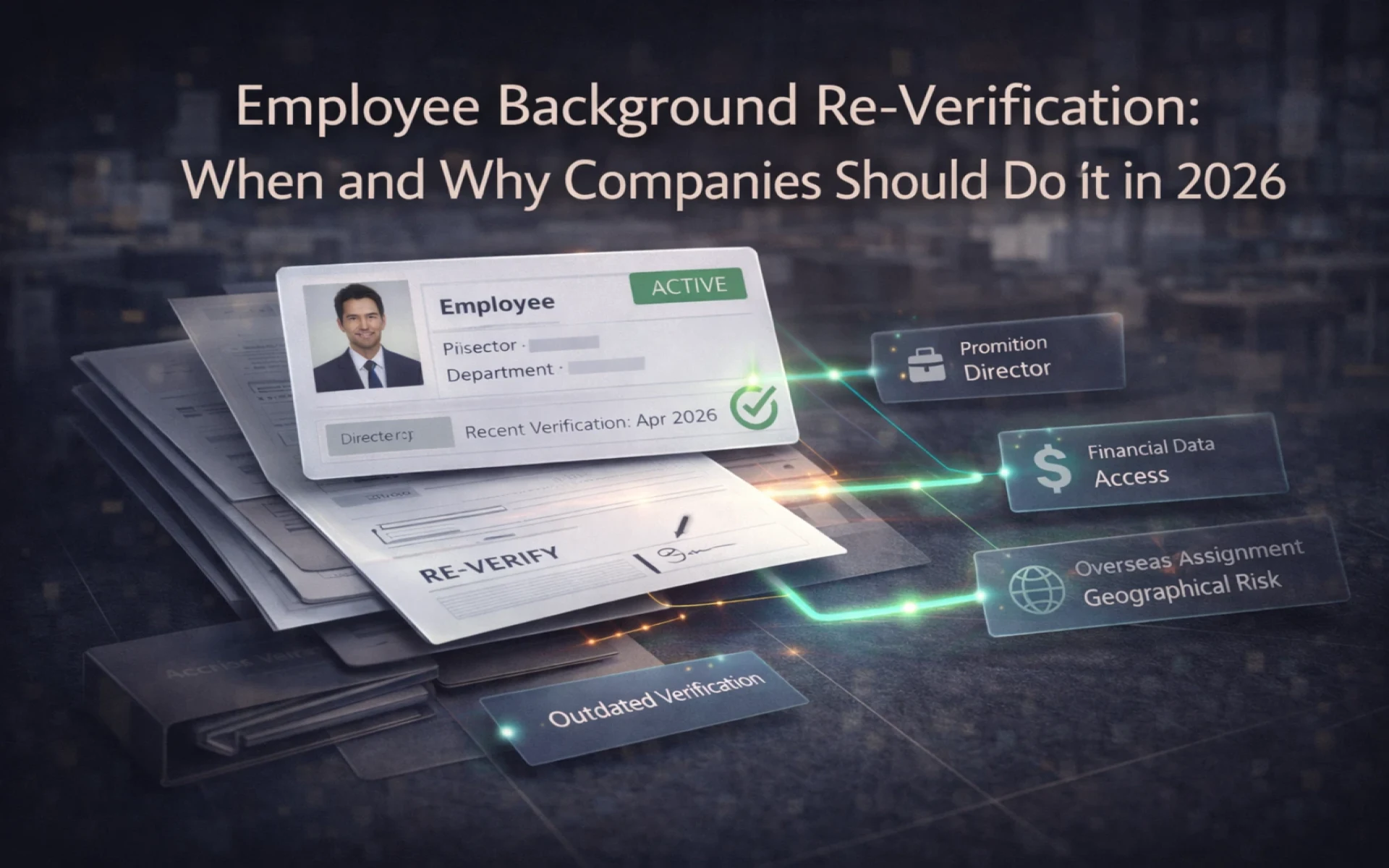
An employee moving into senior management, finance, security, compliance, or another sensitive position may require a different level of verification than was appropriate for their original role.
The change in responsibility can justify revisiting relevant checks.
2. Transfer to a Sensitive Function
Moving an employee into a role involving customer data, financial authority, intellectual property, regulated activities, or vulnerable individuals can materially change the organisation's risk exposure.
A targeted re-check may therefore be appropriate before or alongside the transfer.
3. Regulatory or Contractual Requirements
Certain industries, clients, contracts, or regulated functions may require periodic screening or updated verification.
Where a specific requirement applies, organisations should ensure that their re-verification process matches the applicable rules rather than applying a broader check unnecessarily.
4. Long Tenure in a Critical Role
For employees who have held highly sensitive responsibilities for many years, the original verification may be significantly outdated.
A periodic, proportionate refresh can provide updated assurance where the role genuinely warrants it.
5. A Specific and Credible Concern
A documented concern relating to an employee's identity, credentials, conflict of interest, or other relevant matter may justify a targeted review.
The key distinction is between a legitimate, evidence-based concern and an unfocused attempt to investigate an employee simply because the company can.
Does Employee Re-Verification Require Fresh Consent?
This is one of the most important considerations.
An employee's original background-verification consent should not automatically be treated as unlimited permission to conduct every possible future check. Whether fresh consent is required depends on the nature of the processing, the original notice and consent, the applicable legal basis, the scope of the new check, and the circumstances.
For employers in India, the safest operational approach is to clearly communicate the purpose and scope of any new verification and obtain fresh, specific authorisation where the new processing is not adequately covered by the existing lawful basis or notice.
For example, a consent provided for pre-employment employment and education verification should not casually be interpreted as blanket authorisation for unrelated future investigations years later.
The practical principle is simple:
Do not treat hiring-stage consent as an open-ended licence to collect additional personal information indefinitely.
Where there is uncertainty about the applicable legal basis or consent requirements, employers should obtain appropriate legal advice before conducting the check.
Avoid Turning Re-Verification Into Employee Surveillance
The way re-verification is implemented matters almost as much as the check itself.
Employees may reasonably question a process that appears targeted, unexplained, or significantly broader than the original verification. If employees believe they are being investigated without a legitimate reason, the process can damage trust even when the company's underlying objective is legitimate.
A responsible re-verification programme should therefore clearly explain:
- Why the employee's role is subject to re-verification
- What information will be checked
- Why those checks are relevant
- How the information will be used
- Who will have access to the results
- How the information will be stored and retained
- What happens if a discrepancy is identified
Transparency changes the character of the process. Instead of appearing to be surveillance, re-verification becomes a defined risk-control mechanism applied according to clear organisational standards.
What Should Employee Re-Verification Cover?
Re-verification does not necessarily mean repeating every check performed during hiring.
In many cases, a targeted approach is more appropriate.
For example:
| Current Risk | Potential Re-Verification Focus |
|---|---|
| Sensitive financial role | Relevant financial or employment checks |
| Regulated position | Required credentials or regulatory checks |
| Senior leadership role | Relevant employment, qualification, identity or conflict checks |
| Access to sensitive data | Identity and role-relevant risk checks |
| New professional qualification | Credential validation |
| Long-standing critical role | Selected checks that have become outdated |
The objective should be relevance, not volume.
Rechecking an unchanged university degree simply because it can be checked may add little value. Verifying a new professional licence required for an employee's current responsibilities may add considerably more.
The scope of re-verification should follow the risk.
How Companies Should Handle a Discrepancy
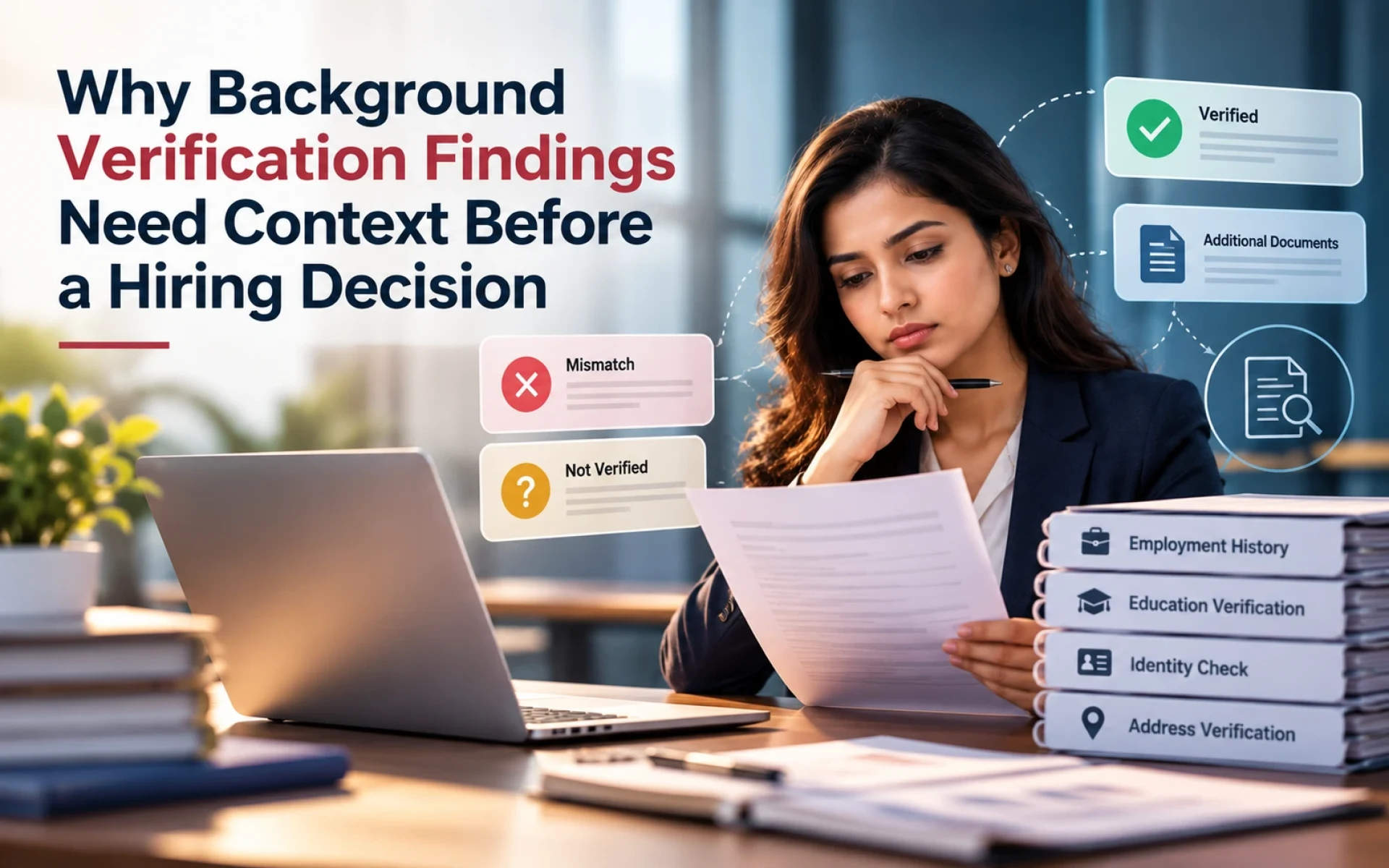
A new verification result does not automatically mean misconduct has occurred.
Discrepancies can arise for completely legitimate reasons:
- Records may contain outdated information
- Names may appear differently across documents
- Employment dates may vary because of notice periods
- Former employers may provide incomplete information
- Administrative or database errors may exist
For this reason, an adverse or inconsistent result should generally be reviewed before any employment decision is made.
A sound process should involve:
- Confirming the finding
- Checking whether the source is reliable
- Determining whether the discrepancy is material
- Giving the employee an appropriate opportunity to explain
- Reviewing the explanation and supporting evidence
- Applying the company's policy consistently
- Documenting the outcome and rationale
Re-verification is a risk-control mechanism, not an automatic disciplinary mechanism.
Build a Formal Employee Re-Verification Policy
Re-verification works best when it is governed by a documented policy rather than handled case by case.
A strong policy should define:
- Which roles are subject to re-verification
- What triggers a new check
- How frequently checks may occur, where applicable
- Which verification components are relevant to each risk category
- What notices and consents are required
- Who can initiate a check
- Who can access the resulting report
- How discrepancies are adjudicated
- How employee data is stored and retained
- How the organisation handles disputes or corrections
This creates consistency.
It also prevents a situation where one employee is subjected to extensive checks while another in a comparable role receives none without a documented reason.
Consistency is particularly important when verification findings may eventually influence employment decisions.
Make Re-Verification Risk-Based, Not Blanket
One of the biggest mistakes organisations can make is applying the same re-verification process to everyone regardless of role.
A better model is to classify roles according to their risk exposure.
For example:
Low-risk roles:
One-time verification may be sufficient unless circumstances change.
Medium-risk roles:
Additional verification may be appropriate following role changes, extended tenure, or specific business requirements.
High-risk roles:
Periodic or event-triggered re-verification may be appropriate where justified by the role, regulation, contractual requirements, or legitimate organisational risk.
This approach makes the programme easier to justify and reduces unnecessary processing of employee information.
Protect Re-Verification Data Carefully
A background-verification report contains personal information that should not be treated like ordinary HR paperwork.
Access should be restricted to people who genuinely need the information for their role. Reports should not be circulated casually through email, messaging groups, or shared folders.
Organisations should also establish appropriate retention and deletion practices rather than keeping verification records indefinitely simply because storage is inexpensive.
The principle is straightforward:
Collect what you need, use it for the stated purpose, restrict access, protect it appropriately, and retain it only as long as justified.
Re-Verification Is About Maintaining Trust
The best way to frame employee re-verification is not as a declaration that employees are inherently untrustworthy.
It is about maintaining an appropriate level of assurance as responsibilities change.
Banks periodically review access controls. Security teams review privileged accounts. Organisations renew credentials and audit critical systems. People who hold significant authority or access can similarly be subject to proportionate verification controls.
The objective is not suspicion.
It is ongoing risk management.
When re-verification is transparent, proportionate, consistently applied, and appropriately governed, it can strengthen organisational trust rather than undermine it.
Key Takeaways
- Pre-employment verification provides a point-in-time view and may become outdated as roles and circumstances change.
- Re-verification should be based on legitimate business, regulatory, contractual, or role-related risk.
- Promotion or transfer into a sensitive role can justify targeted additional verification.
- Hiring-stage consent should not automatically be treated as unlimited permission for future checks.
- Where new processing is not adequately covered, employers should provide appropriate notice and obtain fresh, specific authorisation where required.
- Re-verification should focus on relevant risks rather than unnecessarily repeating every original check.
- A discrepancy should be confirmed and assessed before employment action is considered.
- A formal, consistent policy helps prevent arbitrary or selective re-verification.
- Employee verification data should be access-controlled, protected, and retained appropriately.
- The goal of re-verification is to maintain proportionate assurance, not create continuous employee surveillance.
Conclusion
Background verification should not necessarily end on an employee's joining date.
For many roles, the original verification remains sufficient. But where an employee moves into a higher-trust position, takes on sensitive responsibilities, becomes subject to regulatory requirements, or where a legitimate concern arises, the organisation may need to refresh the assurance it relies on.
The key is to make re-verification proportionate, transparent, purpose-driven and properly governed.
That means defining legitimate triggers, limiting the scope of checks, handling employee information responsibly, providing appropriate notice and consent where required, and giving employees a fair opportunity to address material discrepancies.
Done properly, employee background re-verification is not about treating people with suspicion. It is about recognising that organisational trust, like any other risk control, needs to remain appropriate to the responsibility being entrusted.
Verification confirms the past. Re-verification helps ensure that the assurance behind today's trust is still relevant.
Keep trust current in critical roles. CaseXpert helps companies design proportionate, consent-based re-verification - keeping assurance current for high-risk roles while staying transparent and compliant with 2026 data-protection norms. Talk to our verification specialists or send an enquiry to get started.