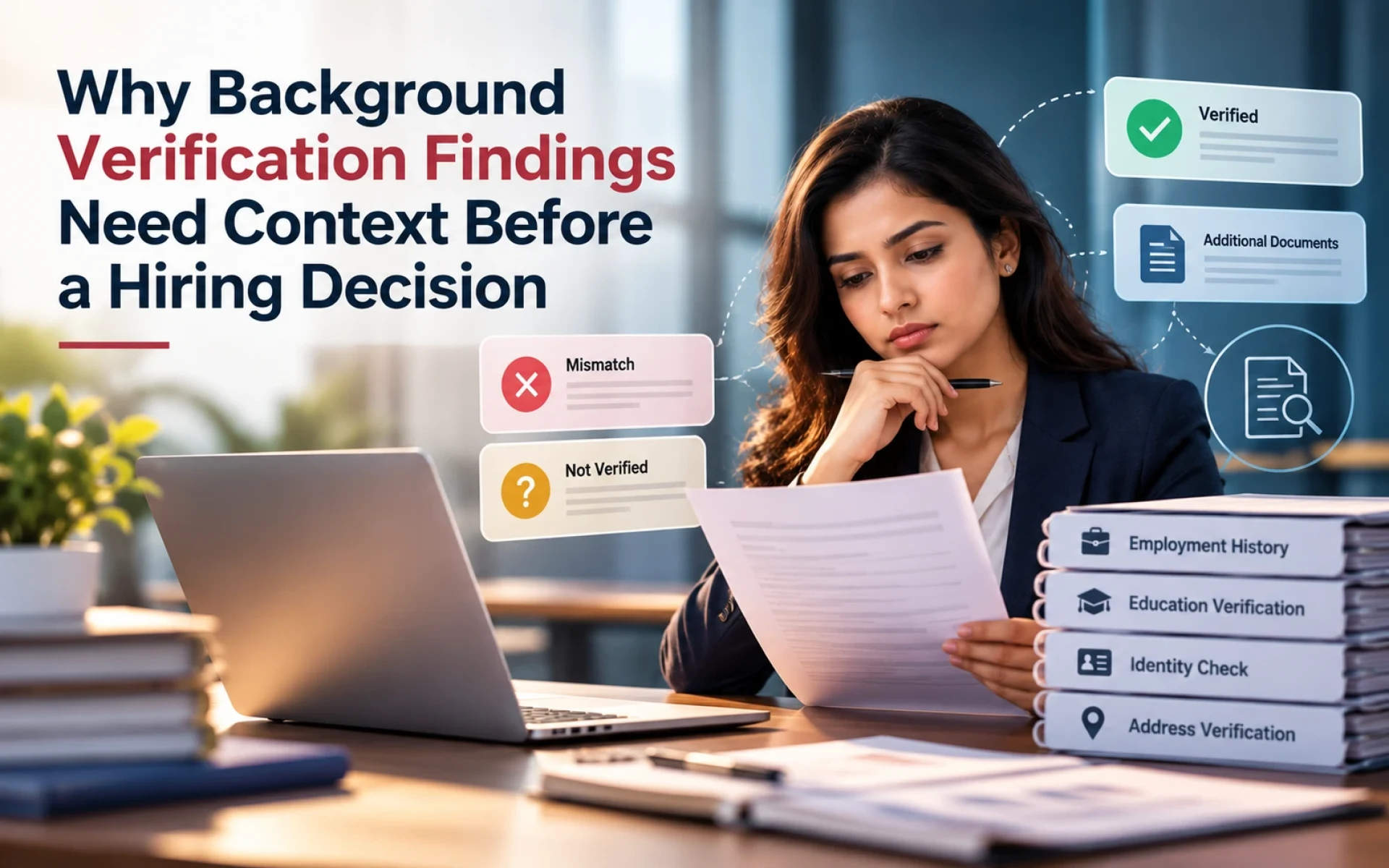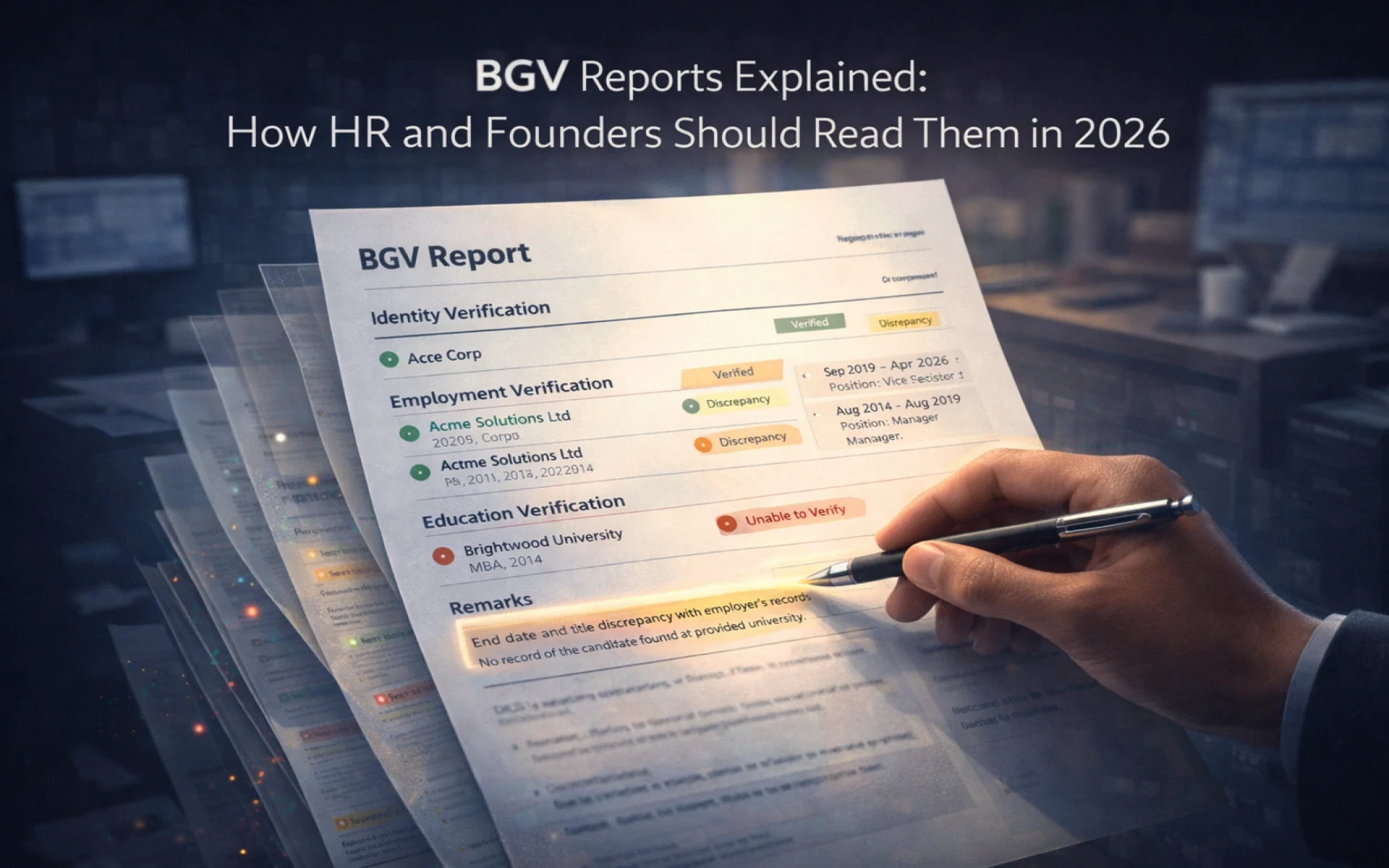
A background verification report lands in an HR inbox, runs several pages, carries colour-coded statuses, and ends with an overall result. At that point, it is tempting to do one of two things: trust the final status without reading further, or skim the report for anything marked in red.
Both approaches miss what a BGV report is actually designed to do.
A background verification (BGV) report is a structured record of evidence. It shows which candidate claims were checked, what sources were consulted, what those sources confirmed, and where discrepancies or verification gaps exist. Understanding that evidence properly can materially improve hiring decisions.
For HR leaders and founders making decisions on important hires, knowing how to interpret a BGV report is more valuable than simply knowing whether it says "clear" or "discrepant."
This guide explains how BGV reports are structured, what common statuses mean, how to evaluate discrepancies, and what HR teams should look for when reviewing reports in 2026.
What Is a BGV Report — and What Isn't?
A BGV report is a documented record of the checks performed on a candidate and the information obtained from relevant sources.
Depending on the verification package, it may cover areas such as:
- Identity verification
- Address verification
- Employment verification
- Education verification
- Criminal record checks
- Professional qualifications
- Reference checks
- Directorship or business associations
- Other role-specific checks
The report is evidence, not a verdict on the candidate as a person.
An overall status such as "clear" or "discrepant" summarises the verification outcome. It does not automatically determine whether someone should be hired, rejected, or retained. That decision requires the employer to consider the nature of the role, the significance of the finding, the candidate's explanation, company policy, and applicable legal requirements.
This distinction is important because it keeps decision-making with the organisation rather than turning a colour or status label into an automatic hiring decision.
Understanding the Anatomy of a BGV Report
Although report formats vary between verification providers, most contain several common sections.
1. Candidate and Case Details
This section establishes whose information was checked and which verification package was requested.
Review details such as:
- Candidate name
- Case or reference number
- Role or designation
- Date of initiation
- Verification package
- Checks requested
An error at this stage can affect the interpretation of everything that follows.
2. Individual Verification Checks
Each check normally has its own section or result.
Depending on the role, these may include:
- Employment history
- Education
- Identity
- Address
- Criminal records
- Professional certifications
- References
- Other relevant checks
This is where most of the substantive evidence sits.
3. Sources and Verification Method
A good report should make it reasonably clear how information was verified.
For example, employment information may be checked against an employer's records, while education credentials may be confirmed through an institution or an appropriate authorised source.
The source matters because not all evidence carries the same level of reliability.
4. Discrepancy or Exception Notes
If the information supplied by the candidate differs from the information obtained during verification, the report should explain the discrepancy.
The important question is not simply "Is there a discrepancy?"
It is:
"What exactly is different, how significant is the difference, and has it been explained?"
5. Overall Result
The report may conclude with an overall status based on the individual checks.
This is useful for quickly understanding the case, but it should be treated as a summary rather than a substitute for reviewing material findings.
Decoding Common BGV Statuses
Different BGV providers use different terminology, so HR teams should always refer to the provider's definitions. However, several concepts appear frequently.
Verified or Clear
Generally indicates that the available source or verification process supported the information provided for that particular check.
It does not necessarily mean that every aspect of the candidate's background has been verified.
Discrepant
Generally indicates that information obtained during verification does not match the information supplied by the candidate.
The discrepancy should be examined rather than treated as an automatic rejection.
Unable to Verify
This status is particularly important.
It can mean that the verification could not be completed because a source was unavailable, records could not be accessed, an institution did not respond, or another verification limitation occurred.
Unable to verify does not mean verified.
It also does not necessarily mean the candidate provided false information. It means the available verification process did not establish the claim.
That distinction should be clearly understood before a hiring decision is made.
Insufficient Information
This may indicate that the information or documentation available was not sufficient to complete the check.
The appropriate next step may be to request additional information or conduct another verification attempt.
Not Every Discrepancy Is a Red Flag
One of the biggest mistakes when reading BGV reports is treating every mismatch as equally serious.
Consider two examples.
A candidate's employment record shows a joining date that differs by three weeks from the date on the resume. There may be a perfectly reasonable explanation involving notice periods, payroll records, internal transfers, or documentation differences.
Now consider a candidate claiming a degree that the issuing institution cannot confirm.
Both are technically discrepancies, but their significance is very different.
HR teams should therefore consider:
- What information was originally declared?
- What information was independently obtained?
- How large is the difference?
- Is the difference material to the role?
- Does the candidate have a reasonable explanation?
- Can the finding be independently reconfirmed?
- Does the discrepancy indicate an error or possible misrepresentation?
The objective is not to eliminate every discrepancy. It is to understand the significance of the discrepancy before acting on it.
Look for Patterns, Not Just Individual Flags
A strong BGV review goes beyond the colour-coded status.
Sometimes the broader pattern provides more useful context than an individual result.
For example, several unresolved discrepancies across employment dates, job titles and qualifications may warrant closer review than a single minor administrative mismatch.
Similarly, multiple "unable to verify" results may simply reflect difficult-to-reach sources — or they may indicate that additional documentation is needed.
The key is to investigate the pattern without assuming intent.
A BGV report should raise informed questions where necessary, not encourage HR teams to make assumptions about why a discrepancy exists.
What HR Should Check Before Acting on an Adverse Finding
When a report contains a material adverse finding, HR should slow down rather than immediately treating the result as a final decision.
A practical review can include:
- Confirm the finding
Make sure the result relates to the correct candidate and verification source. - Understand the evidence
Review what was actually confirmed and how it was confirmed. - Assess materiality
Consider whether the finding is relevant to the role and company policy. - Give the candidate an opportunity to respond where appropriate
Some discrepancies can be explained or corrected with additional evidence. - Apply the company's documented policy consistently
Similar cases should be handled according to the same standards, subject to applicable law and the circumstances of the case. - Document the decision
Record the finding, response, assessment and rationale.
This creates a more consistent and defensible decision-making process than simply accepting a final report status.
The Difference Between a BGV Report and a Hiring Decision
This distinction deserves emphasis.
A BGV provider reports verification findings.
The employer decides what those findings mean in the context of the role and its policies.
For example, a discrepancy involving an employment title may have limited significance for one position but greater relevance where a specific qualification or level of experience is an essential requirement.
Similarly, an unresolved verification may call for additional documentation rather than immediate rejection.
The report provides the evidence. The organisation provides the context.
BGV Reports and Data Protection in 2026
BGV reports can contain personal information, including employment history, education records, identity information and other sensitive details depending on the checks performed.
HR teams should therefore treat these reports as confidential business records and handle them in accordance with applicable privacy and data-protection requirements.
Practical controls include:
- Restricting access to authorised personnel
- Avoiding unnecessary circulation of reports
- Using secure systems for storage and sharing
- Collecting only information relevant to the verification purpose
- Following documented retention and deletion practices
- Maintaining appropriate records of consent and verification activity
Privacy should not be treated as something that begins after the report is generated. Responsible data handling should be built into the verification process from the beginning.
How Founders Should Read BGV Reports
Founders often do not have time to read every page of every verification report themselves.
That does not mean the report should be reduced to a single "clear" or "not clear" label.
For senior or high-impact hires, founders should focus on:
- Material discrepancies
- Unverified or incomplete checks
- Qualification and employment inconsistencies
- Findings directly relevant to the role
- Repeated exceptions or unresolved issues
- The evidence supporting any adverse finding
- Whether the candidate was given an opportunity to clarify where appropriate
For routine hires, a structured HR review process can handle the detailed assessment while escalating material exceptions to the appropriate decision-maker.
The goal is not for founders to become BGV specialists. It is to ensure that important hiring decisions are based on evidence rather than a summary label alone.
How HR Teams Can Build a Better BGV Review Process
Reading reports effectively becomes easier when the organisation has a defined process.
A practical framework is:
Verify → Review → Clarify → Assess → Document → Decide
Verify
Confirm that the checks were performed against appropriate sources.
Review
Read the individual findings rather than relying exclusively on the overall status.
Clarify
Where appropriate, give the candidate an opportunity to explain discrepancies or provide supporting documentation.
Assess
Evaluate the significance of the finding against the role, company policy and applicable requirements.
Document
Record the relevant evidence and rationale.
Decide
Make the final employment decision through the organisation's authorised process.
This approach makes BGV a genuine decision-support function rather than an administrative checkbox.
Common Mistakes When Reading BGV Reports
Several mistakes repeatedly reduce the value of background verification.
Mistake 1: Looking Only at the Final Status
A "clear" label can create false confidence if important checks were incomplete or subject to limitations.
Mistake 2: Treating Every Discrepancy as Fraud
A discrepancy is a fact to investigate, not proof of dishonest intent.
Mistake 3: Treating "Unable to Verify" as a Pass
An incomplete check should remain an unresolved item until the organisation determines how it should be handled.
Mistake 4: Ignoring the Source
Understanding where the information came from helps HR assess its reliability and relevance.
Mistake 5: Making Decisions Without Documentation
If an adverse finding influences an employment decision, the organisation should be able to explain what was found, how it was assessed and why the decision was made.
Key Takeaways
- A BGV report is evidence, not an automatic hiring verdict.
- Read individual verification components instead of relying only on the overall status.
- "Unable to verify" is different from "verified" and should be treated as an unresolved result.
- Evaluate discrepancies based on their significance, context and supporting evidence.
- Give candidates an appropriate opportunity to clarify material discrepancies.
- Apply documented verification and adjudication standards consistently.
- Handle BGV reports as confidential personal-data records.
- Founders and HR leaders should focus on material findings rather than simply looking for a "clear" label.
- Document the reasoning behind important decisions based on verification findings.
Conclusion
A BGV report is only as useful as the way an organisation reads it.
The colour-coded status may provide a quick summary, but the real value lies deeper — in the individual checks, verification sources, discrepancies, limitations and supporting evidence. HR teams and founders who understand those details can make more informed and consistent decisions.
In 2026, that responsibility extends beyond interpretation. Organisations must also think carefully about how verification information is collected, accessed, stored, shared and retained.
The objective is not to treat every discrepancy as a problem or every "clear" status as a guarantee. It is to understand what the evidence actually establishes, identify what remains uncertain, and make the employment decision with the right context.
A BGV report does not make the hiring decision. It provides the evidence behind it — and the quality of that decision depends on how carefully the evidence is read.
Read every report with confidence. CaseXpert delivers clear, well-structured verification reports with unambiguous statuses and documented sources - so HR leaders and founders can read the evidence and decide with confidence. Talk to our verification specialists or send an enquiry to get started.