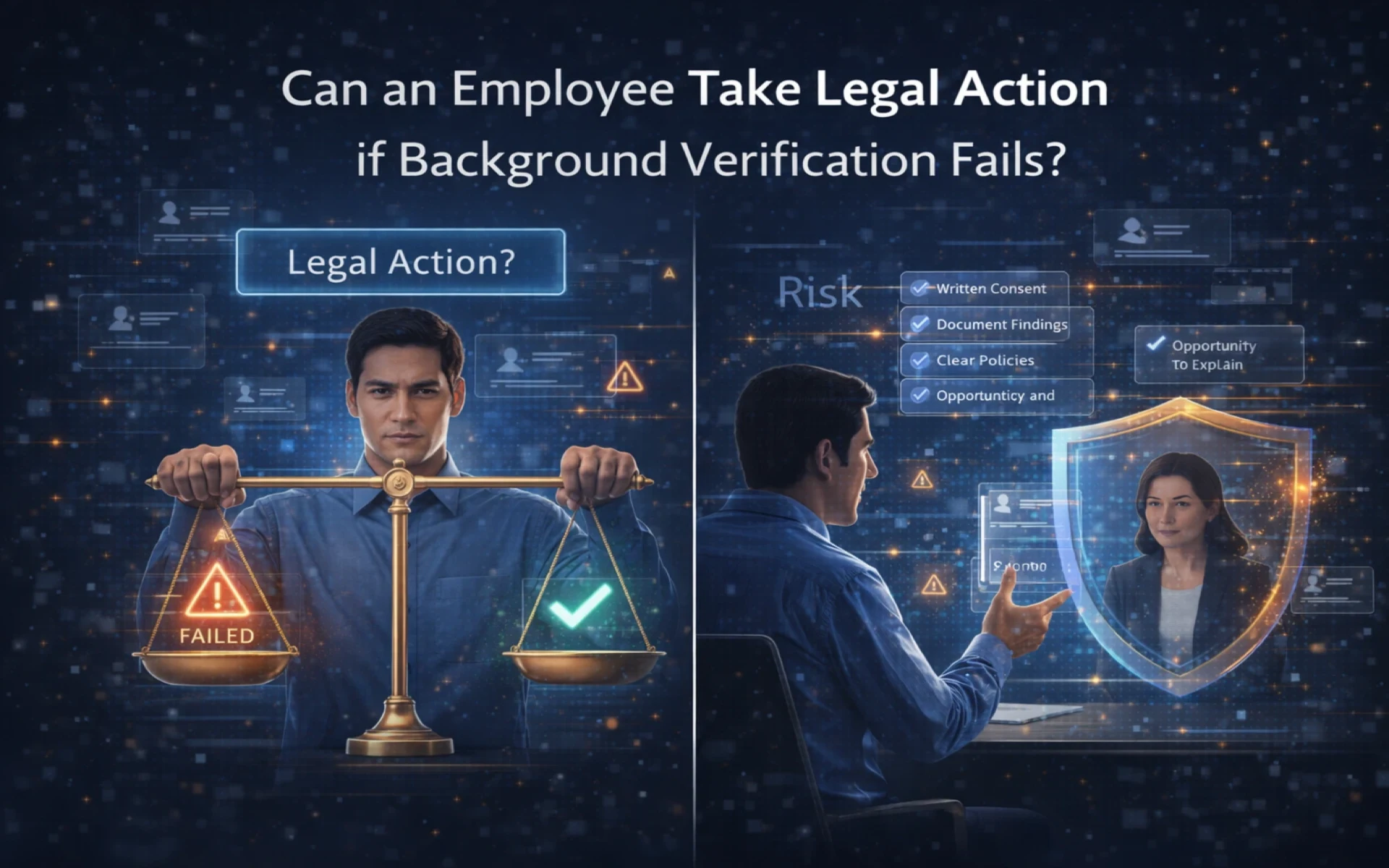
When a background verification produces an adverse finding and an organisation acts on it — whether by withdrawing an offer, delaying onboarding, or terminating employment — an important question follows: Can the candidate or employee take legal action?
The answer is yes. A candidate or employee may challenge a decision connected to background verification, but the existence of an adverse verification result does not automatically make the employer liable. The legal position depends on the nature of the employment relationship, the terms of the offer or employment contract, the accuracy of the verification finding, the applicable employment and privacy requirements, and the process followed before taking action.
For HR teams, the key issue is therefore not simply whether a background check failed. It is whether the organisation verified the information properly, gave the individual a reasonable opportunity to respond, applied its policy consistently, and made the final decision on a defensible basis.
This guide explains the main legal and practical considerations organisations in India should understand when a background verification produces an adverse result.
Note: This article provides general informational guidance and is not legal advice. Employment, privacy and contractual obligations can vary depending on the facts, role, industry and applicable law. Organisations should obtain qualified legal advice before taking action in a disputed or high-risk case.
What Does a Failed Background Verification Actually Mean?
A “failed” background verification is not a legal conclusion by itself.
Verification reports can identify different types of findings, ranging from minor administrative discrepancies to potentially material misrepresentations. For example:
- An employment date may differ slightly between the candidate's declaration and the former employer's records.
- A candidate's name may appear differently across documents.
- An educational institution may be unable to confirm a record immediately.
- A claimed qualification may not exist in the institution's records.
- Employment history may contain a material discrepancy.
- Information provided by the candidate may conflict with verified records.
These situations should not automatically be treated in the same way.
A discrepancy may have a legitimate explanation, while a confirmed material misrepresentation may raise a much more serious concern.
The practical question for HR is therefore:
What was identified, how reliable is the information, how material is it to the role, and has the individual had an opportunity to explain it?
That distinction is critical before any adverse employment decision is made.
Can a Candidate or Employee Challenge the Decision?
Yes. Depending on the circumstances, an affected individual may challenge an employer's action through contractual, employment, privacy or other applicable legal mechanisms.
Potential areas of dispute may include:
- Breach of contractual terms
- Unfair or unlawful termination, where applicable
- Incorrect or misleading verification information
- Mishandling of personal data
- Improper disclosure of personal information
- Defamation-related claims arising from false statements
- Discriminatory treatment, where applicable
- Failure to follow applicable employment procedures
However, the availability and strength of any particular claim depends heavily on the facts.
A candidate or employee disputing a verification result does not automatically mean the employer acted unlawfully. Equally, an employer should not assume that a verification report alone settles the matter.
The organisation should be able to demonstrate how it reached the decision.
The Difference Between a Candidate and an Existing Employee
One of the most important distinctions is whether the person has merely received an offer or has already entered employment.
Before Joining
If an offer is expressly conditional upon successful background verification, the organisation may have contractual grounds to reconsider or withdraw the offer when a material verification condition is not satisfied.
However, the exact wording of the offer matters.
A clause that clearly explains the verification condition provides a different contractual position from an unconditional offer that contains no such requirement.
After Joining
The situation can become more complex once an individual has joined the organisation.
Termination of an existing employee may be subject to applicable employment laws, contractual terms, company policies and, depending on the circumstances, procedural requirements.
The organisation should therefore avoid treating a post-joining verification issue in exactly the same way as a pre-employment finding.
For significant cases, HR should involve appropriate legal or employee-relations specialists before taking action.
Accuracy of the Verification Result Matters
An organisation should not treat every third-party verification result as automatically conclusive.
Verification providers can encounter:
- Incorrect records
- Delayed responses
- Similar-name matches
- Outdated employer information
- Incomplete institutional records
- Data-entry mistakes
- Differences in how dates or job titles are recorded
For this reason, a robust verification process should distinguish between a verified adverse finding and an unresolved discrepancy.
Before taking significant action, HR should consider:
- What source produced the finding?
- Is the source reliable and relevant?
- Has the information been independently verified where appropriate?
- Is the discrepancy material?
- Has the candidate or employee been given an opportunity to explain?
- Does the explanation resolve or materially change the finding?
- Is the organisation applying its verification policy consistently?
This approach reduces the risk of making a significant employment decision based on an administrative error.
Give the Individual an Opportunity to Respond
One of the strongest practical safeguards is to give the affected person a meaningful opportunity to respond before finalising an adverse decision, particularly where the finding could materially affect employment.
The communication should explain the issue factually without presenting an unresolved allegation as an established fact.
For example, instead of stating:
“Your employment history is fraudulent.”
HR could communicate that the information received during verification does not currently match the information provided by the candidate and ask the individual to provide clarification or supporting documentation.
This distinction matters.
A candidate may be able to explain a discrepancy through a name change, merger, contract employment, incorrect employer records or another legitimate circumstance.
Giving the person an opportunity to respond also creates a clearer record of how the organisation reached its eventual decision.
Conditional Offer Letters Can Provide Important Protection
Offer-letter wording is an important part of background verification governance.
Where appropriate, organisations may specify that employment or continuation of an offer is subject to satisfactory completion of applicable verification checks.
The clause should be drafted carefully and should align with the organisation's actual verification policy.
A useful framework should make clear:
- That verification may be conducted
- Which categories of information may be checked
- That employment or onboarding may be subject to satisfactory verification
- What happens if a material discrepancy is identified
- That applicable laws and company procedures will be followed
However, a conditional-verification clause should not be viewed as a blanket right to terminate or withdraw an offer in every situation. The actual contractual language and surrounding circumstances remain important.
Data Protection Is Another Area of Risk
Background verification involves the collection and processing of personal data.
Organisations therefore need to consider applicable data-protection requirements when collecting, storing, sharing and deleting verification information.
For HR teams, this includes reviewing:
- What information is collected
- Why it is required
- What legal basis applies to the processing
- What candidates are told about the processing
- Who can access the information
- Which third parties receive it
- How the information is secured
- How long it is retained
- How applicable data-rights requests are handled
Under India's evolving DPDP framework, organisations should ensure that their verification workflows are designed around appropriate privacy and security controls.
Privacy compliance should not be treated as separate from verification. It is part of the verification lifecycle itself.
Be Careful With Defamatory or Unverified Information
Another potential risk arises when adverse information is communicated beyond those who legitimately need it.
Verification findings should be communicated carefully and factually.
HR teams should avoid:
- Speculation about a candidate's motives
- Describing an unresolved discrepancy as fraud
- Sharing detailed verification reports unnecessarily
- Circulating sensitive information internally without a business need
- Making unsupported statements to future employers or third parties
The safer approach is to record the verified facts, distinguish facts from allegations or unresolved discrepancies, and restrict access to authorised personnel.
Apply the Same Verification Standard Consistently
Consistency is an important part of a defensible background verification programme.
If one candidate's employment discrepancy is considered minor while an identical discrepancy leads to another candidate's rejection, the organisation should have a legitimate, documented reason for the different treatment.
A well-designed policy should establish:
- Which checks apply to which roles
- What constitutes a material discrepancy
- Who reviews adverse findings
- When additional verification is required
- How candidates can provide clarification
- Who has authority to make the final decision
- How decisions are documented
This reduces the possibility that individual recruiters or managers make inconsistent decisions based on personal judgement.
Document the Decision-Making Process
Documentation is one of the most valuable safeguards available to an HR team.
For a significant adverse finding, the organisation should maintain an appropriate record of:
- The verification check conducted
- The information returned
- The source of the information
- Any additional verification performed
- The communication sent to the candidate or employee
- The individual's response
- The documents or evidence provided
- The policy or criteria applied
- The final decision
- The person or function responsible for approving the decision
The purpose is not to create unnecessary paperwork.
It is to establish a clear record showing that the organisation followed a defined and reasonable process rather than making an impulsive decision.
What HR Should Do When Verification Fails
A practical response can follow a structured sequence:
Step 1: Review the Finding
Understand exactly what the report says and whether the finding is complete and reliable.
Step 2: Classify the Issue
Separate administrative discrepancies, incomplete checks and potentially material misrepresentations.
Step 3: Verify the Finding
Where appropriate, obtain additional evidence or clarification before treating the finding as conclusive.
Step 4: Contact the Candidate or Employee
Explain the discrepancy objectively and provide a reasonable opportunity to respond.
Step 5: Review the Response
Consider whether the explanation or supporting evidence resolves or changes the finding.
Step 6: Apply the Company's Policy
Use the organisation's established verification and employment procedures consistently.
Step 7: Escalate Where Necessary
For serious findings, existing employees, regulated roles or potentially disputed decisions, obtain appropriate legal or specialist HR advice.
Step 8: Document the Outcome
Record the basis for the final decision and retain only the information that should appropriately be retained.
What Employers Should Avoid
Several practices can increase legal and reputational exposure.
Automatically Rejecting Every Failed Check
A “failed” status does not necessarily mean fraud or misconduct. The underlying finding should be reviewed.
Making Decisions Based on Rumours
Employment decisions should not rely on unverified allegations simply because they appear in an informal source.
Skipping the Candidate Response Stage
Where clarification could reasonably resolve the issue, refusing to hear the candidate can create unnecessary risk.
Sharing Sensitive Findings Too Widely
Verification information should be accessible only to people who have a legitimate need to know.
Treating Every Role the Same
The relevance and significance of a finding can depend on the responsibilities and risk profile of the role.
Ignoring the Employment Contract
An organisation should review the relevant offer letter, employment agreement and internal policies before taking action.
Why a Strong Verification Process Matters
Legal defensibility begins long before a verification report produces an adverse finding.
A mature verification programme should have:
- Clear candidate communication
- Appropriate consent and privacy processes
- Defined verification checks
- Reliable verification sources
- Standardised review criteria
- A candidate clarification mechanism
- Role-based access controls
- Defined retention practices
- Documented decision-making
- Appropriate vendor governance
When these elements are in place, an adverse finding becomes a structured HR event rather than an emergency.
How CaseXpert Can Support a Defensible Verification Process
A modern background verification platform can help organisations create greater visibility across the verification lifecycle.
CaseXpert enables organisations to structure verification workflows, monitor check status, manage verification information and identify discrepancies that require attention.
The objective should not be to automate employment decisions blindly. Instead, technology can help HR teams automate routine verification work while keeping appropriate human review around important findings and employment decisions.
This approach can improve turnaround time while giving HR teams a clearer record of how verification was conducted.
Key Takeaways
- A failed background verification does not automatically make an employment decision unlawful.
- Candidates and employees may challenge decisions depending on the circumstances and applicable law.
- The accuracy and reliability of the verification finding matter.
- Employers should distinguish genuine discrepancies from material misrepresentation.
- Candidates or employees should have an appropriate opportunity to provide clarification, particularly before significant adverse action.
- Conditional offer wording can help establish the contractual framework for pre-employment verification.
- Existing employees may require a different process from candidates who have not yet joined.
- Verification data should be collected, accessed, shared and retained responsibly.
- Consistent policies and detailed documentation strengthen the organisation's decision-making process.
- Serious or disputed cases should be reviewed with qualified legal or HR specialists.
Conclusion
A background verification failure does not automatically give an employee or candidate a successful legal claim. At the same time, an employer should not assume that a verification report gives it an unrestricted right to reject or terminate someone.
The strongest approach is disciplined and evidence-based:
verify the finding, understand its significance, give the individual an opportunity to respond, apply the organisation's policy consistently, consider the applicable contractual and legal requirements, and document the decision.
Background verification should support better employment decisions — not replace careful judgement.
For HR teams, the goal is not to eliminate every possibility of a dispute. It is to build a verification process in which important decisions are based on reliable information, appropriate safeguards and a clear, consistent process.
A verification finding should inform an employment decision — it should never replace the process required to make that decision fairly and responsibly.
Make every decision defensible. CaseXpert delivers accurate, well-sourced, consent-driven verification with a documented trail - giving your team the foundation to act on findings fairly, consistently and defensibly. Talk to our verification specialists or send an enquiry to get started.