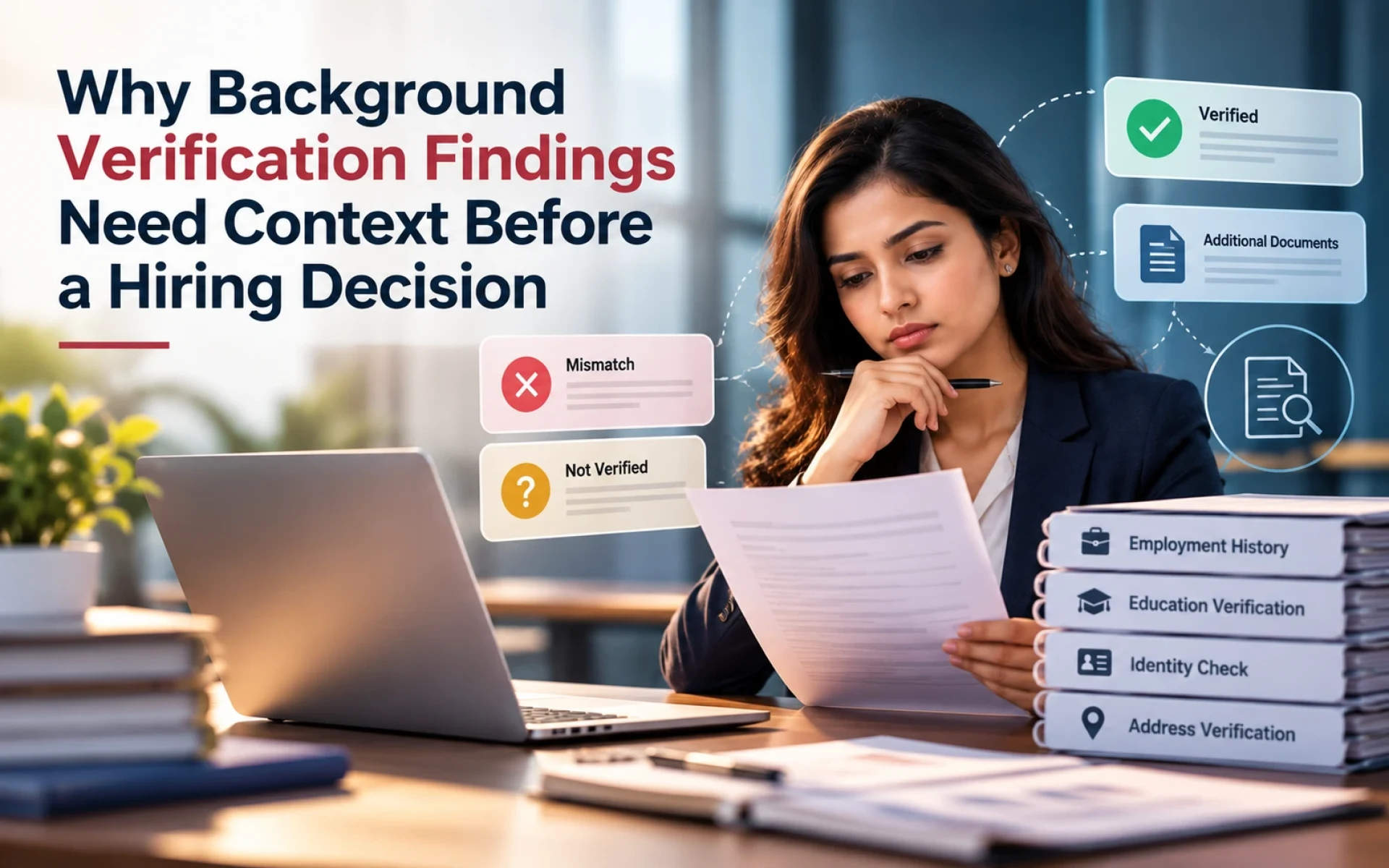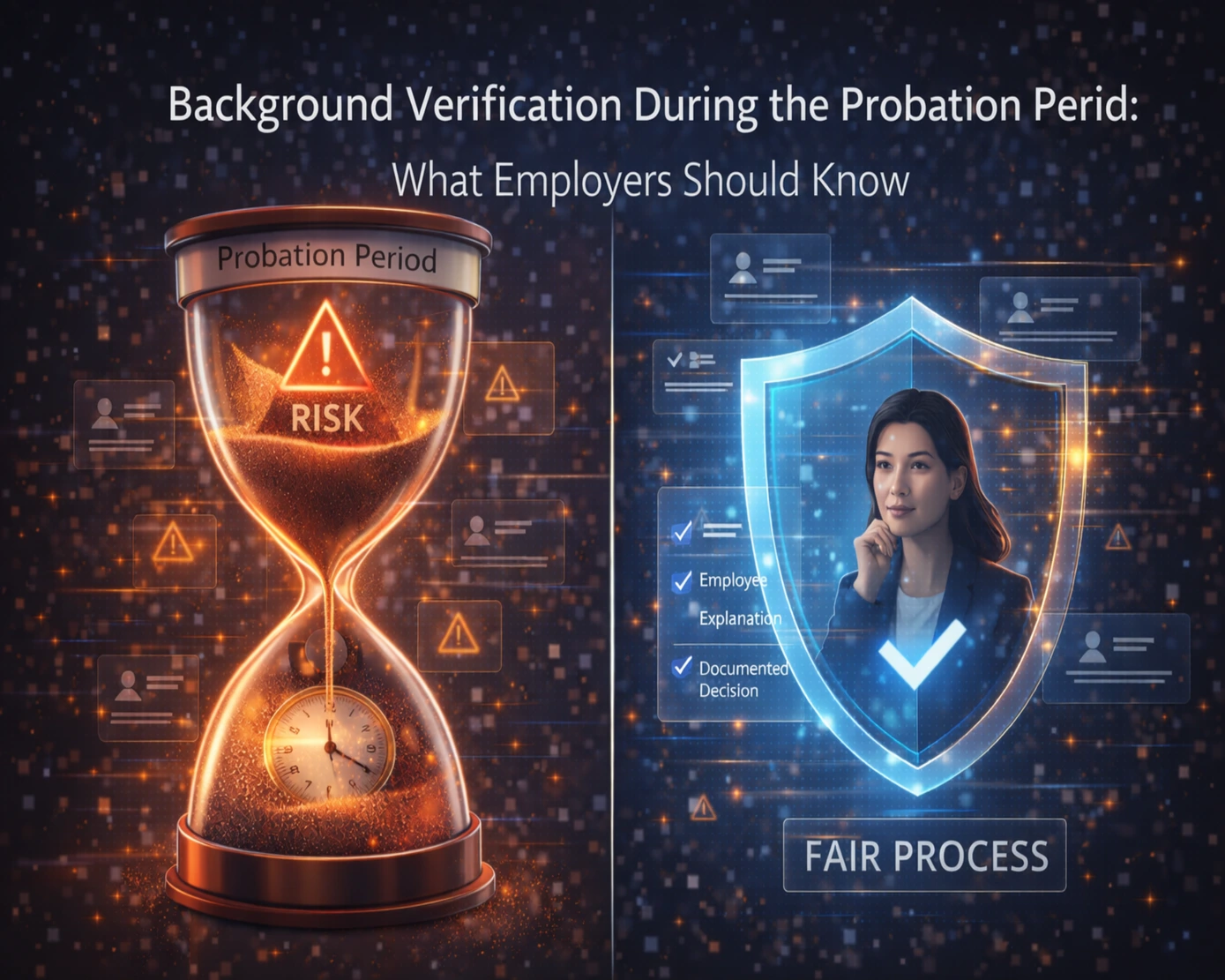
Probation is typically the period in which an employer evaluates whether a new hire meets expectations in terms of performance, conduct and role fit. But there is another question that companies sometimes need to resolve during the same period: does the employee's background match what was represented during hiring?
Ideally, background verification should be completed before an employee joins. In practice, that does not always happen. Previous employers may take time to respond, universities may require additional processing time, address verification may be delayed, or documents may need further validation. As a result, some background checks continue into the probation period.
This raises important questions for HR teams. Can an employer continue verification after an employee has joined? What happens when a check fails during probation? Does probation automatically give the company the right to terminate employment? And what should HR do when a verification finding conflicts with what the employee originally declared?
The answer lies in having a clear verification policy, appropriate contractual language, lawful data handling and a fair process for reviewing adverse findings.
Why Background Verification Sometimes Continues Into Probation
The ideal hiring workflow is straightforward: verify the candidate, review the results, and then complete the joining process. Real-world hiring is rarely that simple.
Verification may continue after joining because:
- A previous employer has not responded within the expected timeframe.
- An educational institution requires additional time to confirm credentials.
- Address verification is delayed because the candidate is unavailable.
- Supporting documents need additional validation.
- A verification partner identifies a discrepancy that requires investigation.
- Certain role-specific checks take longer than standard employment checks.
Starting an employee before every check is complete is not automatically problematic. The important issue is whether the company clearly communicated that background verification was part of the hiring process and, where applicable, that continued employment was subject to satisfactory verification.
The key is not simply when verification finishes. It is whether the organisation established the process and expectations clearly from the beginning.
Make the Verification Condition Clear From the Start
If verification may continue after joining, the offer letter and appointment documentation should clearly address it.
Where appropriate, the employment documentation should explain that employment is subject to satisfactory completion of applicable background checks and that material discrepancies may be reviewed in accordance with company policy and applicable law.
This creates clarity for both sides.
However, simply adding a clause does not mean that every adverse finding automatically justifies termination. The wording of the contract, the nature of the finding, the applicable employment law and the process followed by the employer can all matter.
Probation should not be treated as a blanket exemption from fair process.
A clear contractual framework is one part of a defensible verification programme; it should work alongside a documented background verification policy and a consistent adjudication process.
What If Background Verification Fails During Probation?
Suppose an employee has already joined and a verification report identifies a significant discrepancy.
It could involve:
- A qualification that cannot be verified.
- Employment experience that differs materially from the candidate's declaration.
- An employment period that appears to have been deliberately altered.
- A document that appears inconsistent or potentially fraudulent.
- A material omission relevant to the role.
- Information that requires further clarification before a decision can be made.
The first step should not be immediate termination.
HR should establish exactly what the report has found, verify the reliability of the information and determine whether the discrepancy is material.
A mismatch is not necessarily misconduct.
For example, an employment record showing a slightly different joining date may result from administrative differences between the employee's records and the former employer's records. Similarly, a name discrepancy may have a legitimate explanation.
The important question is:
Is the finding an administrative discrepancy, an unresolved issue or a confirmed material misrepresentation?
That distinction should drive the next step.
Give the Employee an Opportunity to Explain
Once an adverse finding is identified, the employee should generally be given a reasonable opportunity to respond before a final decision is made, particularly where the finding could materially affect their employment.
The employee may be able to provide:
- Additional documents
- Corrected employment records
- University correspondence
- Previous employer documentation
- An explanation for a date or designation mismatch
- Evidence of a legal name change
- Context surrounding an apparently adverse record
This step serves two purposes.
First, it gives the employee an opportunity to correct inaccurate information.
Second, it helps the employer distinguish between a genuine discrepancy and deliberate misrepresentation.
A verification report should be treated as evidence to be reviewed, not as an automatic verdict.
Keep Verification Findings Separate From Performance Issues
One of the most important HR practices during probation is keeping background verification issues separate from performance evaluation.
These are fundamentally different questions.
A performance decision asks:
Is the employee meeting the expectations of the role?
A verification decision asks:
Is the information provided during hiring accurate and adequately verified?
Suppose an employee performs well but their degree is later found to be unverifiable. The performance record should not be used to obscure the verification issue.
Likewise, if an employee is struggling with performance but has passed verification, the company should not retrospectively use a minor verification discrepancy as a substitute for documenting genuine performance concerns.
Maintaining separate records creates a clearer and more defensible employment history.
Probation Does Not Mean “No Rules Apply”
Probation is often misunderstood as a period during which an employer can end employment for any reason without consequence.
That is too broad.
The rights and obligations associated with probation can depend on the employment contract, applicable labour and employment laws, the employee's status, the nature of the organisation and the circumstances surrounding the decision.
For this reason, HR should not assume that being on probation automatically eliminates the need for a fair and documented process.
Where a significant verification issue arises, employers should consider:
- What exactly was represented by the candidate?
- What has the verification process established?
- Is the finding material to the role?
- Is the information reliable and sufficiently verified?
- Has the employee been given an opportunity to respond?
- What does the employment documentation provide?
- What does the company's background verification policy require?
- Is the proposed action consistent with applicable law and previous company practice?
For significant cases, legal review may be appropriate before taking adverse employment action.
Re-Verification During Probation: What Employers Need to Consider
Some companies may want to conduct additional checks after joining, particularly for sensitive positions.
For example, a role involving financial responsibility, access to confidential information or regulated activities may require checks beyond the basic employment and education verification completed during recruitment.
That can be appropriate where there is a legitimate business or regulatory reason.
However, probation should not become an open-ended licence to investigate an employee.
The company should consider whether:
- The check was covered by the original consent.
- The purpose of the additional check is legitimate and proportionate.
- The employee has been appropriately informed.
- The organisation has a lawful basis for processing the information.
- The information will be securely stored and accessed only by authorised personnel.
- Additional consent or notice is required.
The principle is simple: verification should have a defined purpose and scope, even when it continues after joining.
Handle Sensitive Findings Confidentially
Background verification information can contain highly sensitive personal information. A verification issue should therefore be handled discreetly and only shared with people who genuinely need the information to perform their responsibilities.
HR should avoid:
- Discussing the finding with unrelated employees.
- Circulating reports unnecessarily.
- Making accusations before the facts are established.
- Sharing unverified allegations.
- Keeping verification documents in unsecured locations.
Communication should remain factual and professional.
Instead of saying:
“The verification team found that you lied about your employment.”
HR can communicate the issue more carefully:
“Our verification process identified a discrepancy concerning the employment information provided during recruitment. We would like to give you an opportunity to clarify the discrepancy and provide any supporting documentation.”
The second approach preserves neutrality while allowing the employee to respond.
What Happens at the End of Probation?
The end of probation can provide a useful checkpoint for confirming that all outstanding recruitment requirements have been resolved.
Before confirmation, HR should review:
- Whether all required background checks are complete.
- Whether any findings remain unresolved.
- Whether the employee has responded to material discrepancies.
- Whether any additional documentation is required.
- Whether the employee's performance meets the applicable confirmation criteria.
- Whether the proposed confirmation or non-confirmation is consistent with company policy and applicable law.
This prevents a common problem: allowing probation to end without noticing that an important verification check was never completed.
Confirmation should be a deliberate HR decision, not an administrative default.
How Companies Can Prevent Verification Issues During Probation
The easiest way to manage late verification findings is to reduce the number of checks that remain unfinished after joining.
A stronger process includes:
1. Start verification early
Initiate appropriate checks as soon as the candidate reaches the relevant stage of recruitment.
2. Use clear conditional language
Where appropriate, make the offer and employment documentation clear about the relationship between employment and satisfactory background verification.
3. Define verification tiers
Not every role requires the same checks. Establish role-based verification requirements based on legitimate business, regulatory and risk considerations.
4. Establish an adverse-finding process
Define who reviews discrepancies, what evidence is considered, when candidates or employees are contacted and who makes the final decision.
5. Document everything
Maintain a clear record of the finding, verification evidence, employee response and decision-making process.
6. Protect candidate and employee data
Limit access to verification information, establish appropriate retention practices and apply suitable security controls.
7. Review significant cases carefully
Where the finding could lead to termination or another significant adverse action, HR should consider obtaining appropriate legal guidance.
How CaseXpert Helps Manage Verification More Effectively
The challenge with probationary verification is not simply obtaining a report. HR needs visibility into what has been verified, what remains pending and which cases require attention.
CaseXpert brings background verification into a structured workflow, helping organisations manage checks across identity, education, employment and other role-specific requirements.
With better status visibility and a structured approach to discrepancies, HR teams can identify unresolved issues earlier, reduce manual follow-ups and maintain a clearer record of the verification process.
The objective is not to make every verification issue a reason for rejection. It is to give HR the information and process needed to make consistent, informed and defensible decisions.
Key Takeaways
- Background verification may continue into probation when certain checks take longer than expected.
- Employment documentation should clearly address background verification requirements where applicable.
- A verification discrepancy should be investigated rather than treated as automatic proof of misconduct.
- Employees should generally have a meaningful opportunity to explain material adverse findings before a final decision.
- Verification issues and performance issues should be documented and assessed separately.
- Probation does not automatically eliminate an employer's legal or contractual obligations.
- Additional checks during probation should have a legitimate purpose, appropriate scope and proper data handling.
- Confirmation should be based on defined performance and verification requirements rather than occurring automatically.
- A documented, consistent verification process makes decisions easier to manage and defend.
Conclusion
Background verification and probation are often treated as separate stages of employment, but in practice they can overlap. A delayed employer response, an educational verification issue or an unresolved document discrepancy can easily push verification beyond the employee's joining date.
That does not have to create uncertainty.
The strongest approach is to establish expectations before joining, use appropriate contractual language, complete verification as early as practical and maintain a clear process for handling findings that emerge during probation. When an issue does arise, employers should verify the information, assess its materiality, give the employee an opportunity to respond and make the final decision consistently with company policy, contractual terms and applicable law.
Probation should not be viewed simply as a period in which the company tests performance. When verification remains outstanding, it can also be the period in which the organisation completes its understanding of the employee's professional credentials and hiring information.
The goal is not to find reasons to reject employees. It is to make sure that when an important discrepancy appears, HR has the facts, the process and the documentation to handle it fairly.
Finish checks before confirmation. CaseXpert's fast, consent-driven verification helps you complete checks before joining where possible, and resolve any that run into probation cleanly, fairly and on the record. Talk to our verification specialists or send an enquiry to get started.