Terminating an employee after a background verification failure is one of the most sensitive decisions an HR team can face. Unlike a pre-employment rejection, the employee has already joined the organisation, started receiving a salary, gained access to systems and information, and become part of the workforce.
When a serious verification discrepancy emerges at this stage, HR has to balance several considerations at once: the reliability of the finding, the employee's explanation, the terms of employment, applicable law, internal policy and the potential risk to the organisation.
A failed background check does not automatically mean that an employee should be terminated. The nature of the finding, its materiality, the circumstances in which it arose and the process followed by the employer all matter.
The central principle is simple:
A serious verification finding requires a serious process.
This guide explains the key do's and don'ts HR teams should follow when a background verification failure may lead to disciplinary or termination action.
First, Confirm That the Finding Is Accurate and Material
Before considering termination, HR should establish that the adverse finding is both reliable and relevant.
Background verification can produce discrepancies for reasons that have nothing to do with dishonesty. A former employer may provide incomplete information, an educational record may use a different name format, or employment dates may differ because organisations calculate joining and relieving dates differently.
For example:
- A one-month employment-date difference may be administrative.
- A former employer may have incomplete historical records.
- A candidate may have legally changed their name.
- A university may require additional documentation before confirming a qualification.
- A designation may differ between an offer letter and the employer's internal records.
These situations should not automatically be treated as misconduct.
By contrast, a deliberately fabricated qualification, completely fictitious employment experience or material misrepresentation about information relevant to the role may require much more serious consideration.
The first question should therefore be:
What exactly failed, how reliable is the evidence, and how material is the discrepancy to the employment decision?
If there is uncertainty, re-verification or additional evidence may be appropriate before taking action.
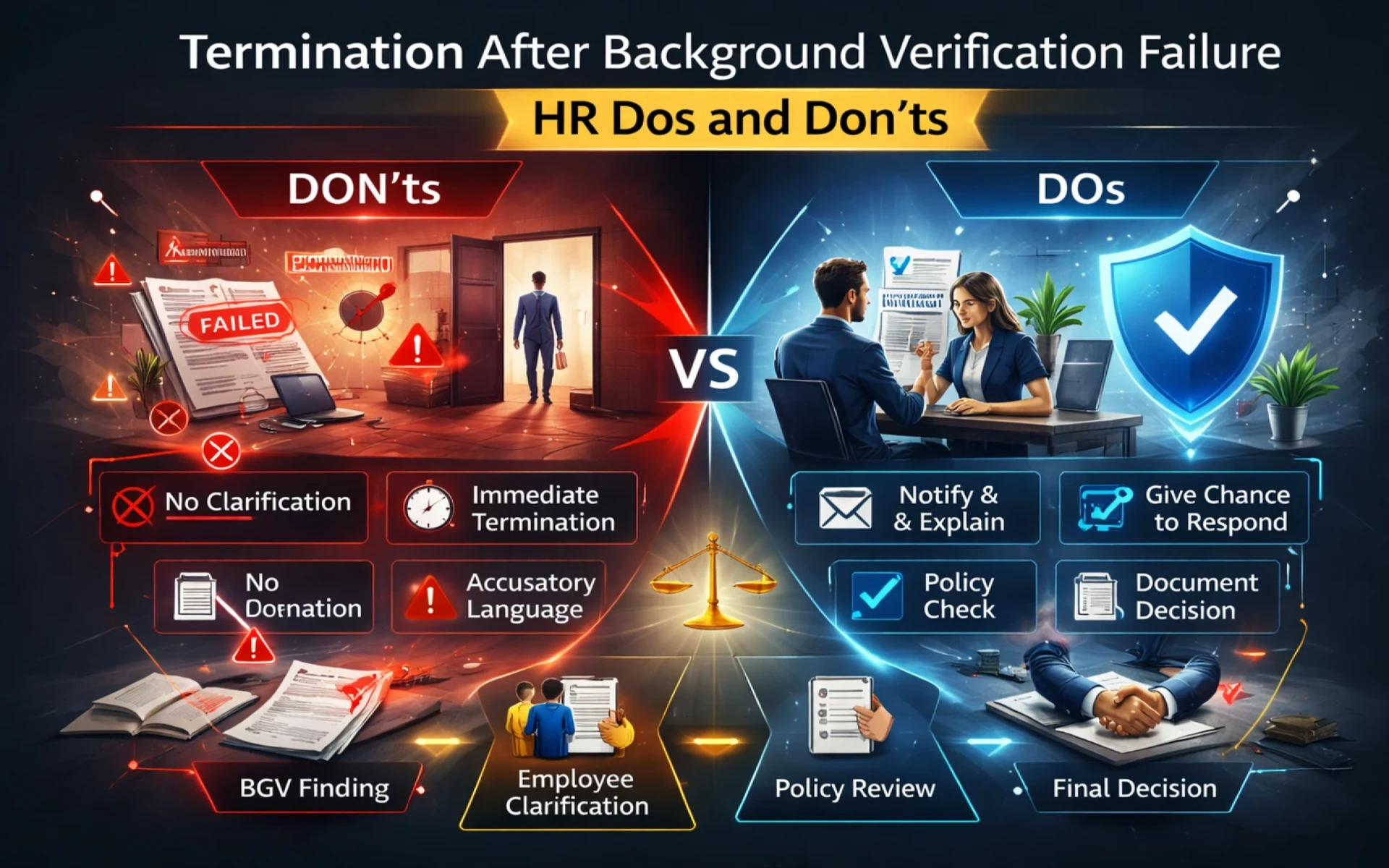
DO: Give the Employee a Meaningful Opportunity to Respond
Once a material discrepancy has been identified, the employee should be informed of the issue and given a reasonable opportunity to explain it.
This is particularly important where the finding could result in disciplinary action or termination.
The employee may be able to provide:
- Additional employment documents
- Corrected educational records
- Previous employer correspondence
- Evidence explaining a date discrepancy
- Documentation relating to a name change
- Clarification regarding a contract or consulting role
- Other evidence that changes the interpretation of the verification result
This step is not simply a formality.
A verification report identifies information that requires assessment; it does not necessarily establish the employee's intention or motive. Giving the employee an opportunity to respond allows HR to distinguish an administrative discrepancy from a potentially deliberate misrepresentation.
A fair process also gives the organisation a stronger record if the eventual decision is challenged.
DON'T: Assume That a Failed Check Automatically Means Termination
One of the biggest mistakes HR teams can make is treating the words “BGV failed” as an automatic termination trigger.
Background verification findings exist on a spectrum.
A minor address discrepancy is not equivalent to a fabricated degree. An incomplete employment verification is not automatically equivalent to fictitious employment. A criminal record, where legally relevant, may require a different assessment from a mismatch in an employment date.
The organisation should therefore have an adjudication framework that considers factors such as:
- Severity of the discrepancy
- Relevance to the role
- Evidence supporting the finding
- Whether the information was intentionally misrepresented
- Employee's explanation
- Applicable company policy
- Contractual terms
- Applicable employment laws and regulations
The decision should be based on the facts rather than the label attached to the verification report.
DO: Review the Employment Contract and Verification Conditions
The employment documentation should be reviewed before taking action.
Where an offer or appointment letter clearly states that employment is subject to satisfactory background verification and accurate information provided by the candidate, that language may be relevant to the employer's decision.
The documentation may address:
- Background verification requirements
- Accuracy of information supplied by the employee
- Consequences of material misrepresentation
- Conditions attached to employment
- Probation requirements
- Disciplinary procedures
- Termination provisions
However, a contractual clause should not be treated as a substitute for applicable law or fair procedure.
A verification condition can strengthen the organisation's position, but HR should still assess the facts and follow the process required in the circumstances.
DON'T: Treat Every Employee the Same Without Considering Their Status
The appropriate process can depend on the employee's circumstances and applicable legal framework.
A probationary employee, a confirmed employee and an employee covered by specific statutory protections may not necessarily be subject to identical procedures.
For example, where an employee falls within a protected employment category or applicable industrial-law framework, additional procedural requirements may apply.
HR should therefore avoid assuming:
“The employee is on probation, so we can terminate immediately.”
or:
“The verification failed, so the contract gives us an automatic right to terminate.”
The correct approach is to examine the employee's status, employment documentation, applicable law and the specific facts before deciding what process is required.
For material or contentious cases, obtaining appropriate legal advice before termination can help reduce avoidable risk.
DO: Keep Verification Findings Separate From Performance Issues
A background verification issue and a performance problem are not the same thing.
If an employee is being considered for termination because they allegedly misrepresented their educational qualification, the organisation should document that issue separately from whether the employee met their performance targets.
Similarly, if the employee has poor performance but the background verification is clean, HR should not use an unrelated verification discrepancy as a substitute for proper performance documentation.
Keeping these matters separate makes the decision-making record clearer and reduces the risk of appearing to manufacture a reason for termination.
DON'T: Make Accusations Before the Facts Are Established
HR communication should remain factual and measured.
Avoid statements such as:
“You committed fraud.”
unless the organisation has established the relevant facts and has an appropriate basis for making that determination.
A more appropriate approach is to state:
“The verification process identified a discrepancy concerning the qualification information provided during recruitment. We are reviewing the matter and would like to provide you with an opportunity to clarify the information.”
This distinction matters.
HR should communicate what has been verified rather than speculate about intent, motive or character.
DO: Protect Confidentiality
Background verification reports can contain sensitive personal information. Details should therefore be shared only with people who have a legitimate need to know.
HR should avoid:
- Circulating the report widely within the organisation.
- Discussing the finding with unrelated colleagues.
- Sharing unverified allegations.
- Including unnecessary personal information in internal communications.
- Sending sensitive verification documents through insecure channels.
If termination ultimately occurs, the organisation should communicate the decision professionally without unnecessarily disclosing confidential verification information to the wider workforce.
DON'T: Defame the Employee During or After Termination
The organisation should be particularly careful about how adverse findings are described to third parties.
A company should distinguish between:
Verified fact:
“The employment information provided could not be substantiated.”
and:
Unverified conclusion:
“The employee is dishonest.”
The first describes a verification outcome. The second makes a broader statement about the person's character.
Where future employment references or third-party enquiries arise, responses should be handled according to company policy and applicable law, with information limited to what can properly be disclosed.
DO: Document the Entire Decision-Making Process
Documentation is one of the strongest safeguards available to HR.
The employee's file should establish a clear chronology of what happened.
It should ideally record:
- The original information provided by the candidate.
- The specific verification check conducted.
- The source of the adverse finding.
- Evidence supporting the finding.
- Any additional verification performed.
- Communication with the employee.
- The employee's explanation and supporting evidence.
- How the explanation was assessed.
- The policy or contractual provision considered.
- The decision-maker or approving authority.
- The final decision and its effective date.
Good documentation should allow an independent reviewer to understand why the organisation reached its decision without having to reconstruct the entire case from scattered emails.
DON'T: Ignore Serious Findings Because of Litigation Concerns
The possibility of a dispute should not cause an organisation to ignore a genuinely material verification issue.
Suppose an employee in a highly sensitive role is found to have deliberately fabricated a qualification that was represented as essential to their appointment. Simply ignoring the issue because HR is concerned about a potential challenge may create a different set of risks.
The answer is not to choose between “act immediately” and “do nothing.”
The stronger approach is:
Verify → investigate → hear → assess → document → decide.
This allows HR to address legitimate risk without turning the verification finding into an automatic termination decision.
DO: Apply the Policy Consistently
A background verification policy should establish consistent rules for comparable cases.
If one employee is terminated for a particular type of material misrepresentation while another employee with substantially similar circumstances is allowed to remain without a documented reason for the difference, the organisation may create questions about consistency and fairness.
Consistency does not necessarily mean identical outcomes in every case. Different roles, evidence, contractual terms and circumstances may justify different decisions.
What matters is that the organisation can explain why the relevant circumstances led to the outcome reached.
DON'T: Let the Verification Vendor Make the Employment Decision
A background verification provider should provide information and verification results. The employer should remain responsible for deciding what those findings mean for employment.
A report saying “discrepancy found” should not automatically translate into “terminate employee.”
HR should evaluate the finding in context, review the evidence and apply the company's policy and applicable legal requirements.
This distinction is particularly important when verification involves automated systems or risk flags. Technology can help identify anomalies, but consequential employment decisions require appropriate human oversight.
Build the Right Process Before a Failure Happens
The best time to prepare for a failed background verification is before one occurs.
Organisations should establish:
A clear verification policy
Define what checks are conducted, for which roles and how findings are assessed.
A documented adjudication process
Establish how discrepancies are reviewed and who has authority to make the final decision.
Clear employment documentation
Where appropriate, include background verification and accuracy-of-information provisions in offer and appointment documentation.
A candidate and employee response mechanism
Provide a defined process for clarifying or challenging potentially inaccurate findings.
Data protection controls
Control access to verification information and establish appropriate storage, retention and deletion practices.
Escalation procedures
Identify circumstances where HR, compliance or legal teams should review the matter before adverse action is taken.
When these foundations exist, HR does not have to improvise when a serious finding appears.
How CaseXpert Helps HR Manage Verification Risk
The challenge for HR is not simply obtaining a background verification report. It is having enough visibility and structure to understand what has been verified, what remains unresolved and which cases require additional attention.
CaseXpert helps organisations manage background verification through a structured verification workflow across relevant checks such as identity, employment and education verification.
By bringing greater visibility to verification status and discrepancies, organisations can identify potential issues earlier and maintain a clearer record of the verification process.
The objective is not to automate the termination decision.
It is to help HR surface reliable information earlier so that people decisions can be made with better evidence, stronger processes and greater accountability.
Key Takeaways
- A failed background check should not automatically trigger termination.
- Confirm that the finding is accurate, reliable and materially relevant before taking action.
- Give the employee a meaningful opportunity to explain significant discrepancies.
- Review the employment contract, verification conditions and applicable legal framework.
- Consider the employee's employment status and any specific statutory protections.
- Keep verification findings separate from performance-related issues.
- Communicate verified facts rather than assumptions about intent or character.
- Protect the confidentiality of background verification information.
- Document the entire investigation, response and decision-making process.
- Apply policies consistently while considering the specific circumstances of each case.
- Keep the final employment decision with the employer rather than the verification vendor or an automated system.
Conclusion
A failed background verification does not automatically answer the question of whether an employee should be terminated. It starts a process.
HR must first establish whether the finding is accurate and material, understand the employee's response, review the applicable employment terms and legal requirements, and then determine the appropriate action through a fair and documented process.
The strongest organisations do not treat BGV failure as a shortcut to termination. They treat it as a trigger for structured investigation and informed decision-making.
That approach protects the organisation without sacrificing fairness to the employee. It also creates something every HR team needs when an employment decision is challenged: a clear record showing that the company acted on reliable information, followed its process and reached its decision for a defensible reason.
A failed background check is a signal to investigate—not an automatic instruction to terminate.
Act on findings without the legal risk. CaseXpert provides accurate, well-sourced, consent-driven verification with a complete documented trail - the foundation HR teams need to act on genuine findings fairly, lawfully and decisively. Talk to our verification specialists or send an enquiry to get started.