Choosing a background verification partner is an important decision for any HR team because the quality of the partner directly influences the quality of verification and risk management an organisation can achieve. A weak partner may provide limited reports that overlook important discrepancies, while a capable partner can provide a structured and reliable verification process across different roles and locations.
Yet many organisations focus primarily on price and only recognise the differences between providers after problems arise.
This article explains what HR leaders should look for in a background verification partner, including the capabilities that matter, the questions to ask during evaluation, and the warning signs to watch for. Choosing carefully helps ensure that background verification is accurate, compliant, transparent, and aligned with the organisation's hiring needs.
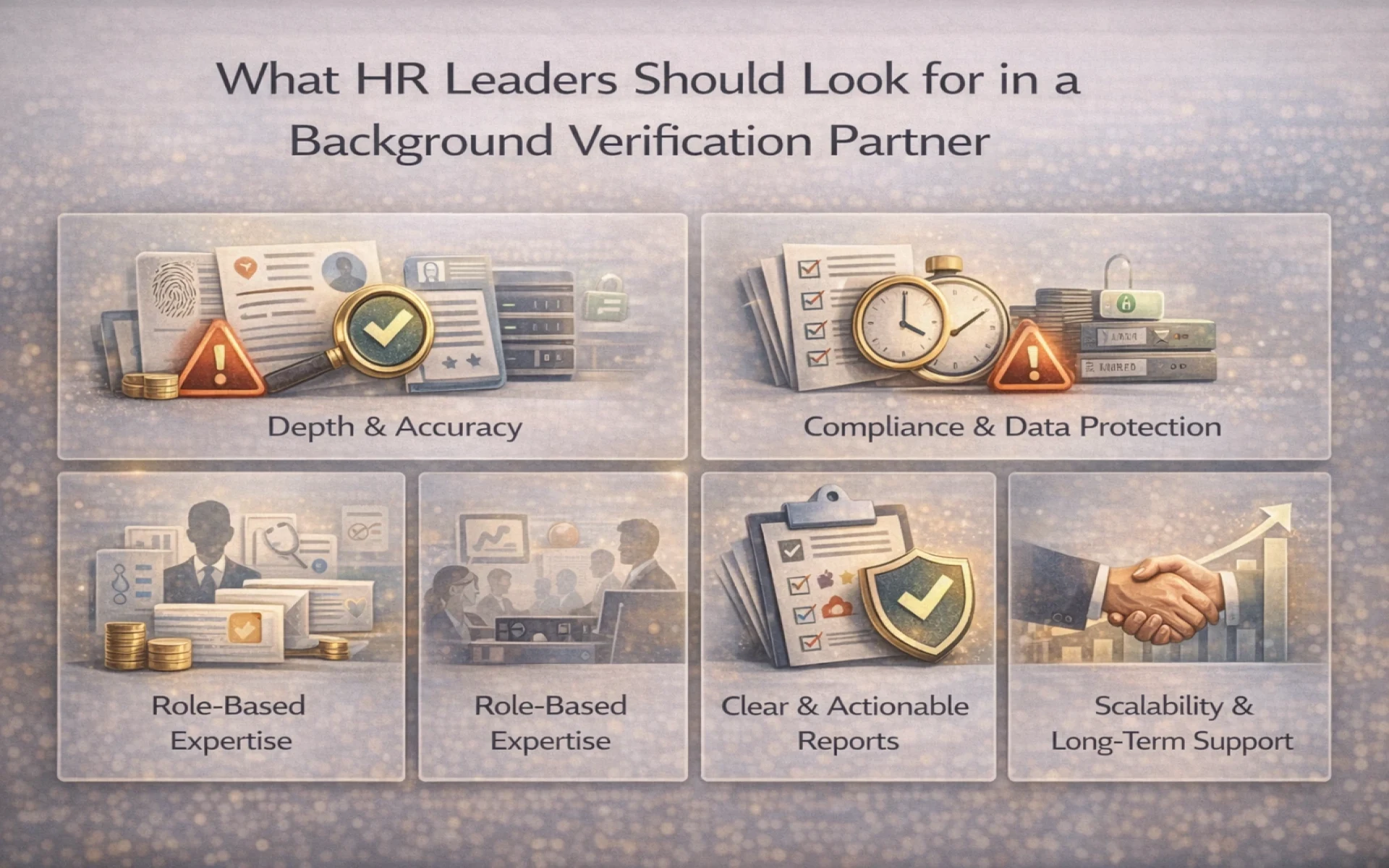
Depth and Accuracy of Checks
One of the most important criteria is the depth and accuracy of the verification process. A capable partner should have defined methods for validating credentials, confirming employment information, checking relevant records, and identifying inconsistencies in candidate-provided information.
The quality of a verification process depends not only on the number of checks performed but also on how those checks are conducted. Where appropriate, information should be validated against reliable or authoritative sources, and cases that require additional investigation should be handled through a defined escalation process.
HR leaders should ask prospective partners:
- What sources are used for each type of check?
- How are credentials and employment details validated?
- How are discrepancies investigated?
- How are non-digitised or difficult-to-access records handled?
- What happens when information cannot be independently verified?
Clear answers to these questions can reveal whether a provider has a robust verification methodology or simply produces standardised reports.
Speed and Real-Time Visibility
Verification needs to be thorough, but it also needs to fit the pace of modern hiring. Delays can affect joining dates, candidate experience, workforce planning, and business operations.
A capable partner should use technology and parallel processing where appropriate to reduce unnecessary delays without compromising verification quality. HR teams should also have visibility into the status of ongoing cases rather than having to repeatedly follow up for updates.
When evaluating a provider, ask to see its case-management or tracking process. Consider whether HR teams can easily identify:
- Checks that are completed
- Checks currently in progress
- Cases requiring additional information
- Delayed or pending verifications
- Overall turnaround status
The objective should be efficient verification without sacrificing the depth or reliability of the checks.
Compliance and Data Protection
Background verification involves the collection and processing of personal information, making data protection an essential part of partner selection.
HR leaders should understand how a provider obtains consent, collects information, stores and transfers data, restricts access, manages retention, and handles candidate requests. The provider should also be able to explain how its processes align with applicable Indian data-protection and privacy requirements.
Important areas to evaluate include:
- Clear and documented consent processes
- Appropriate data collection and purpose limitation
- Secure storage and transmission of information
- Defined access controls and retention practices
- Appropriate handling of candidate information
- Audit-ready records and documentation
A verification partner should reduce operational risk without creating unnecessary data-protection exposure.
Fair and Transparent Discrepancy Handling
A discrepancy does not automatically mean that a candidate has engaged in misconduct. Differences can sometimes result from incorrect dates, administrative errors, name variations, outdated records, or incomplete information.
For this reason, HR leaders should pay close attention to how a verification partner investigates and reports discrepancies.
A reliable partner should provide sufficient context for HR teams to understand what was reported, what was independently verified, what could not be verified, and where clarification may be required. Candidates should also have an appropriate opportunity to provide relevant explanations or supporting information where the process requires it.
Clear classification and transparent reporting help organisations make informed and consistent decisions rather than relying on unexplained pass-or-fail conclusions.
Coverage and Scalability
The right partner should be able to support the organisation's geographic coverage, verification requirements, and hiring volumes.
For companies hiring across India, this may include verification across multiple states and cities, while distributed and remote hiring can require processes that work effectively across different locations. Organisations with international operations may also need cross-border verification capabilities.
Scalability is equally important. Hiring volumes can change quickly during expansion, seasonal recruitment, new projects, or large workforce deployments. A partner should be able to handle increased volumes without a corresponding decline in turnaround time or verification quality.
HR teams should therefore evaluate both current requirements and anticipated future needs.
Reporting Clarity and Support
A verification report is only useful when HR teams can understand the findings and act on them.
Reports should present information clearly, distinguish verified information from discrepancies and pending checks, and provide sufficient context for HR teams to assess the findings. The provider should also offer appropriate support when cases require clarification or additional investigation.
It is useful to involve the actual users of the reports during the evaluation process. A report may appear comprehensive during a sales presentation but still prove difficult for recruiters or hiring managers to interpret in day-to-day use.
Testing sample reports and discussing realistic scenarios with the provider can reveal these practical differences before a contract is signed.
Warning Signs to Avoid
Certain warning signs deserve closer attention during the selection process. These may include unusually low pricing without a clear explanation, vague answers about verification methodology, limited transparency around sources, unclear data-handling practices, poor reporting, or an inability to explain how complex cases are handled.
Price should certainly be considered, but it should be evaluated alongside accuracy, coverage, compliance, technology, service quality, and scalability.
Before selecting a provider, HR teams should be able to answer four basic questions:
- Can the partner verify information accurately and consistently?
- Can it handle our hiring volume and geographic requirements?
- Does its process protect candidate data and support compliance?
- Can our HR team easily understand and act on the results?
If the answer to any of these is unclear, the provider should be evaluated more closely before moving forward.
Key Takeaways
Here are the essential points to carry forward from this guide:
- Evaluate verification depth and methodology, not just the number of checks offered.
- Look for efficient turnaround supported by technology and case visibility.
- Treat consent, data protection, and secure information handling as essential requirements.
- Choose a partner that investigates and reports discrepancies transparently.
- Ensure geographic coverage and scalability match both current and future hiring needs.
- Review sample reports and support processes with the people who will actually use them.
- Do not evaluate providers on price alone; consider quality, compliance, reliability, and overall value.
Conclusion
Choosing a background verification partner requires looking beyond pricing and basic service lists. The most important considerations are the quality of verification, the reliability of the methodology, turnaround time, data protection, discrepancy handling, geographic coverage, scalability, and the clarity of reporting.
HR leaders should evaluate potential partners by asking practical questions about their sources, processes, technology, security controls, reporting, and ability to handle complex cases. Testing sample reports and involving the teams who will use the service can also provide valuable insight before a decision is made.
A background verification partner should function as a reliable extension of the organisation's hiring and risk-management process. The right provider combines thorough verification with efficient technology, transparent reporting, responsible data practices, and the ability to scale as business requirements change.
Ultimately, the goal is not simply to find a provider that can complete background checks. It is to find a partner whose processes, technology, and standards align with the organisation's approach to responsible and informed hiring.
The right background verification partner combines accuracy, transparency, compliance, and scalability — giving HR teams confidence in the process behind every verification.
Choose wisely. CaseXpert combines deep, accurate checks, real-time visibility, strong compliance and clear reporting across India. Talk to our verification specialists or send an enquiry to get started.