Background verification is not one-size-fits-all across industries any more than it is across roles. A hospital, a bank, a logistics firm, and a software company each face distinct risks, regulatory expectations, operational requirements, and client demands — and their verification needs can differ accordingly. Understanding these industry-specific considerations helps companies design screening that is appropriate for their sector.
This article explores industry-specific background verification needs in India across key sectors, explaining what drives the differences and what organisations may need to prioritise. The common thread is that effective verification should reflect the particular risks and obligations of the industry and role, rather than applying an identical checklist everywhere.
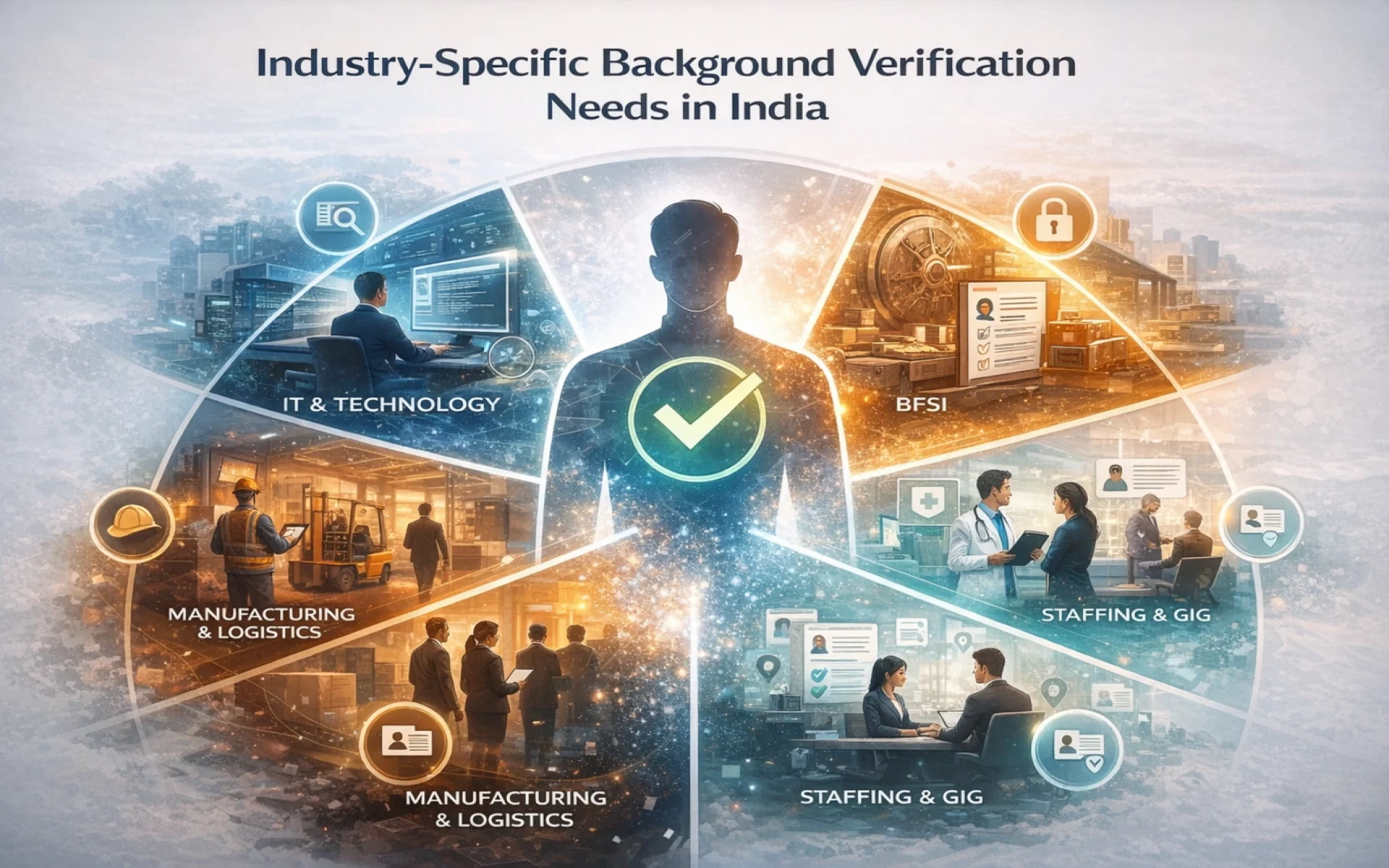
Banking and Financial Services
Financial services involve roles that may handle money, financial information, customer data, and sensitive systems. As a result, organisations may place particular emphasis on identity, employment history, qualifications, role-relevant integrity checks, and other verification requirements applicable to the position.
Certain regulated activities can also involve specific due-diligence or antecedent-verification requirements. However, the exact checks required depend on the role, institution, applicable regulations, and internal policies.
For sensitive financial roles, organisations may also establish additional controls or re-verification processes where appropriate.
IT and IT-Enabled Services
India's IT and ITES sector often works with clients across multiple jurisdictions, and client contracts may include specific background verification requirements.
Verification may cover identity, education, employment history, address, and other role-relevant checks. Positions involving privileged system access, confidential information, or client data may require additional scrutiny based on organisational and contractual requirements.
Moonlighting or concurrent-employment checks may also form part of a company's verification framework where relevant to its employment policies and applicable requirements.
For IT and ITES companies, therefore, verification can be influenced not only by internal risk considerations but also by client, contractual, and international requirements.
Healthcare and Pharmaceuticals
Healthcare organisations deal directly with patient safety, sensitive information, and professional qualifications. Verification of relevant credentials and professional registrations can therefore be particularly important for roles where qualifications or licences are required.
Depending on the position, organisations may also consider identity, employment history, relevant records, and other role-specific checks.
Key areas may include:
- Verification of relevant medical qualifications and professional registrations
- Confirmation of qualifications for specialised functions
- Identity and employment verification
- Relevant record checks for roles where they are appropriate
- Consideration of applicable healthcare and pharmaceutical requirements
The exact scope should reflect the responsibilities of the position rather than treating every healthcare employee identically.
Logistics, Delivery and Field Roles
Logistics, delivery, and field-based roles can involve direct interaction with customers, access to homes or workplaces, handling of goods, vehicles, or payments, and representation of the organisation in the field.
Depending on the role, verification may therefore focus on identity, address, employment history, driving credentials where relevant, and other appropriate checks.
These sectors may also operate at high hiring volumes, making an efficient and scalable verification workflow important.
Technology can help organisations manage large volumes of verification requests, track cases, identify missing information, and standardise routine workflows while retaining appropriate human review.
Manufacturing, Retail and Other Sectors
Manufacturing, retail, and other sectors have their own verification considerations.
Manufacturing organisations may need to consider safety-sensitive positions, technical qualifications, employment history, identity, and other checks relevant to specific functions. Retail organisations may place greater emphasis on roles involving cash handling, customer interaction, inventory, or access to sensitive business information.
Other sectors may have different requirements based on their operations, customers, regulatory environment, and workforce structure.
The broader principle remains the same: verification should reflect the specific responsibilities and risks associated with the role and industry.
Even within a single company, different functions may warrant different verification requirements — which is where industry-specific design meets role-based screening.
Designing Industry-Fit Verification
To design verification that fits an industry, companies should first identify the risks and requirements associated with their sector and workforce.
A practical framework includes:
- Identify sector-specific risks — Understand the types of access, responsibilities, and exposures associated with the industry.
- Map applicable requirements — Consider relevant regulations, client contracts, industry requirements, and internal policies.
- Calibrate checks by role — Select checks based on the actual responsibilities and access associated with each position.
- Standardise the workflow — Create consistent processes for documentation, verification, review, and reporting.
- Review the framework periodically — Update verification requirements as roles, regulations, client expectations, and business risks change.
A professional verification partner with cross-industry experience can support organisations in designing workflows that are appropriate to their requirements while managing verification at scale.
When One Company Spans Multiple Risk Profiles
Many organisations do not fit neatly into a single industry profile because different functions within the same company can carry very different risks.
For example, a manufacturing company may have factory-floor roles, finance positions, HR functions, and IT teams handling sensitive information. Each function may require a different verification emphasis.
Industry-specific design therefore needs to work alongside role-based design, tailoring checks to both the sector and the specific function.
Rather than applying one identical package to every employee, organisations can define appropriate verification requirements for different categories of roles. For example, finance roles may require checks relevant to financial responsibilities, while IT roles with privileged access may require additional identity, employment, or access-related verification.
This approach helps organisations align verification with actual business requirements while avoiding unnecessary checks that may have little relevance to a particular role.
Key Takeaways
Here are the essential points to carry forward from this guide:
- Different industries can have different verification risks and requirements.
- Financial services may place particular emphasis on identity, employment history, integrity, and role-specific requirements.
- IT and ITES verification can be influenced by client contracts and international requirements.
- Healthcare places significant importance on relevant professional qualifications and registrations.
- Logistics and field roles may require identity, address, employment, driving, and other role-specific checks.
- Manufacturing, retail, and other sectors should tailor verification to their operational risks and responsibilities.
- Verification should be designed around both the industry and the specific role.
Conclusion
Industry-specific background verification recognises a simple reality: different sectors face different risks, requirements, and client expectations, so verification processes may need to reflect those differences.
Banking and financial services may emphasise role-relevant integrity and identity checks, IT and ITES may need to accommodate client and contractual requirements, healthcare places importance on professional credentials and registrations, while logistics and field-based roles may require checks appropriate to frontline responsibilities.
The unifying principle is fit. Verification should be designed around the actual responsibilities, access, and risks associated with an industry and its roles rather than applied as a generic checklist.
Companies that tailor verification to their sector — supported where appropriate by an experienced verification partner — can build processes that are more relevant, consistent, and scalable.
The practical takeaway is to move beyond a one-package-fits-all approach. By mapping verification requirements industry by industry and function by function, organisations can ensure that each check has a clear purpose and is relevant to the risks and responsibilities it is intended to address.
Every industry carries different risks and responsibilities, so background verification should be designed around the sector, the role, and the requirements that actually apply.
Fit for your sector. CaseXpert calibrates checks to your sector's specific risks, regulations and client requirements across India. Talk to our verification specialists or send an enquiry to get started.