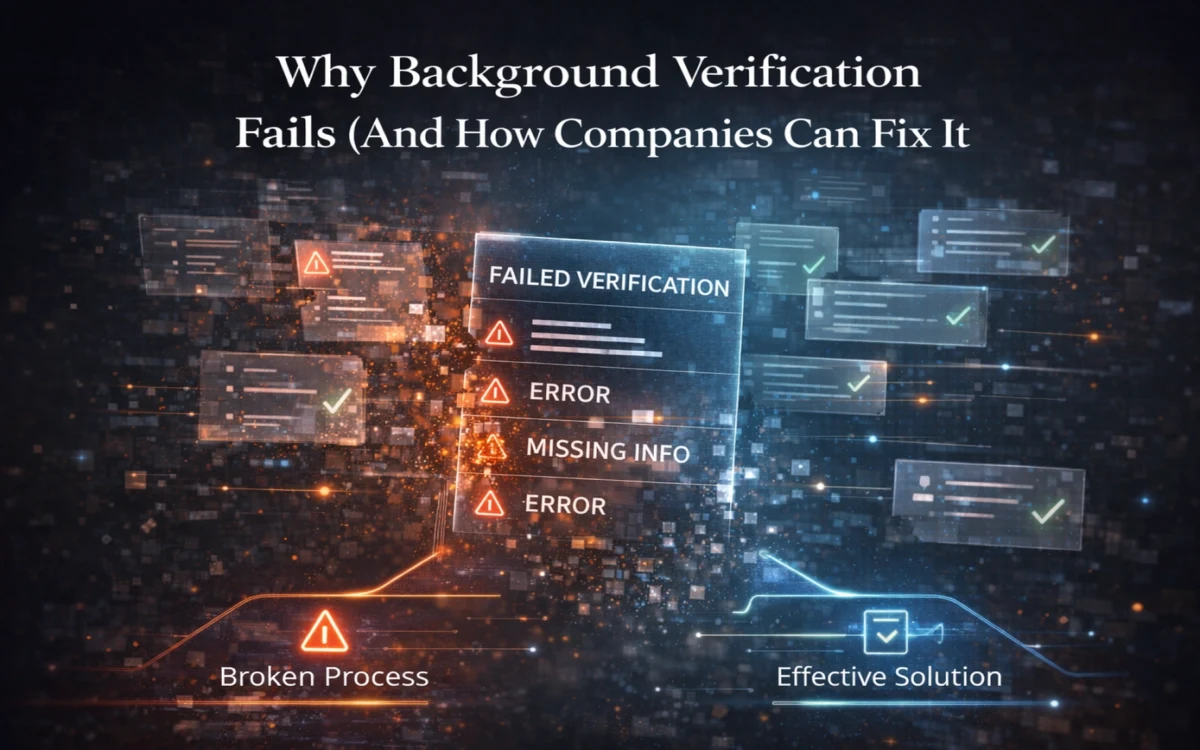
Background verification is supposed to be the safety net that catches the credential fraud, the hidden dismissal and the falsified experience before they walk through the door. Yet companies that run checks religiously still get burned. The uncomfortable truth is that verification fails far more often than most organisations realise ??? not because checking is pointless, but because the way it is designed and executed quietly undermines it.
When a check 'fails', it rarely announces itself. A report comes back clean that should have raised a flag; a discrepancy is noted but never acted on; a check is skipped under deadline pressure and nobody records the gap. This guide examines why background verification breaks down in practice, and what companies can do to fix each failure mode.
Failure One: Treating Verification as a Formality #
The most common reason verification fails is that the organisation never really expected it to find anything. The check is run to satisfy a checklist, the report is filed without being read closely, and a green overall status is taken as permission to proceed. When verification is a ritual rather than a decision input, even accurate reports change nothing.
The fix is cultural before it is procedural: leadership has to treat verification findings as material to the hiring decision. A report that nobody acts on is worse than no report, because it creates a false sense of security while consuming time and money.
Failure Two: Incomplete or Shallow Checks #
Many programmes verify the easy things and skip the hard ones. Identity and education are confirmed because they are simple; the previous employer is 'verified' with a single unanswered phone call; criminal and address checks are dropped because they take longer. The result is a report that looks complete but covers exactly the areas least likely to hide a problem.
- Employment confirmed only through a candidate-supplied contact rather than official channels
- Education checked against a certificate image instead of the issuing institution
- Criminal and address checks omitted to save time
- Gaps in employment history left unexplained
A check that covers everything except where problems hide is not a safety net. It is a comfort blanket.
Failure Three: Slow Turnaround Forcing Shortcuts #
When verification takes weeks, hiring pressure wins. Candidates get start dates before checks complete, recruiters waive steps to avoid losing talent, and the process quietly degrades from a gate into a formality completed after the fact. Slow verification does not just delay decisions; it actively encourages the organisation to bypass its own controls.
The fix is to compress turnaround through better processes and partners, so that completing checks before the offer becomes realistic rather than aspirational. Speed is not a luxury in verification; it is the thing that determines whether the control is used at all.
Failure Four: Findings That Go Nowhere #
Sometimes the check works perfectly ??? it surfaces a discrepancy ??? and then nothing happens. The flag sits in a report nobody adjudicates, or it reaches a manager who lacks the authority or the framework to act. A finding that does not trigger a decision is a failure of the system around the check, not of the check itself.
Companies fix this by building a clear adjudication path: every adverse finding routes to a named decision-maker, against defined criteria, with a documented outcome. Without that pipeline, even a flawless verification process leaks at the last step.
Failure Five: Over-Reliance on Self-Reported Information #
Verification that simply confirms what the candidate supplied ??? calling the referee the candidate chose, checking the certificate the candidate provided ??? verifies the candidate's story against the candidate's own evidence. Sophisticated fraud anticipates exactly this, supplying coached referees and convincing forgeries. Real verification reaches independent, authoritative sources.
The fix is to design checks that triangulate: confirm employment through official records, validate degrees with the institution directly, and corroborate identity against government databases. The more independent the source, the harder the check is to game.
Failure Six: No Consistency Across Candidates #
When depth of checking depends on who is hiring, how busy they are and how much they like the candidate, the programme produces incomparable results. A thorough check on one hire and a cursory one on the next means the organisation has no reliable baseline ??? and no defence if a decision is challenged as inconsistent or unfair.
Consistency comes from a documented policy that defines mandatory checks by role tier and removes individual discretion from the question of what gets verified. Discretion belongs in adjudicating findings, not in deciding whether to look.
Failure Seven: Weak Vendor Selection and Oversight #
Outsourced verification is only as good as the partner doing it. A vendor that prioritises speed over accuracy, cuts corners on source verification, or returns vague reports will produce exactly the false comfort described above ??? except the company will trust it more because it came from a specialist. Poor vendor oversight turns outsourcing into a hidden risk.
The fix is to select and monitor partners on accuracy and source rigour, not price alone, and to review their performance rather than assuming a signed contract guarantees quality.
Building Verification That Actually Works #
The common thread across every failure mode is that verification breaks when it is treated as an event to be completed rather than a control to be operated. Fixing it means making checks deep, fast, independent, consistent and acted upon ??? and choosing a partner who treats accuracy as the product, not a by-product.
Companies that get this right stop experiencing verification as a series of unpleasant surprises. The fraud and misrepresentation that used to slip through start surfacing where they should: before the hire, in a report someone actually reads and acts on.
Key Takeaways #
Here are the essential points to carry forward from this guide:
- Verification fails most often because it is treated as a formality, not a decision input.
- Shallow checks that skip the hard areas create false comfort, not real protection.
- Slow turnaround pushes teams to bypass their own controls ??? speed is essential.
- Findings must route to a named adjudicator with defined criteria, or they go nowhere.
- Independent sources, consistency and strong vendor oversight close the remaining gaps.
Conclusion #
Background verification rarely fails with a bang. It fails quietly ??? through skipped steps, shallow checks, ignored flags and inconsistent standards ??? while everyone assumes the control is working. That gap between the appearance of verification and its reality is where bad hires and avoidable risk slip through.
The fix is not more paperwork; it is better design. Make checks deep, fast, independent and consistent, route every finding to a real decision, and hold your verification partner to a standard of accuracy. Do that, and verification stops being theatre and starts being the safeguard it was always meant to be.
Verification does not fail because checking is useless. It fails because the organisation stopped expecting it to find anything.
Make verification that holds. CaseXpert builds depth, speed and independent source verification into every report ??? and flags findings clearly so your team can act on them before the hire, not after. Talk to our verification specialists or send an enquiry to get started.