Corporate governance is often associated with board meetings, financial disclosures, regulatory compliance, and internal controls. While these elements are essential, one of the most influential aspects of governance is frequently overlooked—the people responsible for carrying out the organization's vision and decisions.
Every employee, manager, executive, and business leader contributes to the integrity of an organization. Their decisions influence customer trust, operational efficiency, regulatory compliance, and ultimately, the company's reputation. Even the strongest governance framework can become ineffective if it is built on a workforce whose credentials, conduct, or accountability are not consistently maintained.
This is why workforce integrity is gaining attention as a strategic business priority. Organizations are beginning to recognize that governance is not only about policies and procedures but also about ensuring that the people entrusted with critical responsibilities continue to meet the standards expected of them.
Understanding Workforce Integrity
Workforce integrity refers to the confidence an organization has that its employees, contractors, and leadership consistently act with honesty, professionalism, accountability, and compliance throughout their employment.
It extends beyond verifying an individual's identity or educational qualifications during recruitment. Workforce integrity involves creating an environment where trust is supported by structured processes, ethical behaviour, transparency, and continuous governance.
When organizations invest in workforce integrity, they strengthen the reliability of the people who influence daily operations, strategic decisions, and customer relationships.
Why Corporate Governance Depends on People
Governance frameworks establish how organizations should operate, but people determine whether those frameworks are followed in practice.
Policies cannot enforce themselves. Compliance systems cannot make ethical decisions. Internal controls cannot replace individual accountability.
Employees handle customer information, approve financial transactions, access confidential business data, manage supplier relationships, and represent the organization in countless interactions every day. Their actions directly affect whether governance objectives are achieved or compromised.
For this reason, organizations that overlook workforce integrity often discover governance failures only after a serious incident has occurred.
The Cost of Weak Workforce Integrity
A governance failure is rarely caused by a single event. More often, it develops gradually through overlooked warning signs, inadequate oversight, or a lack of verification.
Weak workforce integrity can contribute to:
-
Internal fraud
-
Data breaches
-
Regulatory violations
-
Financial misconduct
-
Conflicts of interest
-
Reputational damage
-
Client dissatisfaction
-
Loss of stakeholder confidence
These risks not only create financial consequences but can also weaken investor trust and long-term business resilience.
Workforce Integrity Begins Before Hiring
Building a trustworthy workforce starts well before an employee's first day.
Organizations establish a strong foundation by implementing structured hiring practices that verify critical information such as identity, employment history, educational qualifications, professional certifications, and other role-specific requirements.
A well-designed background verification process helps organizations reduce hiring risks and supports informed recruitment decisions.
However, workforce integrity does not end once an offer letter is accepted.
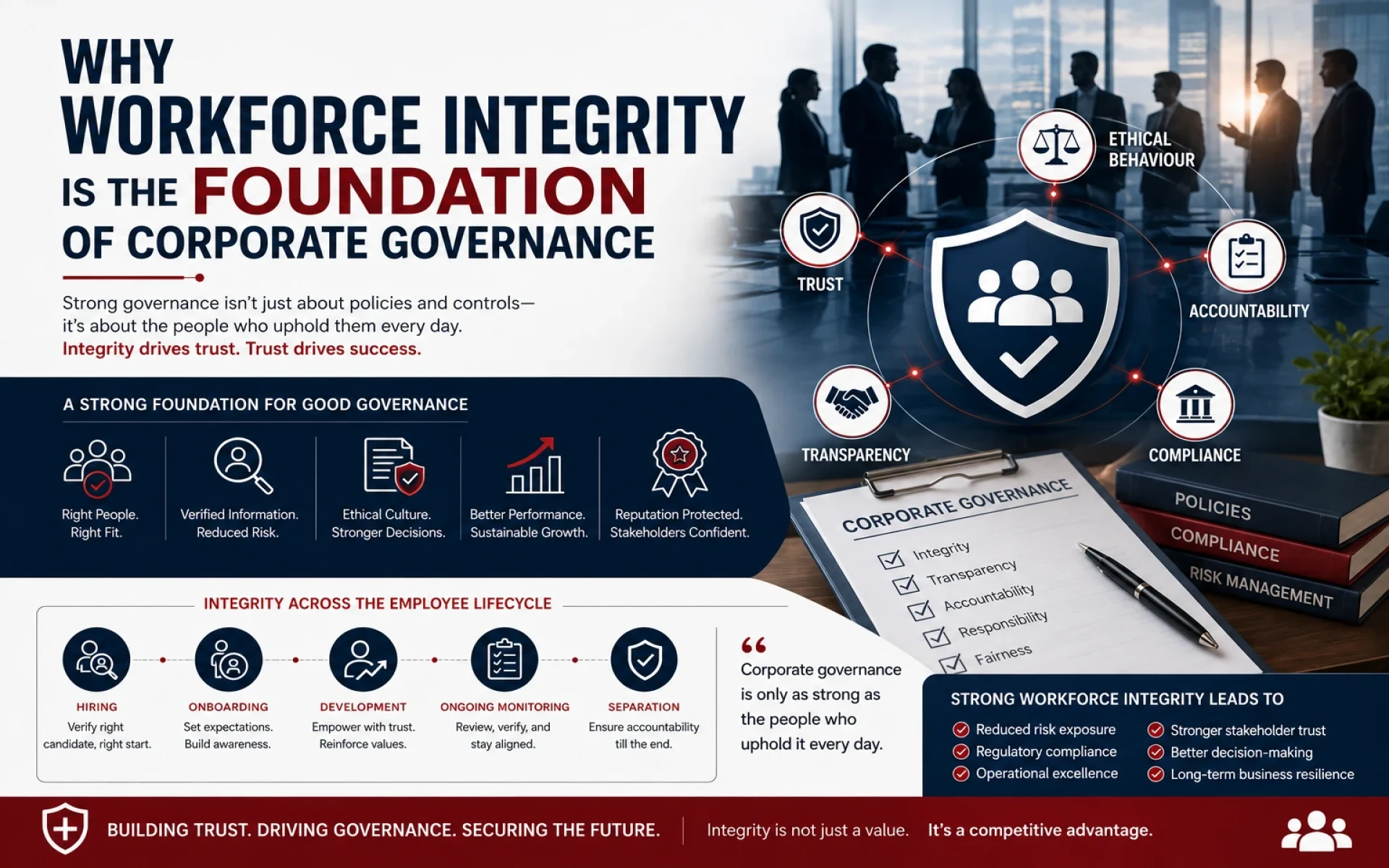
Maintaining Integrity Throughout the Employee Lifecycle
Employee responsibilities evolve over time. Promotions, departmental transfers, leadership appointments, and expanded system access all introduce new levels of responsibility.
Organizations with mature governance practices recognize that trust should be maintained throughout the employment lifecycle.
This may include:
-
Periodic policy acknowledgements
-
Role-based access reviews
-
Conflict-of-interest declarations
-
Continuous compliance training
-
Re-verification for sensitive positions
-
Regular ethical awareness initiatives
These practices help ensure that governance standards remain aligned with changing business responsibilities.
Leadership Sets the Standard
Employees often reflect the values demonstrated by leadership.
When executives prioritize transparency, accountability, and ethical decision-making, these behaviours become embedded within the organizational culture.
Conversely, inconsistent leadership practices can undermine governance efforts regardless of how comprehensive formal policies may appear.
Strong workforce integrity therefore requires visible commitment from senior leadership, not just documented expectations.
Technology Supports—but Does Not Replace—Integrity
Modern organizations increasingly use technology to strengthen governance through automated compliance tracking, digital identity verification, secure access management, and workforce analytics.
These tools improve visibility and operational efficiency, but they cannot replace ethical judgement, responsible leadership, or organizational culture.
Technology should support workforce integrity rather than become its substitute.
Building a Culture of Trust
Organizations that consistently demonstrate integrity create environments where employees understand that accountability is valued, ethical behaviour is recognized, and compliance is viewed as a shared responsibility.
Building such a culture requires:
-
Clear governance policies
-
Transparent communication
-
Consistent enforcement of standards
-
Fair decision-making
-
Ongoing learning and awareness
-
Leadership by example
Trust develops gradually through consistent actions rather than isolated initiatives.
Workforce Integrity as a Competitive Advantage
Beyond reducing risk, workforce integrity contributes directly to business performance.
Organizations known for ethical practices and responsible governance are often better positioned to:
-
Attract skilled professionals
-
Strengthen client relationships
-
Improve investor confidence
-
Meet regulatory expectations
-
Win enterprise contracts
-
Protect brand reputation
In an increasingly competitive marketplace, trust has become a differentiating factor rather than simply a compliance requirement.
Expert Insight
Corporate governance is often measured through policies, audits, and compliance reports. Yet its true strength lies in the people responsible for implementing those standards every day.
Organizations that invest in workforce integrity move beyond reactive risk management. They create a culture where trust is continuously reinforced through verified hiring, ethical leadership, accountability, and ongoing governance. In today's business environment, integrity is not just a human resources objective—it is a strategic business asset.
Final Thought
Corporate governance is only as strong as the people who uphold it.
While frameworks, regulations, and controls provide direction, workforce integrity determines whether those principles are consistently reflected in daily decisions and actions.
Organizations that embed integrity into every stage of the employee lifecycle are better equipped to manage risk, strengthen stakeholder confidence, and build sustainable businesses founded on trust.
Strong governance starts with trusted people — because every policy, control, and decision ultimately depends on the workforce behind it.
Build a Workforce That Strengthens Governance. CaseXpert helps organizations build workforce integrity through reliable background verification, employee screening, and risk-focused verification solutions. Talk to our verification specialists or send an enquiry to get started.