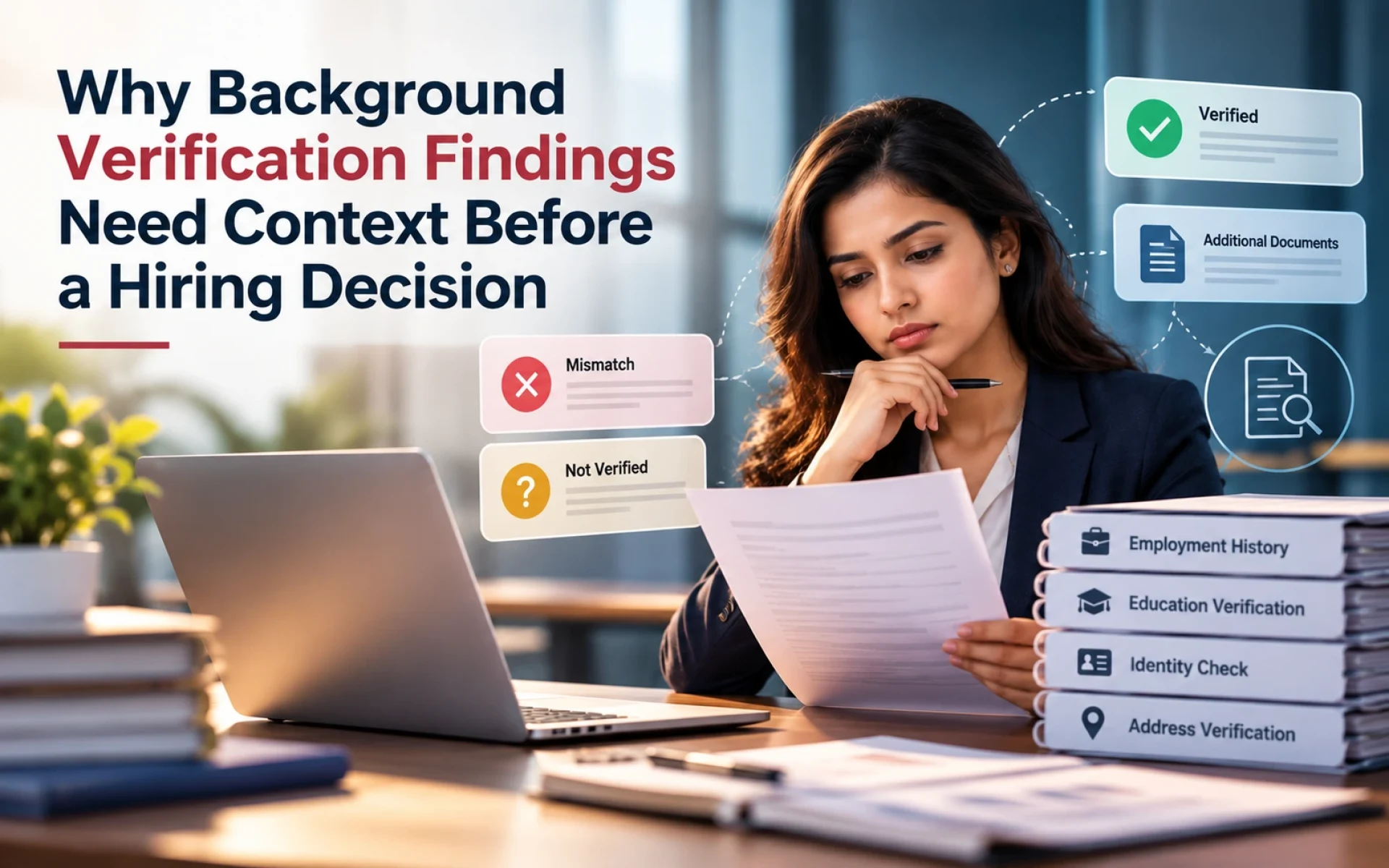
A background verification report arrives with a discrepancy. The candidate's employment dates do not match the former employer's records, a university has not responded to a verification request, or the designation mentioned on the resume differs from the designation confirmed by the employer.
For an HR team working against a joining deadline, these findings can create immediate pressure. Should the offer be put on hold? Should the candidate be asked for additional documents? Does the discrepancy indicate deliberate misrepresentation, or is there another explanation?
The challenge is that a background verification finding and a proven instance of dishonesty are not the same thing. A discrepancy identifies information that needs clarification. Its significance depends on what differs, how reliable the evidence is, whether the information is relevant to the role, and whether the candidate can provide a credible explanation.
For organizations, the objective is not to dismiss every concern or reject every candidate whose records do not match perfectly. It is to establish a consistent process that protects the business while allowing decisions to be made on accurate, relevant, and fairly assessed information.
This distinction matters because an overly lenient approach can allow material misrepresentation to go unnoticed, while an overly rigid approach can lead to the rejection of qualified candidates over explainable administrative differences.
What Does a Background Verification Discrepancy Actually Mean?
A background verification discrepancy occurs when information provided by a candidate differs from information obtained through a verification process.
The difference may involve employment dates, job titles, qualifications, identity details, addresses, professional credentials, or other information relevant to the check.
However, not every discrepancy has the same meaning.
A former employer might confirm that a candidate worked from June to November when the resume states June to December. An educational institution might be unable to locate a record because its archives are incomplete. A candidate might use an industry-recognized job title while the employer's internal records contain a different designation.
These situations require different responses from a case involving a qualification that cannot be authenticated or an employment history that appears to have been fabricated.
The first step is therefore to identify the exact nature of the finding rather than immediately labelling the entire verification as failed.
A useful distinction is between information that has been verified, information that remains unverified, information that conflicts with another source, and information for which credible evidence suggests material misrepresentation.
These categories help HR teams determine what action is appropriate without treating uncertainty as proof.
Why a BGV Discrepancy Should Not Automatically Mean Rejection
Background verification is intended to support better hiring decisions. It should not become a mechanical exercise in which any difference between two records automatically leads to a negative outcome.
There are several reasons a discrepancy may occur without deliberate deception.
Records may use different dates or definitions
Employment records can reflect different administrative milestones. A candidate may report the date they began working, while an employer's system records the date formal onboarding was completed. Notice periods, payroll dates, transfers, and contract transitions can also create apparent differences.
The correct response is to establish what each date represents and whether the difference is material to the hiring decision.
Organizations and institutions change over time
Companies merge, change names, restructure departments, and modify internal job titles. Educational institutions may change their names or administrative arrangements.
A verification request that uses outdated information or an incorrect institutional name may fail to produce a match even when the underlying credential is genuine.
Records may be incomplete or unavailable
Not every institution maintains easily accessible digital records. A former employer may have closed, a university may require additional documentation, or an authorized contact may not respond within the expected timeframe.
An unsuccessful verification attempt does not necessarily establish that the candidate's claim is false. It may simply mean the information could not be independently confirmed through the available route.
Candidate explanations may provide relevant context
A candidate might produce an experience letter, payslip, appointment letter, degree certificate, or clarification from the issuing institution that resolves the apparent mismatch.
These documents should be assessed for authenticity and relevance rather than accepted automatically. The important point is that the candidate should have a reasonable opportunity to clarify a material discrepancy before the organization reaches a final conclusion.
The broader principle is consistent with guidance on employment screening and the importance of evaluating adverse findings objectively rather than treating every exception as an automatic rejection.
Types of Background Verification Findings and How HR Should Assess Them
The following framework can help organizations distinguish routine exceptions from concerns requiring closer examination. These are practical categories for internal decision-making, not universal legal classifications.
1. Minor or administrative discrepancies
Examples include small date differences, spelling variations, or differences between an internal designation and a commonly used job title.
Recommended response: Check the underlying records, obtain clarification where necessary, and document the resolution. If the difference is satisfactorily explained and immaterial to the role, it should not automatically prevent hiring.
2. Unable-to-verify findings
Examples include an institution that has not responded, an employer that is no longer operating, or records that cannot be accessed through the available verification channel.
Recommended response: Determine why verification was unsuccessful. Explore appropriate alternative sources or documents and clearly distinguish an unresolved check from a confirmed false claim.
3. Material discrepancies requiring investigation
Examples include a substantial mismatch in employment duration, a qualification that differs from the one claimed, or a designation discrepancy that could affect eligibility for a sensitive role.
Recommended response: Recheck the source, assess the importance of the information, request a specific explanation, and obtain supporting evidence where appropriate. Keep the decision pending if the unresolved issue is material.
4. Credible evidence of material misrepresentation
Examples may include a qualification confirmed as inauthentic by the issuing institution or evidence that a claimed employer or position did not exist.
Recommended response: Validate the evidence, give the candidate an appropriate opportunity to respond, assess the relevance to the role and applicable policies, and document the final decision. Escalate significant concerns to the appropriate HR, compliance, or legal personnel.
The central principle is proportionality. The response should reflect the quality of the evidence, the seriousness of the issue, and its relevance to the position—not merely the number of discrepancies listed in a report.
A Practical Framework for Reviewing BGV Findings
HR teams can make more consistent decisions by following a structured review process whenever a verification report contains a potentially adverse finding.
Step 1: Identify the exact discrepancy
Begin with the specific information that could not be confirmed or that conflicts with another source.
Avoid broad labels such as "failed BGV" without explaining the underlying reason. A report may contain several completed checks, one pending check, and one discrepancy. Treating the entire report as a single negative result can obscure the actual issue.
Record what the candidate declared, what the verification source established, and what remains unresolved.
Step 2: Validate the source and the finding
Before taking action, determine whether the result is reliable.
Check that the information belongs to the correct individual, that the source is appropriate, and that the verification request used accurate details. Where possible, seek confirmation through an authorized channel.
This is especially important when a finding comes from a name match, a third-party database, an incomplete record, or information that may relate to someone else.
A preliminary match should not be treated as a confirmed adverse fact without adequate validation.
Step 3: Assess materiality
The next question is whether the discrepancy matters to the hiring decision.
A small difference in an employment date may not affect the candidate's suitability for the position. A materially inaccurate qualification could be much more significant if that qualification is mandatory for the role.
HR should consider:
-
Whether the information is essential to the position.
-
Whether the discrepancy affects eligibility or a stated hiring requirement.
-
Whether the available evidence indicates an error, an unresolved issue, or possible misrepresentation.
-
Whether the issue creates a specific operational, compliance, security, or reputational concern.
This assessment helps prevent minor administrative differences from receiving the same treatment as serious concerns.
Step 4: Give the candidate an opportunity to clarify
When a finding could negatively affect a hiring decision, communicate the specific concern clearly and professionally.
Explain what information could not be verified or what appears inconsistent. Allow a reasonable opportunity for the candidate to respond and provide relevant supporting documents.
A candidate may be able to clarify an employment date, explain a change in institutional records, or provide evidence that was not available during the initial verification.
The objective is to establish the facts—not to coach the candidate into producing a particular explanation.
Step 5: Review the response objectively
Assess the candidate's explanation against the available evidence.
A consistent explanation supported by credible documentation may resolve the concern. An explanation that conflicts with reliable records may leave the issue unresolved.
Where the matter is significant, a second reviewer or escalation to the appropriate decision-maker can help reduce individual bias and improve consistency.
Step 6: Record the decision and its rationale
Document the finding, the verification steps taken, the candidate's response, the evidence considered, and the reason for the final outcome.
A clear record helps organizations apply their policies consistently, review decisions when necessary, and demonstrate that material findings were assessed rather than handled arbitrarily.
How HR Should Communicate a Discrepancy to a Candidate
The way an organization communicates a BGV finding can affect both the candidate experience and the quality of the final decision.
An accusatory message may cause unnecessary conflict, especially when the issue is a minor mismatch or an administrative delay. A vague message, on the other hand, may leave the candidate unable to understand what needs clarification.
The communication should be factual, specific, and neutral.
For example, instead of writing:
Your background verification has failed because your employment details are incorrect.
HR could write:
During the verification of your previous employment, we identified a difference between the employment dates you provided and the information currently available from the verification source. Please review the details and share any clarification or supporting documentation that may help us complete the assessment.
This approach does not prejudge the outcome. It identifies the issue and provides a clear route for resolving it.
Organizations should also explain relevant timelines, how the information will be handled, and whom the candidate can contact with questions.
What Happens When the Candidate's Explanation Does Not Resolve the Finding?
Not every discrepancy can be resolved.
A former employer may remain unreachable, a document may be impossible to authenticate, or the evidence may continue to conflict with the candidate's explanation.
In such situations, the organization should distinguish between an unresolved verification result and a finding supported by evidence of misrepresentation.
If the information remains unverified, the hiring decision should follow the organization's established policy for unresolved checks. Depending on the role and the importance of the information, this might involve further verification, a documented exception, a temporary hold, or a decision not to proceed.
If credible evidence indicates material misrepresentation, the organization can evaluate the implications under its hiring policy, applicable law, and any contractual or regulatory requirements.
Neither outcome should be determined solely by an automated report status.
For roles subject to specific legal or regulatory requirements, the organization should also obtain appropriate advice before making a decision where the implications are uncertain.
The Role of a Clear Background Verification Policy
A consistent process cannot depend entirely on the judgement of individual recruiters.
Without a documented policy, one hiring manager may overlook a discrepancy that another treats as disqualifying. Such inconsistencies can undermine fairness, create avoidable disputes, and make it harder to explain why similar cases received different outcomes.
A robust background verification policy should establish:
-
Which checks are appropriate for different roles.
-
How findings are categorized and escalated.
-
What evidence is needed to resolve discrepancies.
-
How candidates are informed and given an opportunity to respond.
-
Who has authority to approve exceptions or final adverse decisions.
-
How personal information and verification records are accessed, retained, and protected.
-
How decisions are documented and reviewed.
The policy should also define how unresolved checks are handled when a joining date is approaching.
This allows HR teams to manage hiring timelines without compromising the quality of their decisions.
Background Verification, Candidate Fairness, and Data Privacy
Background verification involves personal information that can affect an individual's employment prospects. Organizations therefore need to consider not only whether a check is useful, but also whether the information is relevant, appropriately obtained, securely handled, and used for a legitimate purpose.
In India, employers should assess their screening practices against the applicable data protection and employment framework. The Digital Personal Data Protection Act, 2023, and the DPDP Rules, 2025, are important parts of that framework, with applicability depending on the relevant provisions and commencement arrangements. The Ministry of Electronics and Information Technology publishes the official rules and implementation information.
For practical purposes, organizations should ensure that verification processes have a defined purpose, use appropriate access controls, and avoid collecting or retaining information beyond what is justified by the relevant requirements.
Candidate fairness and risk management are not opposing objectives. A process that verifies findings carefully, communicates clearly, and documents decisions can protect both the organization and the people whose information it evaluates.
Common Mistakes HR Teams Should Avoid
Several mistakes can weaken an otherwise well-designed background verification process.
Treating every mismatch as fraud. A discrepancy is a signal to investigate, not conclusive proof of intentional deception.
Confusing unavailable information with false information. A source that does not respond has not necessarily disproved the candidate's claim.
Relying on a single unconfirmed source. Significant findings should be validated through appropriate channels wherever possible.
Ignoring the candidate's explanation. Making an adverse decision before reviewing relevant clarification can produce avoidable errors.
Applying inconsistent standards. Similar cases should be assessed under the same policy, while still considering relevant differences in evidence and role requirements.
Allowing automated statuses to make the decision. Technology can identify exceptions and organize findings, but material decisions require appropriate human review.
Failing to document the rationale. Without a clear record, it becomes difficult to explain how the organization reached its conclusion.
Key Takeaways
-
A background verification discrepancy does not automatically establish dishonesty.
-
HR teams should distinguish minor discrepancies, unresolved checks, material inconsistencies, and evidence of misrepresentation.
-
Every significant finding should be validated and assessed for relevance to the role.
-
Candidates should have a reasonable opportunity to clarify material concerns.
-
Decisions should follow a documented, consistently applied policy and account for applicable legal requirements.
-
A well-managed BGV process protects organizational integrity without turning routine verification exceptions into automatic hiring barriers.
Frequently Asked Questions
Does a background verification discrepancy mean a candidate will fail BGV?
No. A discrepancy means that some information differs or remains unconfirmed. Its outcome depends on the nature of the finding, the reliability of the evidence, its relevance to the role, and whether it can be satisfactorily resolved.
What should HR do if employment dates do not match?
HR should confirm what dates were provided and what the former employer's records establish. The team can then ask the candidate for clarification and assess supporting documents before deciding whether the difference is material.
Can an employer reject a candidate after a failed background verification?
An employer may decide not to proceed when a material concern remains unresolved or credible evidence establishes misrepresentation, subject to applicable law, contractual obligations, and organizational policy. However, an unsuccessful check or unverified claim should not automatically be treated as proof of dishonesty.
How much time should a candidate receive to explain a discrepancy?
There is no single timeframe suitable for every case. Organizations should set a reasonable response period based on the complexity of the issue, the documents required, the role's urgency, and the established policy. The process should allow a meaningful opportunity to respond without creating unnecessary delays.
What is the difference between a BGV discrepancy and a red flag?
A discrepancy is a difference between the information provided and the information obtained. A red flag is a finding that warrants closer examination because it may indicate a material risk. A discrepancy can become a significant red flag, but the two terms are not interchangeable.
CaseXpert Perspective
A background verification report is most valuable when it helps an organization understand what is known, what remains uncertain, and what requires further investigation.
Treating every exception as a failure may appear cautious, but it can produce poor decisions just as easily as ignoring warning signs. The stronger approach is to combine reliable verification, role-based risk assessment, candidate clarification, and documented judgement.
For organizations, the goal is not simply to complete checks. It is to use verified information responsibly to make better hiring decisions.
Final Thought
A hiring decision should not turn on a discrepancy alone. It should turn on what the evidence establishes, how relevant the finding is, and whether the concern has been fairly assessed.
Responsible background verification does more than identify differences between records. It helps organizations understand those differences before deciding what they mean.
That is how businesses protect their interests while building a hiring process grounded in accuracy, accountability, and trust.
A background verification finding is only the starting point for a better hiring decision. Understanding the evidence, assessing the context, and giving candidates a fair opportunity to clarify discrepancies help organizations make more informed and responsible hiring decisions.
Make Every Hiring Decision Count. CaseXpert helps organizations strengthen hiring confidence through reliable background verification and risk management solutions. Talk to our verification specialists or send an enquiry to get started.