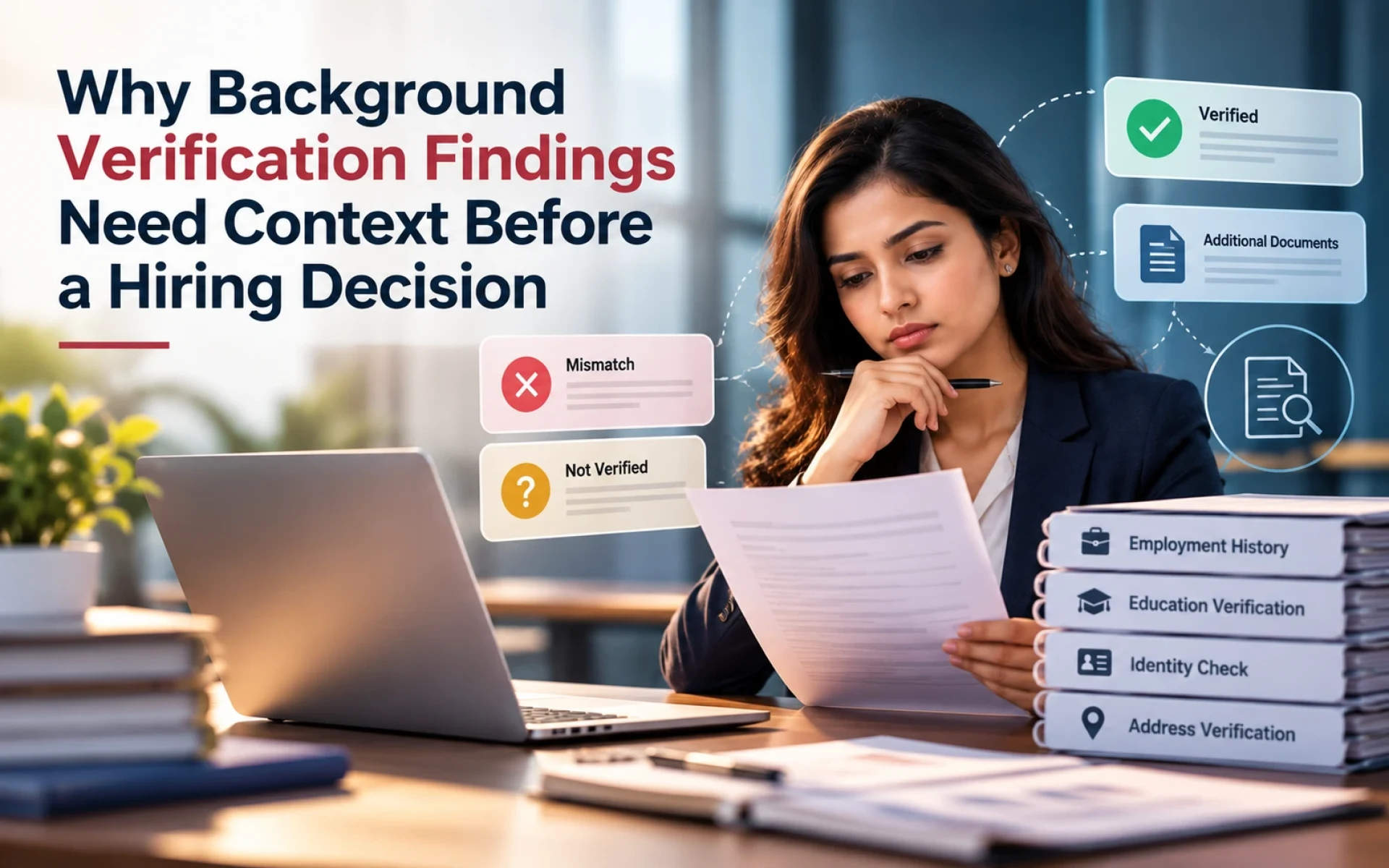
Many companies have a background verification process in place, yet the effectiveness of that process depends on how consistently and carefully it is designed and managed.
Background verification can become less effective when checks are incomplete, performed too late, poorly documented, or handled without a clear process for reviewing discrepancies. Even when a company uses an external verification provider, gaps in the overall workflow can affect the quality and usefulness of the results.
This article explores some of the most common background verification mistakes companies make, why they matter, and how organizations can strengthen their BGV processes.
Treating Verification as a Formality
One of the most common mistakes is treating background verification as a routine administrative step rather than an important part of the hiring process.
If verification begins only after the hiring decision has effectively been finalized, there may be less opportunity to properly review and address significant discrepancies.
An effective process should begin early enough for relevant findings to be reviewed before the organization makes decisions that depend on verification results.
The purpose of BGV is not simply to generate a report. It is to provide reliable information that can support an organization's hiring and risk-management process.
Conducting Incomplete or Inconsistent Checks
Another common mistake is conducting only the easiest or most convenient checks without considering the requirements of the role.
For example, an organization might verify identity and one previous employer while overlooking other relevant aspects of a candidate's history.
Common gaps include:
- Checking only the most recent employer
- Not reviewing relevant employment gaps
- Skipping education verification where qualifications are important to the role
- Failing to conduct relevant address verification
- Applying different verification standards to similar roles without a documented reason
- Not defining which checks are appropriate for different risk levels
A consistent, documented screening framework helps organizations apply their verification policy more systematically and reduces unnecessary variation between candidates in comparable roles.
Ignoring Employment Gaps and Overlaps
Employment timelines can provide important context during background verification.
An organization may verify each individual employment record successfully but still overlook inconsistencies when the records are viewed together.
For example, overlapping employment dates may require clarification, while unexplained gaps may warrant additional questions about the candidate's employment history.
However, a gap or overlap does not automatically indicate misconduct or misrepresentation. There may be legitimate explanations, such as notice periods, consulting assignments, administrative errors, or changes in employment status.
A better approach is to review the candidate's complete chronology and investigate material inconsistencies rather than treating every anomaly as a red flag.
Weak Consent and Documentation Practices
Background verification involves processing candidate information, making appropriate privacy and documentation practices essential.
A common mistake is failing to maintain clear records of:
- What information was collected
- What checks were requested
- What disclosures or notices were provided
- The applicable legal basis for processing
- What sources were used
- What results were received
- How discrepancies were reviewed
Organizations should establish appropriate consent, notice, data-handling, access, retention, and documentation procedures based on the applicable legal and regulatory framework.
Good documentation also helps HR teams understand how a particular verification result was reached and supports consistent internal processes.
Mishandling Verification Discrepancies
Finding a discrepancy is only one part of the verification process. How the discrepancy is reviewed is equally important.
A common mistake is treating every discrepancy as proof of fraud or, at the other extreme, ignoring inconsistencies without investigating them.
For example, a difference in employment dates may result from an administrative error rather than deliberate misrepresentation.
A structured discrepancy-management process can include:
- Identify the discrepancy
- Assess its relevance and materiality
- Verify the information through an appropriate source
- Give the candidate an appropriate opportunity to clarify where required
- Document the review
- Apply the organization's established decision criteria consistently
The final employment decision should be based on the organization's policies, the facts available, the relevance of the issue to the role, and applicable requirements.
Choosing a Verification Provider Based Only on Price
Cost is naturally an important consideration when selecting a BGV provider. However, choosing a provider solely on the lowest price can create problems if the service does not provide the required depth, transparency, turnaround, or support.
Organizations should evaluate providers across multiple factors, including:
- Verification coverage
- Source quality
- Accuracy and review processes
- Turnaround time
- Technology and automation
- Case tracking
- Exception handling
- Data-security practices
- Reporting quality
- Customer support
- Ability to handle the organization's hiring volume
The objective should be to find a provider whose capabilities match the organization's verification requirements rather than simply selecting the cheapest available option.
Treating BGV as a One-Time Activity
Background verification is commonly performed during the hiring process, but some organizations may also need additional screening during employment depending on the role, contractual requirements, organizational policies, or changes in responsibilities.
For example, employees moving into positions with significantly greater access to sensitive information may be subject to additional checks if the organization's policy and applicable requirements provide for them.
However, re-verification should not automatically be applied to every employee. Organizations should determine whether ongoing or periodic verification is appropriate based on factors such as role sensitivity, access levels, regulatory obligations, contractual requirements, and applicable privacy considerations.
Failing to Define a Role-Based Verification Policy
A single BGV package may not be appropriate for every employee.
An employee handling financial transactions may have different verification requirements from someone working in a role with limited access to sensitive information.
Organizations should therefore define screening requirements based on factors such as:
- Role responsibilities
- Access to confidential information
- Access to financial systems
- Customer-facing responsibilities
- Physical asset access
- Regulatory requirements
- Client or contractual requirements
A role-based approach helps organizations conduct relevant checks without unnecessarily collecting information that is unrelated to the position.
Failing to Monitor the Verification Process
Another common mistake is initiating BGV but providing limited visibility into its progress.
When HR teams cannot easily see which checks are complete, pending, or delayed, onboarding decisions can become difficult to manage.
A centralized tracking system can help HR teams monitor:
- Verification status
- Pending checks
- Candidate responses
- Employer or institution responses
- Discrepancies
- Expected completion
- Final reports
Real-time visibility can make it easier to identify bottlenecks and follow up before they unnecessarily delay the hiring process.
Key Takeaways
Here are the essential points to remember:
- BGV should be treated as a meaningful part of the hiring workflow rather than just an administrative formality.
- Verification requirements should be complete enough to address the risks relevant to the role.
- Employment gaps and overlaps should be reviewed rather than automatically treated as evidence of misconduct.
- Clear documentation and appropriate privacy practices are essential when processing candidate information.
- Discrepancies should be investigated consistently and, where appropriate, candidates should have an opportunity to clarify them.
- BGV providers should be evaluated on quality, coverage, technology, compliance practices, and support—not price alone.
- Re-verification may be appropriate for certain roles or circumstances but should be based on a documented, proportionate policy.
- Role-based screening can help organizations balance risk management with privacy and operational efficiency.
- Tracking verification progress helps HR teams identify delays and manage onboarding more effectively.
Conclusion
Background verification is only as effective as the process surrounding it.
Checks performed too late, incomplete verification packages, inconsistent screening standards, weak documentation, and poorly managed discrepancies can all reduce the value of a BGV program.
The good news is that these issues can be addressed through a structured approach.
Organizations can strengthen their verification processes by starting early, defining role-based screening requirements, maintaining appropriate documentation, reviewing discrepancies carefully, monitoring cases, and selecting verification partners based on quality and capability rather than price alone.
A well-designed BGV process turns background verification from a routine checkbox into a structured component of responsible workforce management.
The goal of background verification is not to eliminate every hiring risk. It is to provide reliable, relevant information that helps organizations make informed and consistent employment decisions while respecting candidate privacy and applicable requirements.
Close the gaps. CaseXpert applies consistent, thorough, compliance-ready verification with clear discrepancy handling so nothing slips through. Talk to our verification specialists or send an enquiry to get started.