A failed background verification can be concerning for both an employer and a candidate, but it does not always mean the same thing. A BGV result marked as failed, adverse, or discrepant does not automatically establish that a candidate has committed fraud or that an employment offer must be withdrawn.
What happens next depends on the nature of the finding, the reliability of the information received, the requirements of the role, and the employer's background verification policy.
This article explains what can happen when a candidate receives an adverse or discrepant BGV result in India, the different types of findings, how employers can review them, and why candidates should have an appropriate opportunity to clarify potentially inaccurate or incomplete information.
What Does “Failing” Background Verification Actually Mean?
There is no single definition of a “failed” background verification that applies to every organization.
Different employers and BGV providers may use classifications such as:
- Verified
- Clear
- Discrepancy
- Unable to verify
- Pending
- Adverse finding
- Failed
A BGV result may be flagged when information provided by a candidate does not match information obtained through an appropriate verification source, or when a required check cannot be completed.
However, a discrepancy is not automatically evidence of intentional misrepresentation.
For example, a difference in employment dates could result from an administrative error, while a qualification that cannot be validated may require additional investigation before any conclusion is reached.
The first step should therefore be to understand and classify the finding rather than treating every BGV flag as a final decision.
Common Types of Background Verification Findings
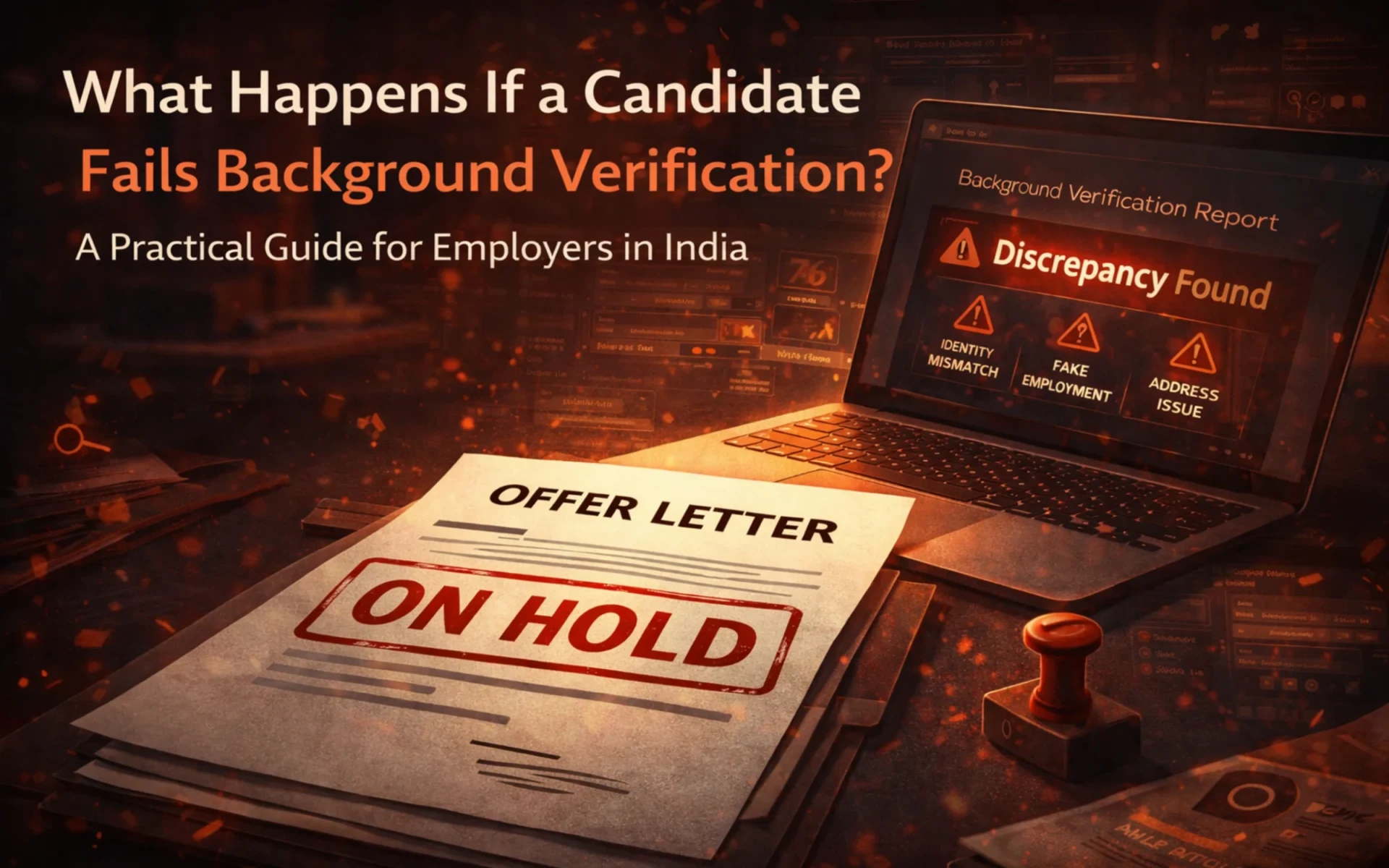
A candidate may receive a discrepancy or adverse finding for several reasons, including:
- Education details that cannot be verified
- Employment dates or designations that differ from available records
- Employment history that requires clarification
- Identity or name mismatches
- Address information that cannot be validated
- Documents containing inconsistencies or suspected alterations
- Relevant criminal or court-record findings, subject to appropriate verification and applicable requirements
- Other discrepancies identified against the organization's defined screening criteria
The significance of each finding depends on the circumstances.
For example, a spelling difference in a name may have a straightforward explanation, while materially inaccurate information about a qualification required for a position may require much more careful review.
Not Every BGV Discrepancy Means Fraud
One of the most important principles in background verification is distinguishing between an unexplained discrepancy and deliberate misrepresentation.
Possible innocent explanations can include:
- Typographical errors
- Different formats for dates
- Changes in a candidate's name
- Differences between current and permanent addresses
- Administrative errors in employer records
- Changes in company names following mergers or acquisitions
- Incomplete historical records
A responsible BGV process should investigate material discrepancies before drawing conclusions.
Similarly, an “unable to verify” result should not automatically be treated as proof that the information provided by the candidate is false. A previous employer or educational institution may simply be unavailable or unable to provide the required information.
What Happens After a BGV Discrepancy Is Found?
The next step is generally to review the finding and determine whether it is accurate, relevant, and material.
A structured process can involve the following steps.
1. Review the Original Finding
The employer or verification provider should identify exactly what information does not match.
This may include:
- Candidate-provided information
- Information obtained from the verification source
- The source used for verification
- Supporting documents
- The nature of the discrepancy
2. Validate the Information
Where appropriate, the finding should be checked again to reduce the possibility of an incorrect match, incomplete record, or verification error.
This is particularly important when the finding could materially affect an employment decision.
3. Give the Candidate an Opportunity to Clarify
Where appropriate under the organization's process, the candidate may be asked to provide an explanation or supporting documentation.
Depending on the situation, this could include:
- Employment documents
- Educational certificates
- Identity documents
- Relieving or experience letters
- Updated records
- Documentation explaining a name or address change
Providing an opportunity for clarification helps distinguish genuine discrepancies from administrative or data-related errors.
4. Assess the Relevance of the Finding
The employer should consider whether the issue is relevant to the requirements of the particular position.
For example, a minor discrepancy in an employment date may have a different significance from inaccurate information concerning a mandatory professional qualification.
5. Apply the Organization's Policy
The final decision should be based on the organization's established BGV and hiring policies, the facts available, the relevance of the finding, and applicable legal or contractual requirements.
What Are the Possible Outcomes?
A BGV discrepancy can result in different outcomes depending on the circumstances.
Verification Continues
If the information is incomplete or an external source has not responded, the verification may remain pending while additional checks are conducted.
Discrepancy Is Resolved
If the candidate provides sufficient clarification or supporting documentation, the organization may close the discrepancy and continue the hiring process.
Additional Verification Is Required
The employer may request further documentation or conduct additional verification before reaching a decision.
Hiring Decision Is Put on Hold
For a material unresolved discrepancy, an organization may decide to pause the hiring process while the matter is reviewed.
Offer Is Withdrawn
An organization may decide not to proceed where a material finding is inconsistent with its established hiring policy or applicable requirements.
The precise outcome depends on the organization's policy, the facts of the case, and the circumstances of the role.
For candidates who have already joined, any employment action should be handled according to the applicable employment terms, company policies, and relevant legal requirements.
Can a Company Reject a Candidate After a Failed BGV?
A BGV finding can be relevant to an employment decision, but a “failed” status should not automatically be treated as a universal instruction to reject a candidate.
Employers should first understand:
- What caused the finding
- Whether the information is accurate
- Whether the discrepancy is material
- Whether the issue is relevant to the role
- Whether the candidate has provided an explanation
- What the organization's established policy requires
Organizations should also apply their screening criteria consistently to comparable situations and comply with applicable employment, privacy, contractual, and regulatory requirements.
For complex cases, particularly those involving potentially sensitive legal or personal information, organizations should consider obtaining appropriate legal advice.
What If the Candidate Disputes the BGV Result?
Candidates may disagree with a verification finding for legitimate reasons.
For example, a candidate may explain that:
- The previous employer's records contain an error
- Their name has changed
- Their employment dates were recorded differently
- The institution has incomplete historical records
- The address provided was a previous or permanent address
- The verification result relates to another individual with similar identifying information
An effective verification process should have a mechanism for reviewing such disputes.
The organization or BGV provider can reassess the relevant information, request supporting evidence, and document the outcome of the review.
This helps prevent incorrect or incomplete information from being treated as a confirmed adverse finding.
BGV Failure vs. Unable to Verify
These terms should not be treated as interchangeable.
| BGV Status | What It Generally Means |
|---|---|
| Verified | The relevant information was successfully confirmed |
| Discrepancy | Information does not fully match |
| Pending | Verification is still in progress |
| Unable to Verify | Available sources did not allow the check to be completed |
| Adverse Finding | A finding requires further assessment under the organization's criteria |
| Failed | An organization's defined criteria have not been satisfied |
The exact definitions can differ between employers and BGV providers, so HR teams should understand how their verification system classifies each result.
Common Mistakes Employers Should Avoid
Automatically Treating Every Flag as Fraud
A discrepancy is not necessarily evidence of intentional deception.
Making a Decision Without Reviewing the Finding
Employers should understand the source and nature of the discrepancy before taking action.
Ignoring Material Discrepancies
The opposite approach can also create risk. Significant discrepancies relevant to the role should be reviewed according to the organization's established process.
Applying Different Standards to Similar Cases
Organizations should maintain consistent screening criteria while allowing legitimate role-specific differences.
Sharing BGV Information Unnecessarily
Background verification can involve sensitive personal information. Access to reports and supporting documents should be appropriately controlled and managed in accordance with applicable privacy and data-protection requirements.
How Can Companies Build a Fair BGV Process?
A well-designed BGV process should combine risk management with appropriate candidate safeguards.
Organizations can:
- Define clear verification criteria for different types of roles.
- Document the BGV process and decision criteria.
- Use appropriate verification sources for each check.
- Review discrepancies before reaching conclusions.
- Provide an appropriate clarification process for candidates.
- Apply policies consistently to comparable cases.
- Limit access to sensitive verification information.
- Maintain appropriate records of verification and discrepancy reviews.
- Periodically review the BGV policy to keep it aligned with applicable requirements.
Protecting the Candidate Experience
A BGV discrepancy can be stressful for a candidate, particularly when they do not understand why their application has been flagged.
Clear communication can make the process more transparent.
HR teams should avoid unnecessarily accusatory language and explain what additional information or clarification is required.
A respectful process does not mean ignoring genuine risks. It means giving the organization a structured way to investigate findings while avoiding premature conclusions.
How CaseXpert Can Help
CaseXpert provides technology-driven background verification solutions designed to help organizations manage BGV workflows through centralized tracking and structured reporting.
A technology-enabled process can help HR teams:
- Monitor verification status
- Track pending checks
- Manage candidate documentation
- Identify discrepancies
- Maintain verification records
- Review verification results
- Access structured reports through a centralized workflow
The objective is not simply to label a candidate as “pass” or “fail.” A useful BGV process should provide sufficient information for HR teams to understand what was verified, what could not be verified, what discrepancies were identified, and what may require further review.
Key Takeaways
- A failed BGV result does not automatically mean that a candidate has committed fraud.
- Different BGV providers and organizations may use different definitions of “failed.”
- Discrepancies should be reviewed and, where appropriate, verified before a final decision is made.
- Candidates may need an appropriate opportunity to clarify potentially inaccurate or incomplete information.
- “Unable to verify” is not necessarily the same as “failed.”
- The relevance and materiality of a finding should be considered in relation to the role.
- Employers should apply their BGV policies consistently.
- Sensitive verification information should be handled appropriately.
- Final employment decisions should follow the organization's policies and applicable legal, regulatory, and contractual requirements.
Conclusion
A failed background verification is not necessarily the end of the hiring process. It is often the point at which an organization needs to investigate a finding more carefully.
The right approach is to verify, review, clarify, and assess rather than treating every BGV flag as proof of misconduct.
Some findings may result from genuine errors or incomplete records, while others may reveal material inconsistencies that require further action. A structured process helps organizations distinguish between these situations.
For employers, the goal of background verification should be to obtain reliable information and make consistent, well-informed decisions. For candidates, a transparent clarification process helps ensure that genuine errors or inaccurate records do not automatically become final conclusions.
When BGV is managed as a structured review process rather than a simple pass-or-fail exercise, it can help organizations manage hiring risk while maintaining a fair and responsible candidate experience.
A failed check is not a verdict—it is a signal to assess the findings carefully, provide an appropriate opportunity for clarification, and let established policy—not panic—guide the outcome.
Handle findings the right way. CaseXpert delivers clear, accurate reports with structured discrepancy handling so your decisions are fair, consistent and defensible. Talk to our verification specialists or send an enquiry to get started.