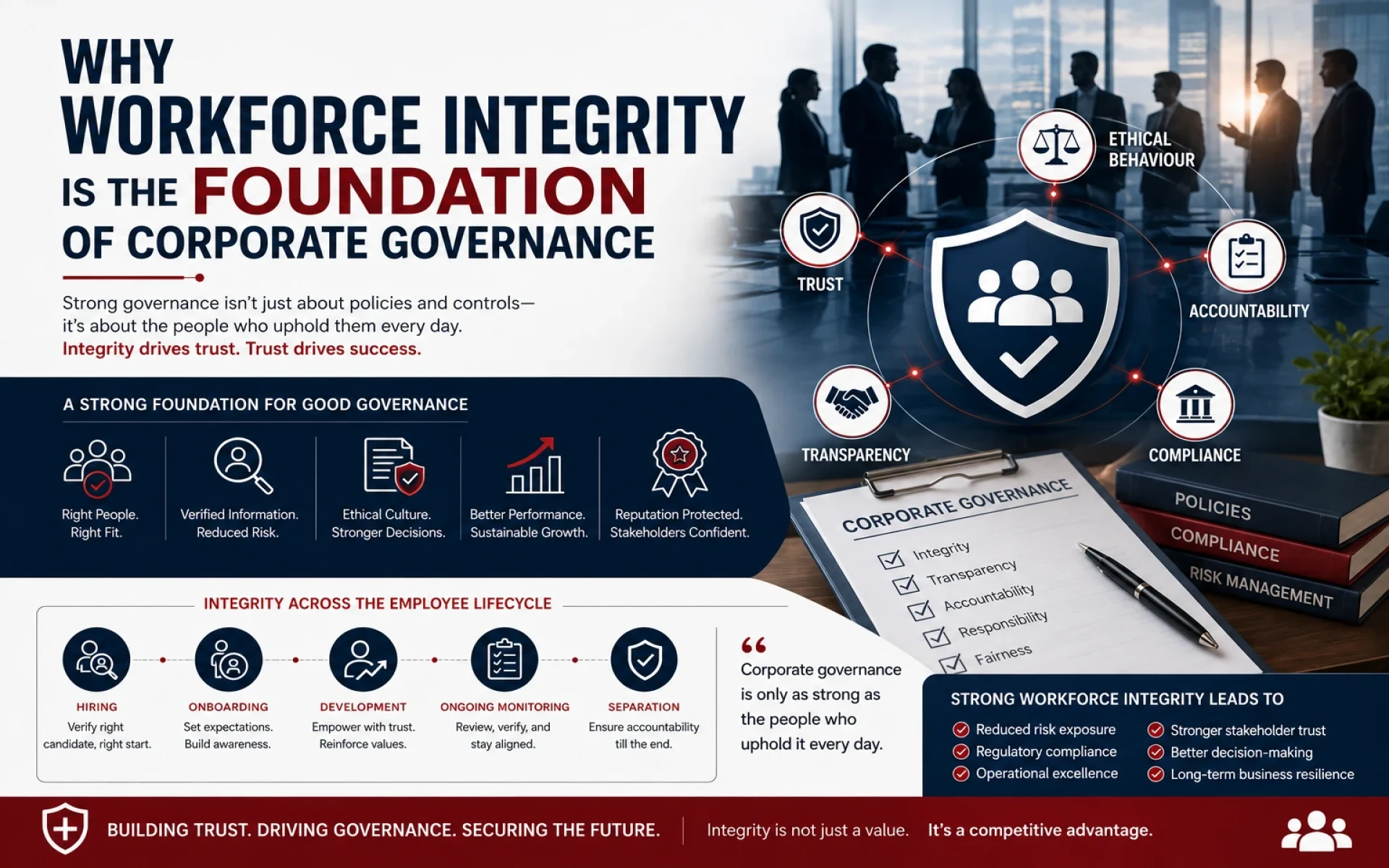
Regulatory compliance and background verification can be closely connected in India, particularly in regulated sectors, sensitive roles, and client or contractual arrangements that require personnel screening. However, background verification is not a universal statutory requirement for every employer or every employee.
Its relevance depends on the industry, role, applicable regulations, contractual requirements, and the type of information being processed. Understanding these factors helps companies use background verification as one component of a broader compliance and risk-management framework rather than treating it as a standalone legal requirement.
This article explains how background verification can support regulatory compliance in India, where sector-specific requirements may apply, how data-protection obligations affect the verification process, and why appropriate documentation can help organisations demonstrate that their defined screening procedures were followed.
Verification as a Compliance Control
In some regulated environments, organisations are expected to conduct appropriate due diligence on particular personnel, service providers, or roles. Background verification can support these requirements by helping organisations collect and verify relevant information through an established process.
For example, RBI guidance in certain contexts requires banks to conduct due diligence on recovery agents and ensure that antecedent verification of their employees is carried out, which may include pre-employment police verification.
Similarly, SEBI's regulatory framework includes "fit and proper person" criteria for specified regulated entities and persons, covering considerations such as integrity, reputation, character, competence, and certain convictions or disqualifications.
These examples illustrate an important point: the compliance relevance of background verification depends on the specific regulatory framework rather than on a blanket requirement applicable to all companies.
Sectors Where Verification May Support Compliance
Background verification can be particularly relevant in sectors and roles involving financial activity, sensitive information, regulated services, security, or significant customer access.
Examples may include:
- Banking and financial services, where specific regulatory or outsourcing requirements may apply
- Securities and financial-market roles subject to applicable fit-and-proper requirements
- Healthcare and other roles where professional credentials and responsibilities require verification
- IT and IT-enabled services working with regulated or international clients
- Roles involving sensitive personal, financial, or confidential business information
- Outsourced or contractual roles where client requirements specify personnel screening
The exact checks required should be determined by the applicable regulation, role, contractual requirement, and organisational policy.
Companies should therefore avoid assuming that a particular check is legally mandatory simply because it is common within an industry.
Data Protection Compliance in Verification Itself
Background verification involves the collection and processing of personal information, which means the verification process itself needs appropriate data-protection controls.
India's Digital Personal Data Protection framework establishes requirements concerning the processing of digital personal data, while the Digital Personal Data Protection Rules, 2025 provide additional implementation details. The Rules were notified in November 2025 with a phased commencement schedule.
The framework includes requirements around matters such as notice, consent in applicable circumstances, processing purposes, security safeguards, and individual rights. The exact obligations depend on the relevant provisions, their commencement status, and the circumstances of the processing.
For organisations conducting BGV, practical considerations include:
- Clearly communicating the purpose and scope of information collection
- Using an appropriate legal basis for processing
- Collecting information relevant to the stated purpose
- Applying appropriate security and access controls
- Managing retention and deletion appropriately
- Maintaining suitable records of verification activities
The key point is that compliance applies to how verification data is collected and processed, not simply to whether a company performs background checks.
Demonstrating Due Diligence
Documented verification can help an organisation demonstrate that it followed its established screening process.
Appropriate records may include information about which checks were requested, the status or outcome of those checks, relevant verification sources, and follow-up actions taken when discrepancies arose.
Documentation can be particularly useful where a client, internal auditor, or applicable regulator requires evidence that a defined process was followed.
However, maintaining a verification record does not automatically establish regulatory compliance. The underlying process must still be appropriate to the applicable legal, regulatory, contractual, and organisational requirements.
Supporting Client and Contractual Compliance
Background verification may also form part of contractual or client-specific requirements.
For example, an enterprise customer may require a service provider to conduct employee screening before allowing personnel to access customer systems, data, facilities, or projects.
In such cases, the obligation may arise from the commercial relationship rather than directly from a statute or regulation.
Companies should clearly document these requirements and ensure that the checks conducted match the scope agreed with the client.
For regulated entities that outsource activities, regulatory expectations may also extend to how service providers are selected, monitored, and controlled. RBI's outsourcing framework, for example, places responsibility on banks to manage outsourcing risks and retain appropriate oversight of outsourced activities.
Building Compliance-Ready Verification
To make background verification a useful component of a compliance framework, organisations should first identify the requirements that actually apply to the role, industry, and engagement.
A practical approach includes:
- Map relevant checks to applicable regulatory and contractual requirements
- Establish appropriate privacy, consent, or other lawful processing requirements
- Use relevant and reliable verification sources
- Document verification activities and material findings appropriately
- Apply defined screening criteria consistently
- Review discrepancies using evidence and context
- Periodically review the screening framework as regulations and business requirements change
A specialist BGV provider can help organisations operationalise these processes, but responsibility for determining applicable compliance requirements remains with the organisation and its relevant advisers.
Preparing for Audits and Regulatory Reviews
A structured verification process can make it easier for organisations to respond when an auditor, client, or regulator asks how personnel screening is conducted.
Instead of reconstructing individual cases from emails, documents, and manual records, an organisation with an established workflow can more readily identify what checks were requested, what information was received, and what follow-up occurred.
This does not mean every verification process will satisfy every audit or regulatory review. The relevant evidence will depend on the applicable framework and the nature of the organisation.
The objective is to maintain appropriate records that accurately reflect the process followed.
Key Takeaways
Here are the essential points to carry forward from this guide:
- Background verification is not a blanket statutory requirement for every employer in India.
- Specific sectors, roles, regulations, and contracts may create particular screening or due-diligence requirements.
- RBI and SEBI frameworks provide examples of contexts where personnel due diligence or fit-and-proper requirements can be relevant.
- The BGV process itself must handle personal data responsibly and in accordance with applicable requirements.
- Documentation can help demonstrate that an organisation followed its defined verification process.
- Client contracts may impose screening requirements independently of statutory obligations.
- Compliance-ready verification should be proportionate, documented, role-appropriate, and regularly reviewed.
Conclusion
Background verification can play an important supporting role in regulatory compliance in India, but its significance depends on the organisation, industry, role, and applicable requirements.
In some regulated environments, specific personnel or service-provider due-diligence requirements may make verification particularly relevant. In other situations, screening may arise from client contracts, internal risk policies, or the responsibilities associated with a particular role.
At the same time, organisations must remember that conducting BGV does not automatically make an organisation compliant. The verification process itself involves personal data and therefore needs appropriate privacy, security, governance, and record-keeping practices.
The strongest approach is to connect background verification with the organisation's broader compliance framework: identify the requirements that apply, conduct proportionate checks, use appropriate sources, handle information responsibly, document the process, and review findings consistently.
For HR, compliance, and risk teams, this makes BGV more than an isolated recruitment activity. It becomes one practical control within a wider framework for managing people-related and regulatory risk.
Background verification does not replace compliance — it supports it when the checks, data practices, documentation, and review process are aligned with the requirements that actually apply.
Compliance you can prove. CaseXpert delivers documented, consent-driven, audit-ready verification that supports your regulatory and contractual obligations. Talk to our verification specialists or send an enquiry to get started.