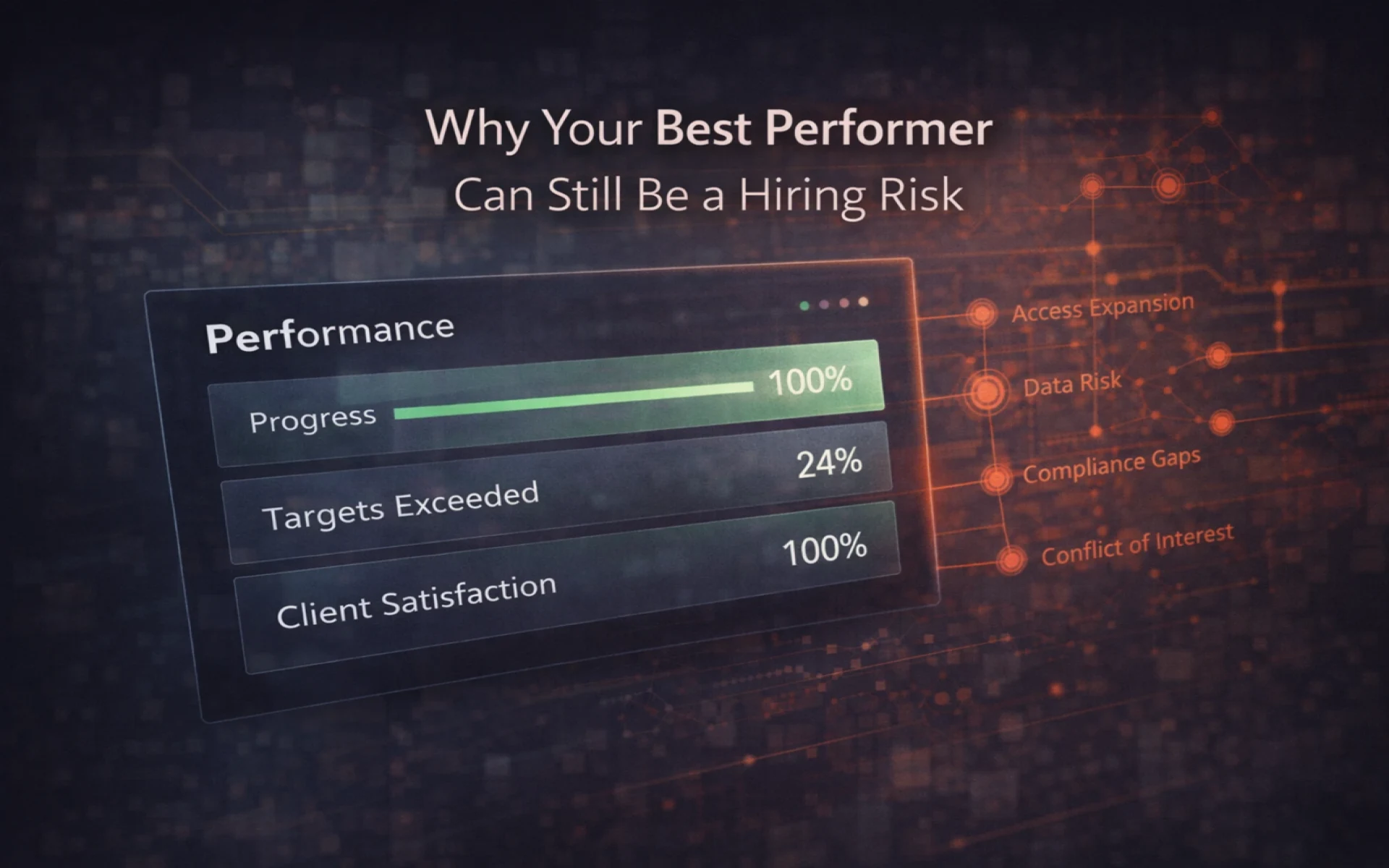
It is one of the most counterintuitive risks in hiring: excellent performance does not automatically mean low risk.
Companies naturally become more confident in employees who consistently deliver results. Someone who meets targets, earns leadership's trust, solves difficult problems, and receives strong feedback can quickly become one of the organisation's most trusted people. Over time, that trust can reduce the level of scrutiny applied to them.
But performance and integrity are different dimensions.
A high-performing employee may be exactly as trustworthy as they appear. They may also have inaccurate credentials, an undisclosed conflict of interest, or another issue that was never identified during hiring. Their strong performance does not prove either conclusion.
This matters because high performers often receive greater autonomy, broader access, and more responsibility. If a material issue does exist, the potential impact can therefore be greater.
The lesson is not to distrust successful employees. It is to ensure that performance never becomes a substitute for appropriate verification and risk controls.
Why We Equate Performance With Trustworthiness
People naturally use shortcuts when making judgements about others. One well-known example is the halo effect: a positive characteristic can influence how we perceive unrelated characteristics.
An employee who is highly capable may therefore be perceived as more reliable, honest, or responsible simply because they perform exceptionally well.
That assumption can create a subtle verification gap.
A strong performer may have demonstrated that they can deliver results. They have not necessarily demonstrated that every qualification on their resume is accurate, every previous employment claim is correct, or every relevant conflict was disclosed.
Performance is evidence of performance. It is not independent evidence of background accuracy.
This distinction is particularly important when organisations make decisions about access, authority, promotions, and sensitive responsibilities.
The Access Paradox
High-performing employees often earn greater trust.
That trust can translate into:
- Access to sensitive business information
- Greater system or financial authority
- Customer or client access
- Strategic decision-making responsibilities
- Greater autonomy
- Leadership responsibilities
- Access to intellectual property and confidential information
These are appropriate rewards for strong performance. But they also mean that the consequences of an undiscovered issue can increase as an employee's access grows.
This creates what can be called the access paradox:
The more an organisation trusts someone, the more access it may give them — which makes appropriate controls more important, not less.
The solution is not to restrict successful employees unnecessarily. It is to ensure that access, verification, and internal controls are governed by the role and its risk rather than by personal reputation alone.
How Strong Performance Can Mask Unresolved Issues
Strong performance can sometimes make organisations less likely to question the information that supported the original hiring decision.
For example, suppose an employee performs exceptionally well but their original employment history was never independently verified. Their current success may make anyone less inclined to revisit those earlier claims.
The same can happen with:
- Inflated job titles
- Exaggerated responsibilities
- Incorrect employment dates
- Unverified qualifications
- Undisclosed conflicts of interest
- Inaccurate professional certifications
None of these necessarily means the employee is dishonest. Some may be administrative discrepancies or misunderstandings.
The important point is that current performance cannot independently validate historical claims.
A person can be highly capable in their current role while still having an inaccurate statement somewhere in their background.
The Senior-Hire Verification Gap
This becomes particularly important with senior and high-access positions.
Organisations may subject junior candidates to detailed checks while relying more heavily on reputation, references, professional networks, or perceived credibility when hiring senior candidates.
That creates a potential mismatch between risk and verification depth.
Senior employees often have greater authority, broader access, and a larger potential impact on the organisation. Their verification should therefore be designed around the requirements and risk profile of the role rather than their seniority or reputation.
An impressive resume should not eliminate verification.
If anything, the higher the consequences associated with the role, the more important it becomes to confirm material claims independently.
Performance Is Not a Substitute for Background Verification
Background verification and performance management answer different questions.
Performance management asks:
Is this employee delivering what the organisation expects?
Background verification asks:
Are the material claims and credentials on which the hiring decision was based accurate and independently supported?
Neither replaces the other.
A strong performance review cannot confirm that a degree was actually awarded. A successful sales record cannot independently validate previous employment. Strong leadership cannot establish that every professional certification listed during hiring was genuine.
This is why verification remains relevant even when an employee has already demonstrated considerable value to the organisation.
What HR Should Verify — and When
The appropriate level of verification depends on the role, the information being relied upon, and the organisation's legitimate risk requirements.
At the hiring stage, employers may consider verifying relevant areas such as:
- Identity
- Employment history
- Education and qualifications
- Professional certifications
- Address or other relevant information
- Criminal or court-related checks where legally appropriate
- Role-specific requirements
For existing employees, additional verification may become relevant when there is a legitimate trigger, such as:
- Promotion into a sensitive position
- Transfer into a regulated function
- New licensing or certification requirements
- Significant increase in access or authority
- Contractual or regulatory re-screening requirements
- A specific and credible concern requiring investigation
The important principle is proportionality.
Not every employee requires the same level of scrutiny, and re-verification should not become a blanket surveillance programme.
How to Manage Risk Without Punishing High Performers
The objective is not to make successful employees feel distrusted.
Instead, organisations should establish controls that apply consistently based on role, access, and risk.
For example, if employees in a particular high-trust role are subject to specific verification requirements, those requirements should apply because of the role rather than because management happens to distrust a particular individual.
This creates a healthier system.
The employee's performance can continue to determine recognition, promotion, and rewards, while verification and risk controls operate independently.
That separation is important because it prevents personal reputation from becoming a substitute for objective controls.
What If a Verification Issue Appears Later?
A later discrepancy should not automatically be treated as proof of fraud.
The organisation should first determine:
- Whether the information is accurate
- Whether the source is reliable
- Whether the discrepancy is material
- Whether there is a reasonable explanation
- Whether the employee should be given an opportunity to respond
- What company policy and applicable employment requirements provide
- Whether the issue actually affects the employee's role or suitability
For example, a difference of several weeks in an employment date may have an innocent explanation. A qualification that an employee was required to hold but never obtained may be materially different.
The distinction between an administrative discrepancy and a material misrepresentation matters.
Any employment action should therefore be based on confirmed facts, applicable policy, and an appropriate process rather than simply on the existence of a red flag.
Trust Should Be Based on More Than One Signal
A mature hiring process does not ask employees to repeatedly prove themselves because the organisation assumes everyone is a risk.
Instead, it recognises that different controls answer different questions.
- Interviews assess communication, reasoning, and role fit.
- Work samples assess practical capability.
- References provide additional perspectives.
- Performance reviews assess actual performance after joining.
- Background verification independently checks relevant historical claims.
- Access controls limit exposure based on business need.
- Re-verification, where justified, refreshes assurance for appropriate roles.
No single signal provides a complete picture.
The strongest approach is to use the right control for the right question.
Trust That Is Earned, Not Assumed
A high-performing employee may have earned significant trust through their work.
That trust is valuable.
But organisational trust does not require abandoning objective controls. In fact, the healthiest organisations separate trust in capability from verification of material facts.
An employee's results can demonstrate what they are capable of doing today. Verification can establish whether important claims made during hiring were supported.
Both can coexist.
And when verification requirements are based on role risk rather than personal suspicion, high performers have no reason to be treated differently from anyone else in a comparable position.
Key Takeaways
- Exceptional performance does not automatically establish background accuracy or integrity.
- High performers may receive greater access and authority, making appropriate controls important.
- The halo effect can cause organisations to extend positive assumptions beyond what the evidence supports.
- Senior and high-access roles should be verified according to their risk profile, not simply their reputation.
- Performance management and background verification answer different questions and should not replace one another.
- A later verification discrepancy should be confirmed and assessed before conclusions are drawn.
- Verification and re-verification should be proportionate, role-based, and consistent.
- Strong performance should be recognised without allowing reputation to override appropriate risk controls.
Conclusion
Your best performer may also be one of your most trusted employees — and that is exactly why organisations need to distinguish trust in performance from verification of background claims.
Exceptional results demonstrate capability. They do not independently confirm qualifications, employment history, certifications, or other information provided during hiring.
The answer is not to treat high performers with suspicion. It is to build a hiring and workforce-risk framework in which verification is determined by the role, access, and legitimate business requirements rather than by how impressive someone appears.
When those principles are followed, performance and verification work together rather than competing with each other.
Let performance demonstrate what an employee can do. Let verification establish that the important facts behind the hiring decision are supported.
Performance can earn trust in someone's work. Verification helps ensure that trust is built on facts, not assumptions.
Verify your most trusted people too. CaseXpert helps companies apply consistent, risk-based verification across every level - so the people with the most access to harm you are confirmed as trustworthy, not just assumed to be. Talk to our verification specialists or send an enquiry to get started.