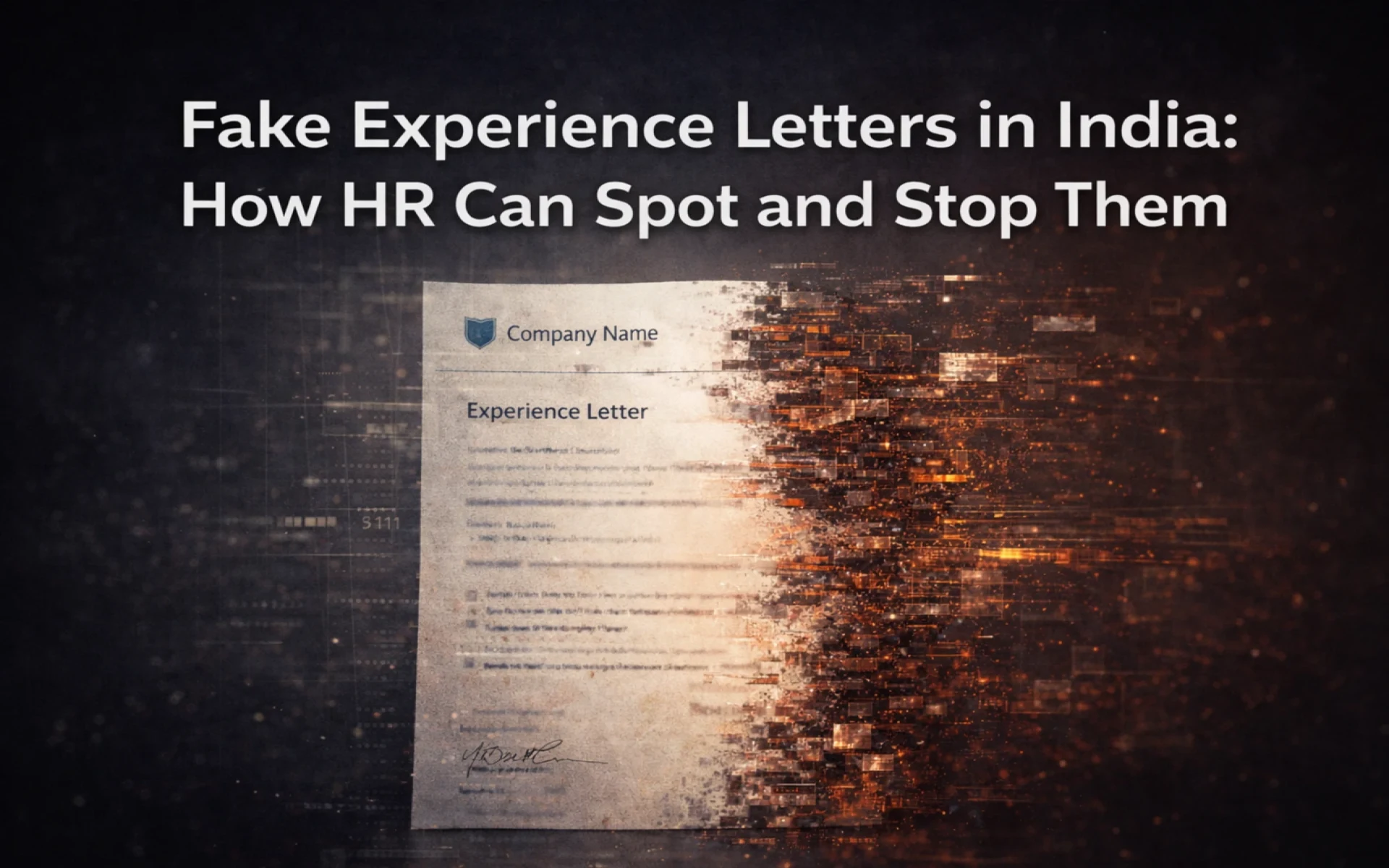
Fake experience letters are a serious form of employment fraud in India. A fabricated relieving letter, inflated designation, altered employment dates, or falsified salary details can misrepresent a candidate's professional history and create significant hiring, compliance, operational, and reputational risks for an organisation.
The challenge for HR teams is that experience-letter fraud is no longer limited to poorly designed documents. Forged letterheads, manipulated documents, fabricated HR contacts, and coordinated references can make false employment claims appear legitimate during a superficial review.
The answer is not to judge documents by appearance alone. It is to build a verification process that independently validates employment claims, checks discrepancies, and gives candidates an opportunity to explain genuine inconsistencies.
This guide explains the common forms of fake experience letters in India, the warning signs HR teams should look for, why candidate-provided contacts are not enough, and how a structured background verification process can identify employment fraud more reliably.
Why Experience-Letter Fraud Happens
Professional experience directly influences hiring decisions, job levels, compensation, and career progression. This creates an incentive for some candidates to exaggerate or fabricate their employment history.
A candidate may misrepresent experience to:
- Qualify for a role requiring more experience
- Negotiate a higher salary
- Hide employment gaps
- Conceal a short or unsuccessful tenure
- Present a more senior designation
- Support claims about skills they have not actually developed
The problem is not limited to completely fictional employment. In many cases, the underlying employer is genuine but specific details such as dates, designation, salary, or responsibilities have been altered.
That makes employment verification particularly important. HR teams need to establish not simply whether a company exists, but whether the candidate's specific employment claim matches independently available records.
Common Types of Fake Experience Letters
Experience-related fraud can take several forms, ranging from completely fabricated employment to relatively subtle alterations of genuine records.
Common examples include:
- Completely fabricated employment at a real or non-existent company
- Inflated job titles or seniority
- Altered joining and relieving dates
- Extended employment periods to hide career gaps
- Falsified salary information
- Misrepresentation of employment status
- Fabricated relieving or resignation letters
- Concealed termination presented as a voluntary resignation
- Genuine employment combined with exaggerated responsibilities
The most difficult cases can involve genuine employment with altered details. Because the employer exists and the candidate may have genuinely worked there, a basic reference check may not immediately identify the discrepancy.
How Fake Experience Letters Are Made to Look Genuine
Modern document manipulation can make fraudulent employment documents appear professional. Letterheads, signatures, formatting, company addresses, email addresses, and other visual elements can be reproduced or altered with relative ease.
Some fraudulent claims may also be supported by individuals who are willing to provide a false reference.
This is why document inspection alone should not be treated as proof of employment.
A professional verification process should independently establish whether the employer exists, whether the candidate actually worked there, and whether the key employment details match the information provided by the candidate.
The objective is not simply to determine whether a document looks authentic. It is to verify whether the underlying employment claim is genuine.
Red Flags HR Teams Should Watch For
HR teams can identify potential inconsistencies before or during formal verification.
Possible warning signs include:
- Inconsistent fonts, formatting, dates, or terminology
- Different job titles across the resume and supporting documents
- Employment dates that overlap with another full-time role
- Salary figures that do not align across documents
- Generic or unusual email addresses for supposed HR contacts
- Missing or inconsistent company information
- Unclear reporting structures or responsibilities
- Candidate reluctance to provide reasonable employment details
- Significant differences between the resume and experience letter
None of these indicators independently proves that a document is fraudulent. They should instead trigger additional verification.
The distinction is important: a red flag is a reason to investigate, not a conclusion.
Why Calling the Number on the Experience Letter Is Not Enough
One of the most common verification mistakes is relying entirely on the contact information printed on an experience letter.
If the document itself is fraudulent, the associated phone number or email address may also be controlled by the person creating the false employment claim. A person answering the call may therefore provide confirmation without actually representing the employer.
A stronger approach is to obtain employer contact information independently through reliable sources and use those channels to verify the candidate's employment.
The verification should ideally confirm key details such as:
- Employment period
- Designation
- Nature of employment
- Last working date
- Relevant responsibilities, where appropriate
- Other details required by the organisation's verification policy
The principle is straightforward: the source used to verify employment should be as independent as reasonably possible from the document being verified.
Using Independent and Statutory Evidence
Employment claims can sometimes be corroborated using independent records, subject to applicable law, consent, access rights, and organisational policy.
In India, employment-related statutory or payroll records may provide useful corroborating evidence where lawfully accessible. For example, provident fund information may help establish employment relationships and timelines in applicable cases.
Other supporting evidence can include employer records, payroll documentation, tax-related records, or independently confirmed employment information.
These sources should not automatically be treated as conclusive in every case. Records can contain errors, employment arrangements differ, and not every employee or employer will appear in every system.
The strongest verification approach therefore uses multiple appropriate sources rather than relying on a single document or database.
How HR Can Build a Strong Experience Verification Process
A reliable employment verification process should be structured rather than dependent on individual judgement.
A practical framework includes:
1. Collect the Candidate's Employment Details
Capture the employer name, designation, joining date, last working date, location, employment type, and other information required by the verification policy.
2. Compare Multiple Documents
Where appropriate, compare the resume, experience letter, relieving letter, salary documentation, and other permitted records for inconsistencies.
3. Verify the Employer Independently
Confirm the organisation and use independently sourced contact channels wherever possible rather than relying solely on contact details supplied in the document.
4. Validate Key Employment Details
Confirm the information relevant to the organisation's verification requirements, including employment dates and designation.
5. Investigate Discrepancies
A discrepancy should be reviewed before any conclusion is reached. Data-entry mistakes, company restructuring, changes in company names, and differences in record-keeping can all create legitimate mismatches.
6. Give the Candidate an Opportunity to Respond
If a material discrepancy remains, the candidate should have an appropriate opportunity to provide an explanation or supporting information.
7. Document the Outcome
Record what was verified, what discrepancy was identified, how it was investigated, and how the final outcome was determined.
This creates a consistent and defensible process while reducing the risk of both false positives and missed fraud.
What to Do When a Fake Experience Letter Is Confirmed
If verification establishes that an experience document is materially false, the organisation should follow its documented verification and employment policies.
The process should include:
- Documenting the evidence and verification findings
- Giving the candidate an appropriate opportunity to respond
- Reviewing the explanation and supporting evidence
- Assessing the significance of the misrepresentation
- Applying the organisation's policy consistently
- Maintaining a clear record of the final decision
If the individual has already joined, additional employment-law and contractual considerations may apply. Organisations should therefore follow their internal policies and obtain appropriate professional advice where necessary.
The important principle is consistency. Similar cases should be handled according to the same established standards rather than through ad-hoc decisions.
Why Consistent Verification Matters
Selective verification creates its own problems. If only candidates who appear suspicious are subjected to detailed checks, genuine fraud may go undetected while innocent candidates may face unnecessary scrutiny.
A consistent verification framework provides a more reliable control.
Every candidate can undergo the checks appropriate to the role, while additional investigation can be triggered when genuine discrepancies or risk indicators appear.
This approach helps HR teams balance verification quality, candidate experience, privacy, and operational efficiency.
How a Background Verification Partner Can Help
Managing employment verification internally can become difficult when organisations are hiring at scale or verifying candidates across multiple locations and employers.
A professional background verification partner can help organisations structure and standardise the process, including employment verification, document review, discrepancy handling, and reporting.
For HR teams, the value is not simply faster verification. It is having a repeatable process that produces documented findings and makes discrepancies easier to investigate and resolve.
With the right verification framework, experience claims become evidence that can be assessed rather than assumptions that have to be trusted.
Key Takeaways
- Fake experience letters can involve completely fabricated employment or altered details of genuine employment.
- A professional-looking document does not prove that the underlying employment claim is genuine.
- Calling the contact number printed on a document may not provide independent verification.
- HR teams should verify employment through appropriate independent sources and corroborating records where legally and operationally appropriate.
- A discrepancy should be investigated rather than treated as automatic proof of fraud.
- Candidates should have an appropriate opportunity to explain material discrepancies.
- Consistent verification standards help reduce both employment fraud and unfair decisions.
- A structured background verification process creates a documented record that HR teams can rely on when making informed hiring decisions.
Conclusion
Fake experience letters can create serious hiring risks, but organisations do not have to rely on document appearance or candidate-provided references alone.
The stronger approach is independent, structured employment verification. By validating the employer, checking key employment details, reviewing discrepancies carefully, and documenting the outcome, HR teams can identify questionable claims while reducing the risk of incorrectly rejecting genuine candidates.
For organisations hiring at scale, a consistent background verification programme provides the framework needed to make employment history more transparent and hiring decisions more evidence-based.
The goal is not simply to catch fake documents. It is to establish whether the professional history presented by a candidate can be independently supported.
A convincing experience letter is still only a claim until the employment behind it is independently verified.
Stop credential fraud. CaseXpert verifies employment through official registries and statutory records - not the contacts on the letter - so fabricated experience, inflated titles and concealed terminations surface before they reach your payroll. Talk to our verification specialists or send an enquiry to get started.