Organizations have never measured more data than they do today. Revenue growth, customer acquisition costs, employee retention, compliance scores, operational efficiency, and cybersecurity metrics are tracked with increasing precision. Dashboards have become central to decision-making, helping leaders understand performance across every function of the business.
Yet one of the most valuable drivers of long-term success often remains unmeasured—trust.
Trust influences how customers choose brands, how employees collaborate, how investors evaluate organizations, and how regulators assess governance. It affects whether suppliers commit to long-term partnerships, whether candidates accept job offers, and whether clients feel confident sharing sensitive information.
Although trust is intangible, its impact is measurable. Progressive organizations are beginning to treat trust not as an abstract value but as a strategic business capability that deserves the same attention as financial and operational performance.
Trust Has Moved Beyond Brand Reputation
For many years, trust was viewed primarily as a marketing objective. Companies focused on building public confidence through advertising, customer service, and corporate communications.
Today's business environment tells a different story.
A single compliance failure, insider fraud incident, cybersecurity breach, or unethical leadership decision can significantly affect customer confidence, employee engagement, shareholder value, and regulatory relationships.
Trust now influences every department within an organization—not just marketing.
It has become an operational asset that requires continuous attention.
Every Business Decision Either Builds or Weakens Trust
Trust is not created through mission statements.
It develops through thousands of individual decisions made every day.
Organizations build trust when they:
-
Hire responsibly.
-
Protect customer data.
-
Honor contractual commitments.
-
Treat employees fairly.
-
Demonstrate ethical leadership.
-
Respond transparently during crises.
-
Apply governance consistently.
Conversely, shortcuts in recruitment, weak compliance practices, inconsistent leadership decisions, or poor vendor oversight gradually erode confidence among stakeholders.
Trust is therefore cumulative. Small decisions shape long-term reputation.
Why Traditional KPIs Miss an Important Story
Financial metrics explain what has already happened.
Trust indicators often reveal what may happen next.
For example:
A company may report strong quarterly revenue while simultaneously experiencing declining employee confidence, increasing customer complaints, higher regulatory observations, or weakening supplier relationships.
These early warning signs often indicate deeper organizational challenges before financial performance begins to decline.
Leaders who monitor trust-related indicators gain a broader understanding of organizational health.
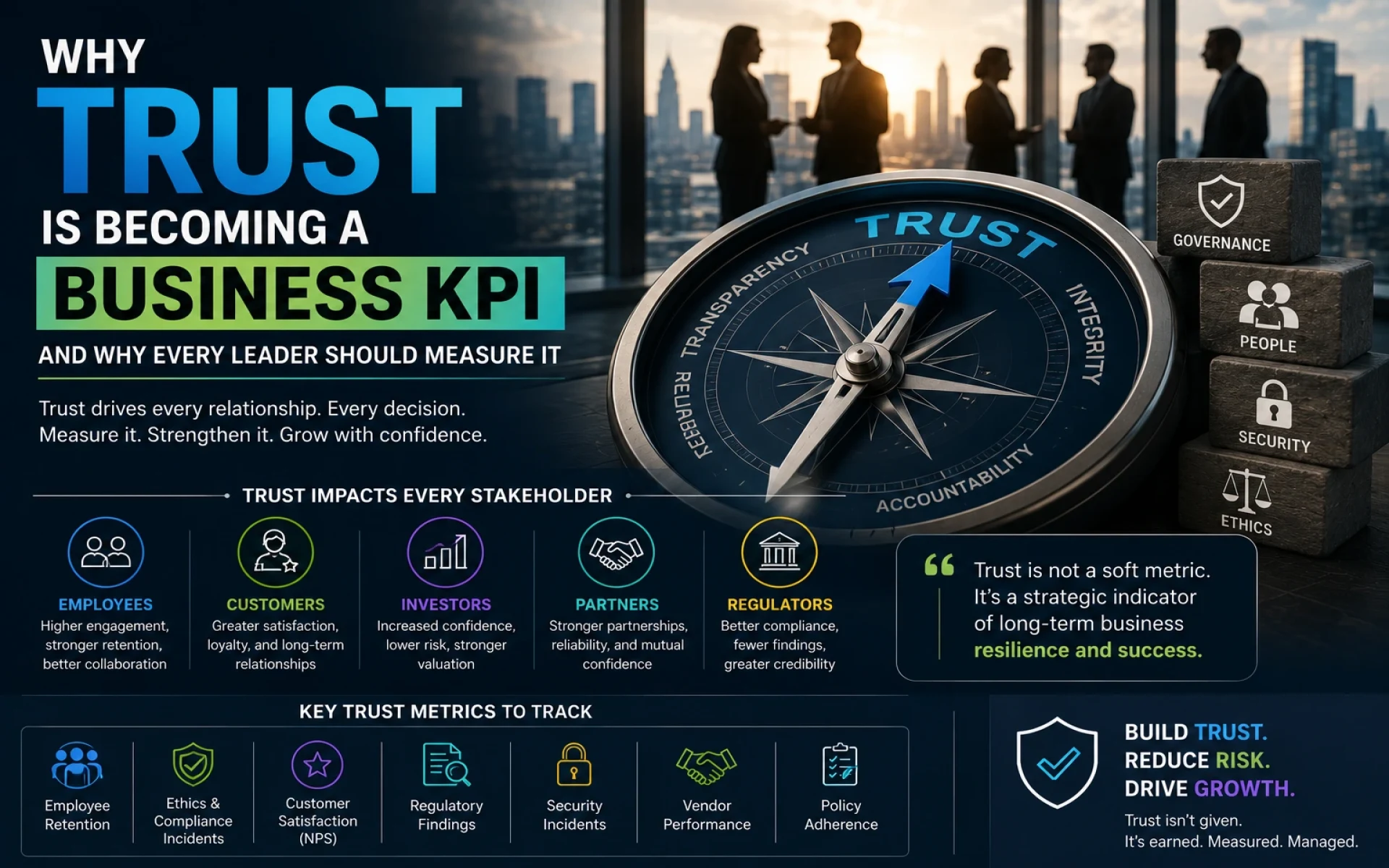
Trust Influences Every Stakeholder
Modern organizations operate within interconnected ecosystems.
Customers evaluate whether businesses handle information responsibly.
Employees assess whether leadership demonstrates integrity.
Investors consider governance practices before making financial commitments.
Business partners evaluate operational reliability.
Regulators examine compliance maturity.
Communities observe corporate responsibility.
Although each stakeholder group views trust differently, all of them contribute to organizational success.
Strong trust creates alignment across these relationships.
Can Trust Really Be Measured?
One of the biggest misconceptions is that trust cannot be quantified.
While trust itself is a human perception, the behaviours that strengthen or weaken trust can be measured.
Organizations often monitor indicators such as:
-
Employee retention trends
-
Ethics hotline activity
-
Compliance violations
-
Background verification completion
-
Customer satisfaction
-
Vendor performance
-
Regulatory findings
-
Information security incidents
-
Internal audit observations
-
Policy adherence
Individually, these metrics provide operational insight.
Collectively, they offer a meaningful picture of organizational trust.
The Relationship Between Trust and Governance
Strong governance creates predictable behaviour.
Predictable behaviour creates confidence.
Confidence builds trust.
Organizations with mature governance frameworks establish clear expectations, transparent accountability, consistent decision-making, and effective oversight.
Rather than relying solely on individual judgement, they create systems that encourage trustworthy behaviour across the business.
Governance therefore becomes one of the strongest foundations for sustainable trust.
Trust Begins With People
Technology can strengthen processes.
Policies can establish standards.
Audits can identify gaps.
Ultimately, however, organizations earn trust through people.
Employees interact with customers.
Managers shape workplace culture.
Executives define organizational priorities.
Board members influence governance.
Every individual contributes to the organization's reputation through daily decisions.
This is why workforce integrity, responsible hiring, and ethical leadership remain essential components of business trust.
Why Trust Will Become a Boardroom Discussion
Historically, boards focused primarily on financial performance and regulatory compliance.
Increasingly, trust is becoming part of strategic oversight.
Investors expect stronger governance.
Customers demand greater transparency.
Regulators require improved accountability.
Employees seek organizations whose values align with their own.
These expectations are transforming trust from a cultural aspiration into a measurable business objective.
Organizations that proactively manage trust will likely be better positioned to adapt to changing stakeholder expectations.
Building Trust as a Strategic Capability
Organizations strengthen trust by embedding it into everyday decision-making rather than treating it as a communications initiative.
This includes:
-
Hiring responsibly
-
Verifying information appropriately
-
Investing in ethical leadership
-
Maintaining transparent governance
-
Protecting sensitive information
-
Monitoring compliance consistently
-
Evaluating third-party relationships carefully
-
Encouraging accountability across every level
When these practices become part of organizational culture, trust evolves from an abstract concept into a sustainable competitive advantage.
CaseXpert Perspective
Business leaders often describe trust as something that is earned over time. While this is true, trust is also actively managed through the decisions organizations make every day.
Hiring practices, governance standards, compliance frameworks, and due diligence processes all contribute to stakeholder confidence. Organizations that intentionally measure and strengthen these foundations are better equipped to reduce risk, protect their reputation, and build lasting relationships.
In the coming years, trust will no longer be viewed simply as a corporate value—it will increasingly become a business performance indicator.
Final Thought
Organizations measure what they believe matters.
For decades, businesses focused primarily on financial, operational, and customer metrics. Those indicators remain important, but they tell only part of the story.
Trust influences every relationship that supports long-term success—from employees and customers to investors, regulators, and business partners.
The organizations that treat trust as a measurable strategic capability today will be the ones best prepared to earn confidence, navigate uncertainty, and achieve sustainable growth tomorrow.
Trust is no longer just a corporate value — it is becoming a measurable part of how organizations manage people, risk, governance, and reputation.
Make Trust a Measurable Part of Your Business. CaseXpert helps organizations strengthen verification, workforce integrity, and risk management. Talk to our verification specialists or send an enquiry to get started.