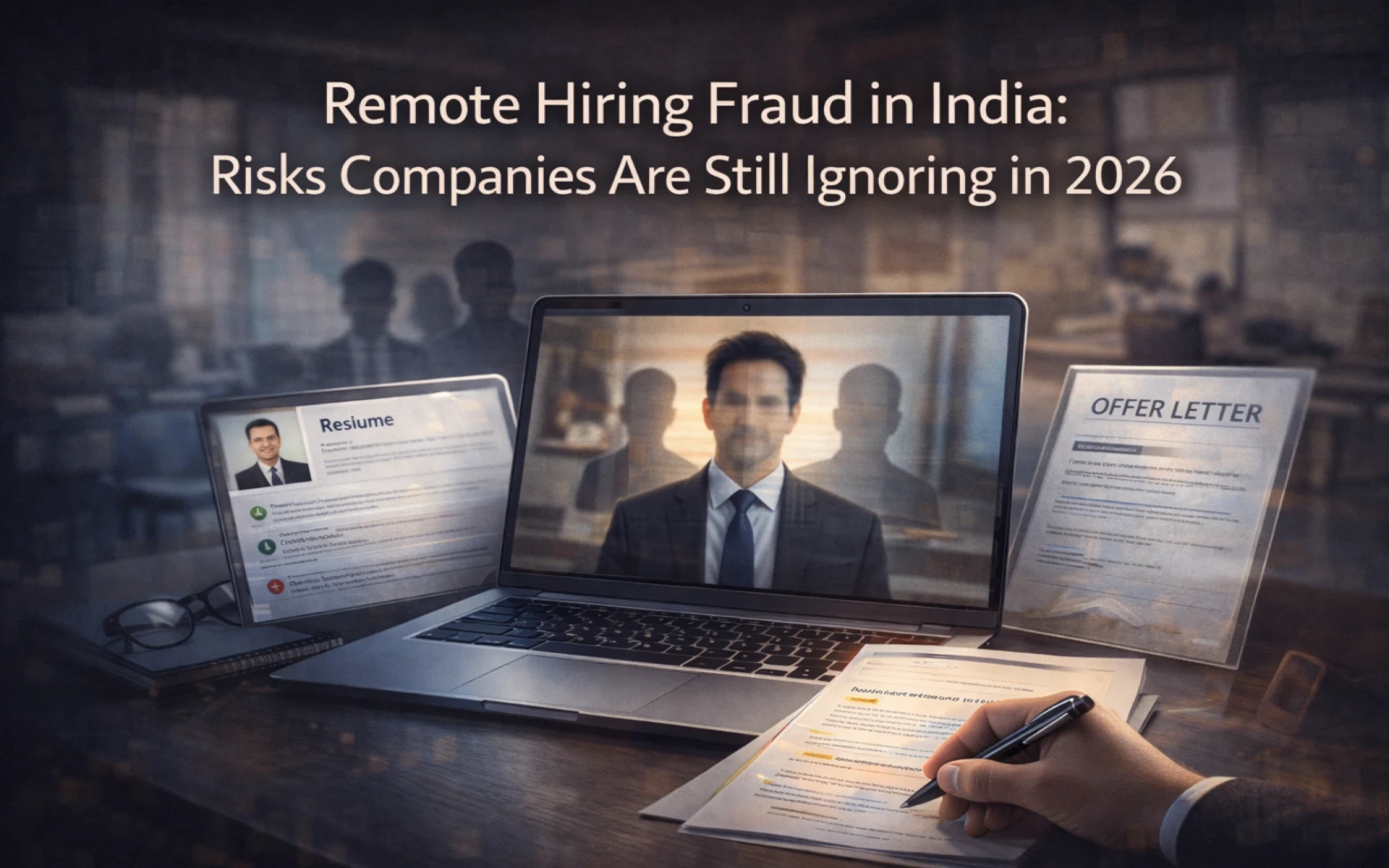
Remote and hybrid hiring have become an established part of the Indian employment landscape. Alongside the benefits of a distributed workforce, however, remote recruitment creates verification challenges that are easier to overlook when the entire hiring journey happens online.
When sourcing, interviews, document submission, and onboarding take place through digital channels, some of the informal safeguards associated with in-person hiring disappear. Identity may be established through a video call rather than physical interaction, documents may be submitted as digital copies, and the person interviewed may never meet the organisation face-to-face.
That does not make remote hiring inherently unsafe. It means organisations need to replace the assurance once provided by physical presence with deliberate, independent verification.
Remote hiring fraud can take several forms, including identity misrepresentation, interview impersonation, forged documents, fabricated employment histories, and cases where the person hired is not the person ultimately performing the work.
This guide examines the key risks associated with remote hiring in India and the verification controls companies can use to address them in 2026.
Why Remote Hiring Changes the Fraud Landscape
Traditional hiring often included informal verification points that were easy to take for granted.
Candidates appeared in person, presented physical documents, interacted with multiple employees, and completed onboarding in the same environment where they would eventually work.
Remote hiring removes many of these physical touchpoints.
Instead:
- Identity may be established digitally.
- Documents may be submitted as scans or photographs.
- Interviews happen through video platforms.
- Onboarding can take place without an in-person meeting.
- Employment may continue for months without physical interaction.
None of these practices is inherently problematic. The risk arises when organisations assume that digital convenience provides the same level of verification as independent identity and credential checks.
Remote hiring therefore requires a more deliberate approach to confirming that the person, credentials, employment history and other information presented during recruitment are genuine.
Interview Impersonation and Identity Misrepresentation
One of the most significant risks in remote recruitment is uncertainty around identity.
If an interview happens entirely online, organisations need to establish that the person participating in the recruitment process is actually the candidate whose credentials are being evaluated.
Potential scenarios can include:
- Another person participating in an interview on the candidate's behalf
- Someone assisting a candidate during an assessment
- Identity information being misrepresented during onboarding
- Account or credential sharing after joining
Technology can make identity manipulation more difficult to detect, particularly when recruitment relies heavily on a single video interaction.
The practical response is not to assume every remote candidate is suspicious. It is to build identity confirmation into the recruitment and onboarding process rather than treating a video call itself as proof of identity.
Digital Document Fraud
Remote recruitment also changes how documents are reviewed.
Instead of seeing an original certificate, employment letter or identity document in person, recruiters may receive a digital copy uploaded through an HR portal or sent by email.
This creates opportunities for documents to be:
- Altered
- Edited
- Misrepresented
- Taken out of context
- Presented without sufficient supporting evidence
Examples could include modified employment dates, altered job titles, fabricated experience letters or credentials that cannot be independently confirmed.
A document supplied by the candidate should therefore be treated as supporting information rather than independent proof.
Where practical, important credentials should be validated against the issuing organisation or another appropriate authoritative source.
Fake Employment and Qualification Claims
Remote recruitment can also make fabricated career histories harder to identify when organisations rely heavily on resumes and candidate-submitted documents.
Potential misrepresentations include:
- Employment at an organisation the candidate never worked for
- Inflated job titles
- Extended employment dates
- Exaggerated responsibilities
- Fabricated qualifications
- Unverified professional certifications
A polished resume can make these claims appear credible, particularly when hiring teams are under pressure to move quickly.
Independent employment and education verification closes this gap by testing candidate claims against external sources rather than relying entirely on information supplied by the candidate.
The Proxy-Worker Problem
Another risk associated with remote work is the possibility that the person hired is not the person consistently performing the job.
In some cases, an individual may attempt to have another person perform work on their behalf. Other situations may involve undisclosed simultaneous employment or arrangements that conflict with contractual or company requirements.
These situations can create several problems:
- Reduced accountability
- Confidentiality and data-security concerns
- Intellectual-property risks
- Quality and productivity issues
- Access-control problems
- Potential contractual violations
This is different from a conventional background-check problem. A company may have correctly verified the candidate's identity and qualifications but still face a post-hire identity or workforce-integrity issue.
That means organisations should think beyond pre-employment screening and consider appropriate controls throughout the employment lifecycle, particularly for sensitive remote roles.
Why Some Companies Still Underestimate the Risk
Several factors can make remote hiring risks easy to overlook.
Speed of Hiring
Recruitment teams are often measured on time-to-hire. Additional verification steps can be perceived as friction, particularly when candidates are competing for offers.
Overconfidence in Interviews
A strong video interview can create a sense that the candidate has been thoroughly assessed.
But an interview primarily evaluates how a candidate communicates and responds in that setting. It does not independently prove that their employment history or qualifications are accurate.
Overreliance on Candidate-Supplied Documents
A resume, certificate or experience letter can provide useful information, but the candidate remains the source of that information.
Independent verification is what turns a claim into evidence.
Assumption That BGV Automatically Solves Everything
Background verification is important, but it has defined boundaries.
A standard BGV process may confirm identity, employment, education, address or other selected checks. It does not necessarily detect every form of remote-work misconduct or guarantee that the verified person will always be the person performing the work.
Companies should therefore align verification with the specific risks of the role.
How Background Verification Should Adapt to Remote Hiring
The principle remains straightforward:
Do not rely solely on what the candidate provides. Confirm important claims through appropriate independent sources.
For remote hiring, this can include:
1. Identity Verification
Use appropriate identity-verification methods to establish that the candidate is the person whose records are being checked.
2. Employment Verification
Confirm employment history with former employers or appropriate authoritative records rather than relying exclusively on candidate-provided experience letters.
3. Education Verification
Validate important degrees, qualifications and certifications with the relevant institutions or authorised sources where feasible.
4. Address Verification
Where relevant to the role, verify the candidate's declared address through an appropriate process.
5. Role-Specific Checks
Sensitive roles may require additional verification based on the responsibilities involved, such as financial, regulatory, leadership or access-related checks.
6. Identity Continuity
Organisations should also consider how identity is maintained between recruitment, onboarding and access provisioning.
The objective is to ensure that the identity established during recruitment remains connected to the person who receives company credentials and access.
Remote Hiring Should Be Risk-Based, Not Suspicion-Based
Not every remote role carries the same level of exposure.
A practical approach is to assess verification requirements according to factors such as:
- Access to sensitive information
- Financial authority
- Access to customer data
- Regulatory responsibilities
- Privileged technology access
- Seniority and decision-making authority
- Access to physical or digital assets
This allows organisations to apply proportionate controls instead of creating unnecessary friction for every candidate.
A junior role with limited access may require a different verification package from a senior employee responsible for financial systems, confidential information or critical infrastructure.
Communicate Verification Clearly to Candidates
Strong verification does not require an adversarial candidate experience.
Candidates should understand:
- What will be checked
- Why the checks are relevant
- What information they need to provide
- How the information will be handled
- How long the process may take
- What happens if a discrepancy is identified
Clear communication can reduce anxiety while making verification feel like a standard part of responsible hiring rather than a personal investigation.
Do Not Wait Until a Problem Appears
One of the most common weaknesses in remote hiring is treating verification as an administrative step that happens after the hiring decision has effectively been made.
A better approach is to define the verification process before recruitment begins.
The organisation should establish:
- Which roles require verification
- Which checks apply to each role
- When verification begins
- What happens when information cannot be verified
- How discrepancies are reviewed
- Who makes the final decision
- How verification records are secured and retained
This turns verification from an emergency response into a repeatable control.
Remote Hiring and Data Protection
Remote verification also creates an important data-management responsibility.
BGV processes can involve identity information, employment records, educational details, addresses and other personal information. Organisations should therefore ensure that candidate information is collected, accessed, shared, stored and retained in accordance with applicable privacy and data-protection requirements.
Practical safeguards include:
- Limiting access to authorised personnel
- Using secure verification and HR systems
- Avoiding unnecessary sharing of reports
- Defining retention periods
- Protecting documents during transmission and storage
- Maintaining appropriate records of consent and verification activity
Remote hiring should make verification more deliberate — not make personal data handling less disciplined.
Building a Safer Remote Hiring Framework
A practical remote hiring framework can be built around five stages:
Identity → Claims → Sources → Continuity → Monitoring
Identity
Confirm that the candidate is who they claim to be.
Claims
Identify the information that needs to be verified, including employment, education and qualifications.
Sources
Confirm important claims using appropriate independent sources.
Continuity
Ensure that the verified identity is connected to onboarding and access provisioning.
Monitoring
For appropriate roles, consider whether certain risks require controls beyond pre-employment verification.
This approach recognises that safe remote hiring is not about one background check. It is about maintaining confidence in the person's identity and the information on which the hiring decision was based.
Key Takeaways
- Remote hiring removes some of the informal verification safeguards associated with physical recruitment.
- Identity misrepresentation, interview impersonation and document fraud can create additional recruitment risks.
- Candidate-supplied resumes and documents should not be treated as independent proof.
- Employment, education and identity claims should be verified through appropriate independent sources.
- Remote-work risks can continue after hiring, so organisations should consider identity continuity and role-specific controls.
- Verification requirements should be proportionate to the risk and responsibilities of the role.
- Candidates should receive clear information about the verification process and how their data will be handled.
- Strong remote hiring depends on deliberate verification rather than assumptions created by a smooth digital process.
Conclusion
Remote hiring is not inherently risky. The real risk comes from carrying an old hiring model into a digital environment without adapting the controls around it.
When recruitment happens entirely online, organisations lose some of the informal safeguards that physical interaction once provided. Identity, documents, employment history and qualifications therefore need to be confirmed deliberately rather than assumed.
The solution is not to abandon remote hiring or introduce unnecessary friction into every recruitment process. It is to build proportionate, independent verification into the hiring workflow and extend appropriate controls into onboarding and employment where the role warrants them.
In 2026, the organisations best positioned to hire remotely with confidence will be those that understand an important distinction: digital hiring can make recruitment faster, but only verification can establish whether the information behind the candidate is trustworthy.
Remote hiring removed some of the checks that physical hiring provided naturally. Smart verification replaces those checks deliberately — without giving up the benefits of a remote workforce.
Hire remotely without the fraud risk. CaseXpert replaces the assurances remote hiring removed - with identity, employment and document verification confirmed against independent sources, so the person you hire is the person who shows up. Talk to our verification specialists or send an enquiry to get started.