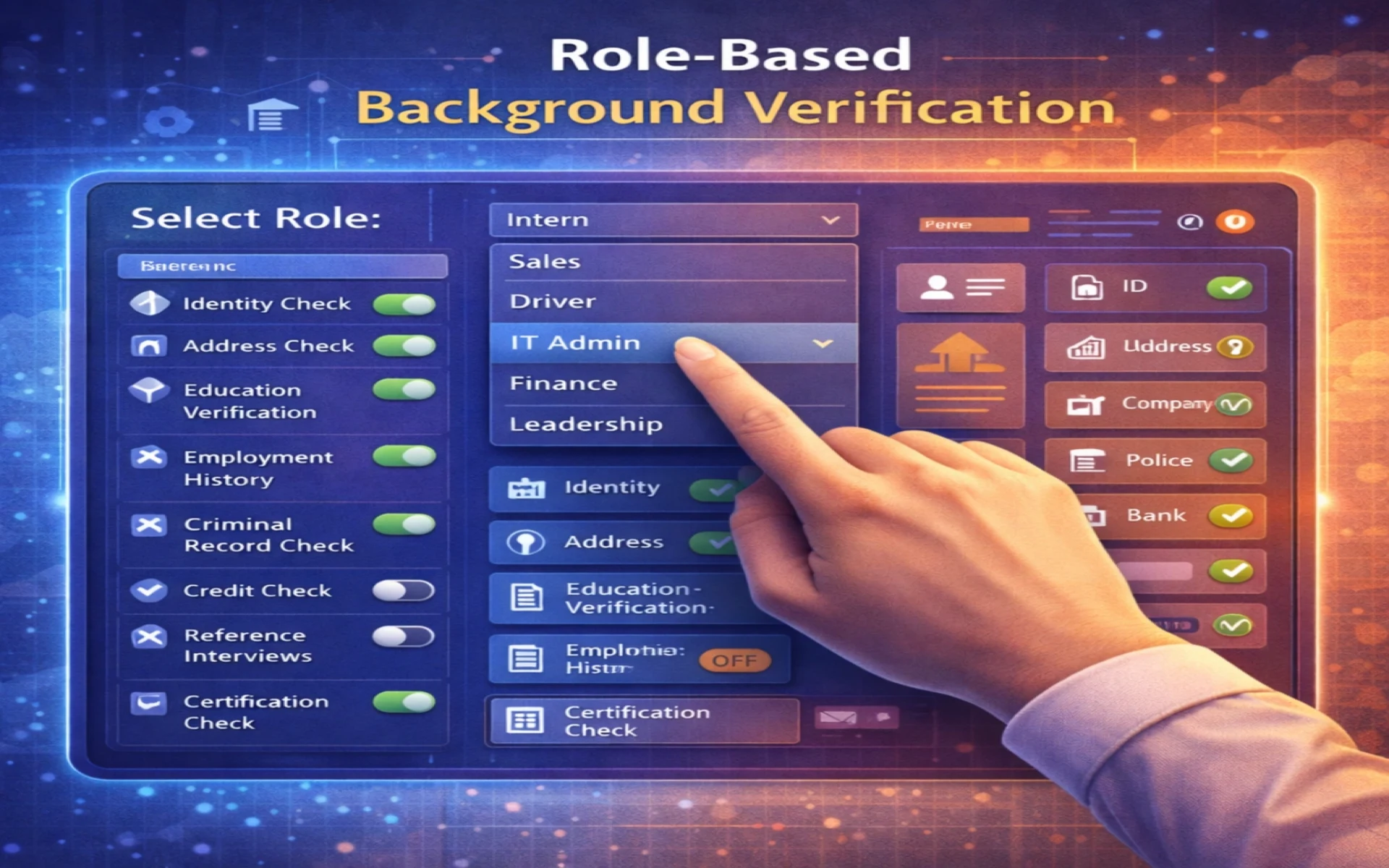
Not every role carries the same level of risk, so it may not be appropriate to verify every candidate in exactly the same way. A data-entry employee and a chief financial officer can have very different levels of access, authority, and responsibility. A one-size-fits-all verification process may result in unnecessary checks for some roles while providing insufficient coverage for others.
Role-based background verification addresses this by matching the scope and depth of checks to the responsibilities and risk factors associated with a position.
This article explains how to design role-based verification, how to group roles according to relevant risk factors, which checks may be appropriate for different categories, and why a proportionate approach can improve efficiency and consistency.
Why One-Size-Fits-All Can Be Inefficient
A uniform verification standard may appear straightforward, but it does not always reflect the different responsibilities associated with individual roles.
Applying extensive checks to every position can increase costs and processing time without adding meaningful value for lower-risk roles. On the other hand, applying only basic checks across the organisation may not address the specific risks associated with positions involving sensitive data, financial authority, systems access, or vulnerable individuals.
Role-based verification provides a more targeted approach. By aligning verification requirements with role responsibilities and relevant risk factors, organisations can focus their resources where additional scrutiny is genuinely appropriate.
How to Tier Roles by Risk
The foundation of role-based verification is a clearly documented framework for assessing roles. Organisations can consider factors such as:
- Access to financial information or assets
- Access to confidential or personal data
- Privileged access to technology systems
- Contact with customers or vulnerable individuals
- Authority to make significant financial or operational decisions
- Physical access to sensitive premises or infrastructure
- Regulatory or contractual requirements associated with the position
A possible framework could include:
- Tier 1 — Higher-risk roles: positions involving significant financial authority, privileged system access, sensitive data, or senior decision-making
- Tier 2 — Moderate-risk roles: customer-facing, operational, or other positions with meaningful organisational or customer access
- Tier 3 — Lower-risk roles: positions with limited access, authority, or exposure
- Special categories: roles subject to specific regulatory, contractual, licensing, or safeguarding requirements
Risk tiering should not be based on job title or seniority alone. For example, a mid-level technology employee with privileged access to production systems may require more extensive verification than a senior employee whose role has limited access to sensitive resources.
Matching Checks to Each Tier
Once roles have been categorised, organisations can establish an appropriate verification package for each category.
For example, a lower-risk role may require basic identity, address, and employment verification. A role with greater responsibility may require additional education, employment, credential, or other relevant checks. Higher-risk roles may warrant additional verification based on the specific responsibilities and applicable requirements.
The exact package should depend on the organisation, industry, role, and applicable legal or contractual requirements.
A layered approach helps organisations avoid both unnecessary screening and insufficient verification. The objective is to ensure that each candidate receives checks that are relevant to the position they are being considered for.
Special Requirements for Sensitive Roles
Certain positions may require additional consideration because of their responsibilities or the environment in which they operate.
Examples can include roles involving:
- Vulnerable individuals or safeguarding responsibilities
- Significant financial authority
- Sensitive customer or personal information
- Critical technology or infrastructure
- Regulated professional functions
- Specific client or contractual requirements
Some industries or client relationships may impose additional verification requirements. Organisations should identify these requirements before designing the screening package rather than relying solely on a general risk tier.
This helps prevent situations where a role with specific obligations is treated in exactly the same way as an ordinary position.
Benefits of the Role-Based Approach
Role-based verification can provide several operational benefits:
- Better allocation of verification resources by focusing additional checks where they are relevant.
- Reduced unnecessary screening for roles that do not require extensive verification.
- Greater consistency through documented criteria for determining verification requirements.
- Improved transparency because organisations can explain why particular checks apply to a role.
- Easier process management as verification requirements can be mapped to predefined role categories.
The approach also supports proportionality by connecting the level of scrutiny to the responsibilities and access associated with the position rather than to assumptions about individual candidates.
Implementing It in Practice
Putting role-based verification into practice starts with mapping positions against defined risk factors and establishing a verification package for each category.
A practical implementation process can include:
- Identify the responsibilities and access associated with each role.
- Define relevant risk factors and special requirements.
- Group comparable positions into appropriate categories.
- Create a verification package for each category.
- Document the policy and approval process.
- Apply the framework consistently.
- Review the framework periodically as roles, systems, and business requirements change.
A professional BGV provider can support organisations in implementing these workflows and managing different verification packages at scale.
The framework should not remain static. New systems, expanded responsibilities, regulatory changes, or changes in client requirements may alter the risk associated with a position. Periodic review helps ensure that verification requirements continue to reflect the organisation's actual needs.
Avoiding Common Pitfalls in Role Tiering
Role-based verification can become ineffective if roles are categorised using job titles alone. A junior employee with privileged access to production data, for example, may carry significant risk despite having a relatively junior title.
Another common issue is allowing the framework to become outdated. As responsibilities change, employees gain access to new systems, or business operations expand, an old risk classification may no longer accurately reflect the role.
The solution is to anchor tiering in measurable factors such as access, authority, data sensitivity, financial responsibility, customer exposure, and regulatory requirements.
Organisations should also avoid using role-based verification as a reason to collect unnecessary personal information. Checks should remain relevant and proportionate to the purpose for which they are being conducted.
Key Takeaways
Here are the essential points to carry forward from this guide:
- A uniform verification standard may not be appropriate for every role.
- Roles should be assessed based on access, authority, responsibilities, and relevant risk factors—not seniority alone.
- Verification packages should be matched to the requirements of each role category.
- Sensitive or regulated roles may require additional checks based on applicable requirements.
- Role-based verification can improve efficiency, consistency, and proportionality.
- Verification policies should be documented and reviewed as roles and business requirements evolve.
Conclusion
Role-based background verification provides an alternative to treating every candidate and position identically. By matching verification requirements to the responsibilities, access, and relevant risks of each role, organisations can create a more targeted and manageable BGV process.
The principle is straightforward: different roles can create different verification requirements. A position with access to sensitive financial information or critical systems may warrant greater scrutiny than a role with limited organisational access.
A documented role-based framework helps organisations explain which checks apply to different positions and provides HR teams with a repeatable process for managing verification.
As organisations grow and roles evolve, reviewing these categories regularly ensures that BGV requirements continue to reflect actual business responsibilities rather than outdated job descriptions.
Risk is not spread evenly across your roles, so your verification shouldn't be either. Match the depth of the check to the weight of the role.
Right-size every check. CaseXpert helps you tier roles and tailor checks so every position gets exactly the scrutiny it warrants - no more, no less. Talk to our verification specialists or send an enquiry to get started.