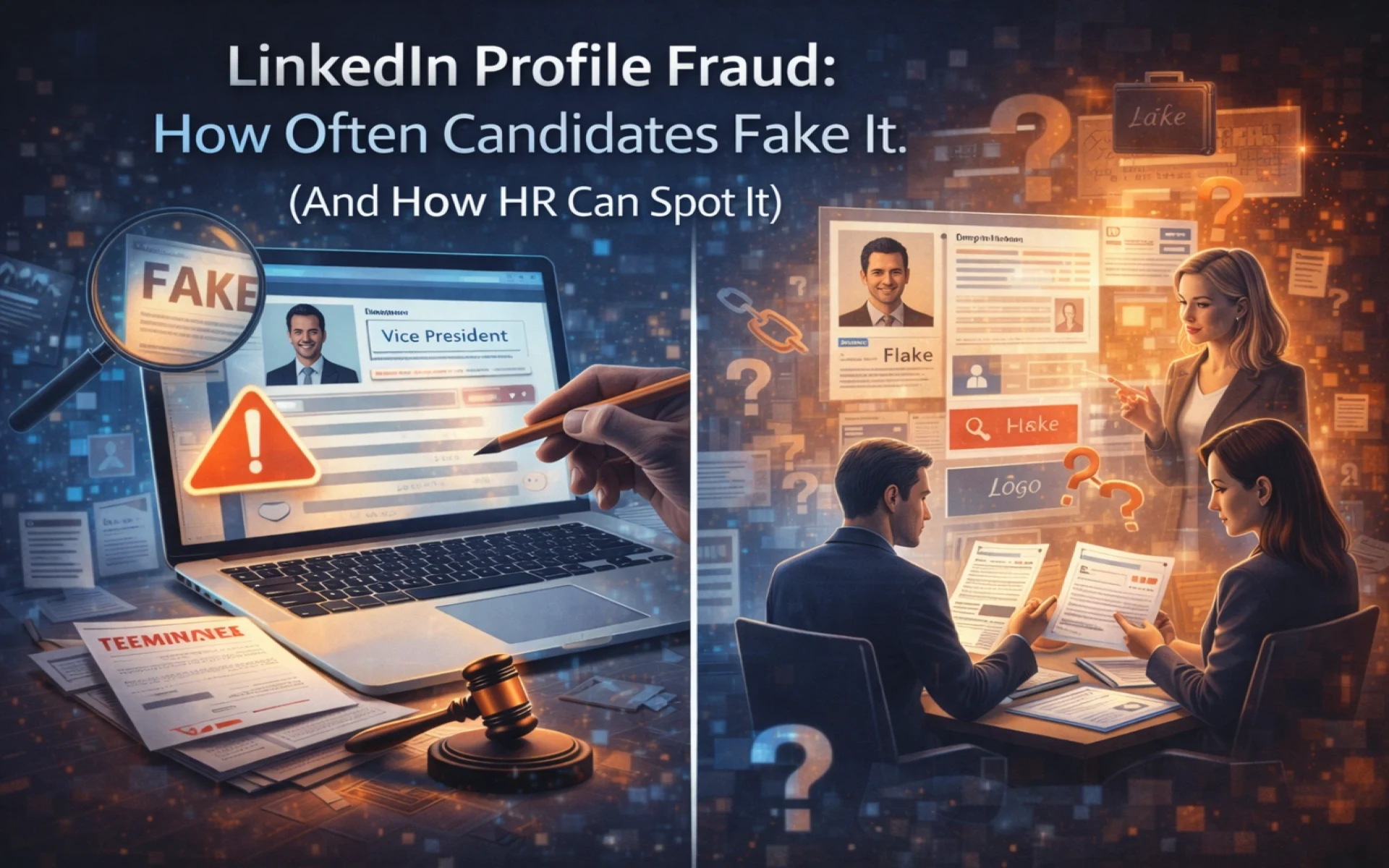
For many recruiters, a candidate's LinkedIn profile is one of the first places they look when assessing professional experience. It appears credible by design: job titles, company names, employment dates, skills, recommendations, endorsements and professional connections all create the impression of an established career record.
But there is an important distinction HR teams need to remember: a professional-looking LinkedIn profile is not the same thing as a verified professional history.
LinkedIn profiles are largely self-reported. Candidates control the information they add about their roles, employers, dates, responsibilities and achievements. While LinkedIn can be extremely useful for sourcing and understanding a candidate's professional background, it should not be treated as independent proof of employment or credentials.
This guide explains the common ways candidates may exaggerate or fabricate LinkedIn profiles, why recruiters can miss these inconsistencies, and how HR teams can use LinkedIn intelligently while relying on independent background verification for facts that matter.
Why LinkedIn Feels Trustworthy but Isn't Verification
LinkedIn's design naturally creates an impression of credibility. A profile can show years of experience, recognised companies, hundreds of connections and recommendations from other professionals.
Those signals can be useful, but they do not independently establish that the information is accurate.
A recommendation does not necessarily confirm that a candidate held the stated position. A connection does not prove an employment relationship. An endorsement does not establish expertise. Even a detailed employment history remains a claim unless it has been independently verified.
This distinction matters because fraudulent profiles do not always look suspicious. In fact, the most difficult inaccuracies to identify are often the ones that look completely plausible.
How Candidate Profiles Can Be Embellished
There is no single reliable figure that captures how frequently candidates falsify LinkedIn profiles across all industries and markets. The nature and seriousness of inaccuracies vary considerably.
Some changes may be relatively minor exaggerations. Others can materially misrepresent a candidate's experience.
Common examples include:
- Title inflation: Presenting a junior or mid-level position as a more senior role.
- Date stretching: Extending employment dates to reduce visible career gaps.
- Phantom employment: Claiming to have worked for an organisation without actually holding the stated position.
- Responsibility inflation: Describing team-level responsibilities as individual achievements.
- Achievement inflation: Presenting company or team results as personal accomplishments.
- Credential embellishment: Presenting incomplete education or certifications as fully completed.
- Selective omission: Leaving out employment periods, roles or circumstances that may raise questions.
The important point for HR is that profile fraud does not have to involve an entirely fabricated career. Small inaccuracies can also affect hiring decisions when they change how a candidate's experience is perceived.
The Most Common Warning Signs HR Should Look For
A LinkedIn profile should not be treated as suspicious simply because it contains an unusual career path. People change industries, take career breaks, work on contracts and move between different types of organisations for many legitimate reasons.
Instead, recruiters should look for inconsistencies that can be objectively checked.
1. LinkedIn and Resume Dates Don't Match
Compare employment dates across the candidate's resume and LinkedIn profile.
Differences may have innocent explanations, but unexplained gaps or overlapping full-time employment periods deserve clarification.
2. Job Titles Change Significantly Across Sources
A candidate may describe themselves as a "Senior Manager" on LinkedIn while their official employment record shows a substantially different designation.
The difference does not automatically indicate fraud, because organisations use different internal and external titles. However, material differences should be clarified rather than assumed.
3. Responsibilities Seem Disproportionate to the Role
A candidate may claim responsibility for very large teams, budgets, projects or business outcomes that appear inconsistent with their stated position.
This is a useful area for interview questions and reference verification.
4. Employment History Contains Unexplained Gaps
Career gaps are not inherently problematic. However, if dates appear deliberately adjusted across different sources to conceal a gap, HR should seek clarification.
5. Education or Certifications Are Difficult to Reconcile
A profile may list a qualification, institution or certification that cannot be matched with the candidate's documents or official records.
For roles where credentials are material to eligibility, these claims should be independently verified.
6. The Profile and Interview Story Contradict Each Other
A candidate may describe one level of responsibility during an interview while their profile suggests something substantially different.
One inconsistency does not prove dishonesty, but repeated contradictions warrant closer examination.
Why Recruiters Can Be Fooled
Recruiters are often working under significant time pressure. When a candidate's resume and LinkedIn profile tell the same story, it can feel as though two independent sources have confirmed the information.
They haven't.
Both may have been created or updated by the same candidate.
This creates an important distinction:
Consistency is not corroboration.
A resume matching a LinkedIn profile tells you that the candidate has presented the same story in two places. It does not independently establish that the story is accurate.
Independent confirmation comes from sources such as:
- Previous employers
- Educational institutions
- Government or authorised records, where applicable
- Professional licensing bodies
- Other authoritative sources relevant to the specific check
That is where background verification becomes important.
What LinkedIn Cannot Tell HR
Even a completely genuine LinkedIn profile is not designed to provide everything an employer may need to know during hiring.
For example, a profile generally cannot independently establish:
- Whether the candidate actually worked for a stated employer
- Their official employment dates
- Their official designation
- Whether a qualification was actually awarded
- Whether documents submitted during hiring are genuine
- Whether important information has been omitted
- Whether the candidate's stated experience matches official records
LinkedIn is therefore better understood as a professional information and sourcing platform, rather than a background verification database.
LinkedIn vs. Background Verification
The two serve different purposes.
| Background Verification | |
|---|---|
| Candidate-controlled professional profile | Independent verification process |
| Useful for sourcing and research | Used to validate specific claims |
| Provides career context | Checks information against relevant sources |
| Can highlight inconsistencies | Investigates and resolves discrepancies |
| Not a substitute for verification | Designed to establish whether key claims can be confirmed |
The right approach is not to stop using LinkedIn. It is to use it for what it does well while recognising its limitations.
How HR Can Use LinkedIn as an Early Screening Tool
LinkedIn can still provide valuable signals during recruitment.
Recruiters can compare the profile with the resume, look for unexplained inconsistencies, understand the candidate's career progression and identify areas that need clarification during interviews.
For example, if a candidate's resume says they worked at a company from 2021 to 2024 but their LinkedIn profile shows 2020 to 2024, the discrepancy does not establish fraud. It simply creates a question:
Which date is correct, and why are the records different?
That is the right role for LinkedIn: raising questions rather than providing final answers.
How Background Verification Closes the Gap
Once a candidate reaches the appropriate stage of hiring, important claims can be verified through independent sources.
Employment verification can confirm relevant details such as employment history and dates. Education verification can establish whether a stated qualification was awarded. Identity verification can validate identity information against appropriate documentation or sources.
The exact checks should depend on the role, organisation, applicable requirements and candidate consent.
This changes the hiring question from:
"Does this profile look credible?"
to:
"Can the important claims on this profile be independently confirmed?"
That is a much stronger standard for hiring decisions.
What HR Should Do When an Inconsistency Appears
An inconsistency should not immediately be treated as proof of fraud.
A better process is:
- Identify the discrepancy.
- Compare the information across available sources.
- Ask the candidate for clarification where appropriate.
- Determine whether there is a legitimate explanation.
- Verify material claims through appropriate independent sources.
- Document the finding and its resolution.
- Apply the organisation's verification and hiring policy consistently.
This approach reduces the risk of rejecting candidates because of harmless administrative differences while still allowing HR to identify genuine misrepresentation.
Don't Confuse a Career Gap With Fraud
One important distinction deserves emphasis: an incomplete LinkedIn profile is not necessarily a fraudulent one.
Candidates may leave out short-term employment, career breaks, freelance work or personal periods for many legitimate reasons.
Similarly, different job titles may reflect internal designations versus market-facing titles.
The purpose of verification is not to punish candidates for having imperfect career histories. It is to establish whether information that is material to the hiring decision can be supported.
That distinction helps HR maintain both accuracy and fairness.
How CaseXpert Helps HR Verify Candidate Claims
LinkedIn can help recruiters discover candidates and identify potential inconsistencies. But when an organisation needs confidence in employment, education, identity and other relevant claims, independent background verification provides a stronger foundation.
CaseXpert helps organisations structure this process through background verification workflows designed to validate candidate information and surface discrepancies that require attention.
The objective is not to make recruiters distrust every LinkedIn profile.
It is to help them know what should be trusted, what should be questioned, and what should be independently verified.
Key Takeaways
- LinkedIn is a valuable professional and sourcing platform, but a profile should not be treated as independent verification.
- Candidate inaccuracies can range from minor title or date differences to material misrepresentation.
- Common warning signs include inconsistent dates, inflated titles, unexplained career discrepancies and unsupported credentials.
- A matching resume and LinkedIn profile are not two independent sources of evidence.
- HR should investigate inconsistencies rather than automatically treating them as fraud.
- Material employment, education and credential claims should be verified through appropriate independent sources.
- LinkedIn is most useful as a starting point for questions; background verification provides the evidence needed to answer them.
Conclusion
LinkedIn has changed the way recruiters discover and evaluate talent, but visibility should not be confused with verification.
A polished profile can provide useful context about a candidate's career, skills and professional interests. It can also reveal inconsistencies worth exploring. But the information remains largely self-reported, which means it should not become the final evidence behind an important hiring decision.
The strongest approach is simple: use LinkedIn to understand the candidate, use interviews to explore their experience, and use independent verification to validate the claims that matter.
That approach does not assume every candidate is dishonest. It simply recognises that good hiring decisions should be based on evidence rather than appearance.
A LinkedIn profile can tell you what a candidate says about their career. Independent verification helps establish what can actually be confirmed.
Verify the career, not just the profile. CaseXpert verifies employment, titles, durations and credentials against independent, authoritative sources - so your hiring decisions rest on confirmed facts, not a candidate's self-written page. Talk to our verification specialists or send an enquiry to get started.