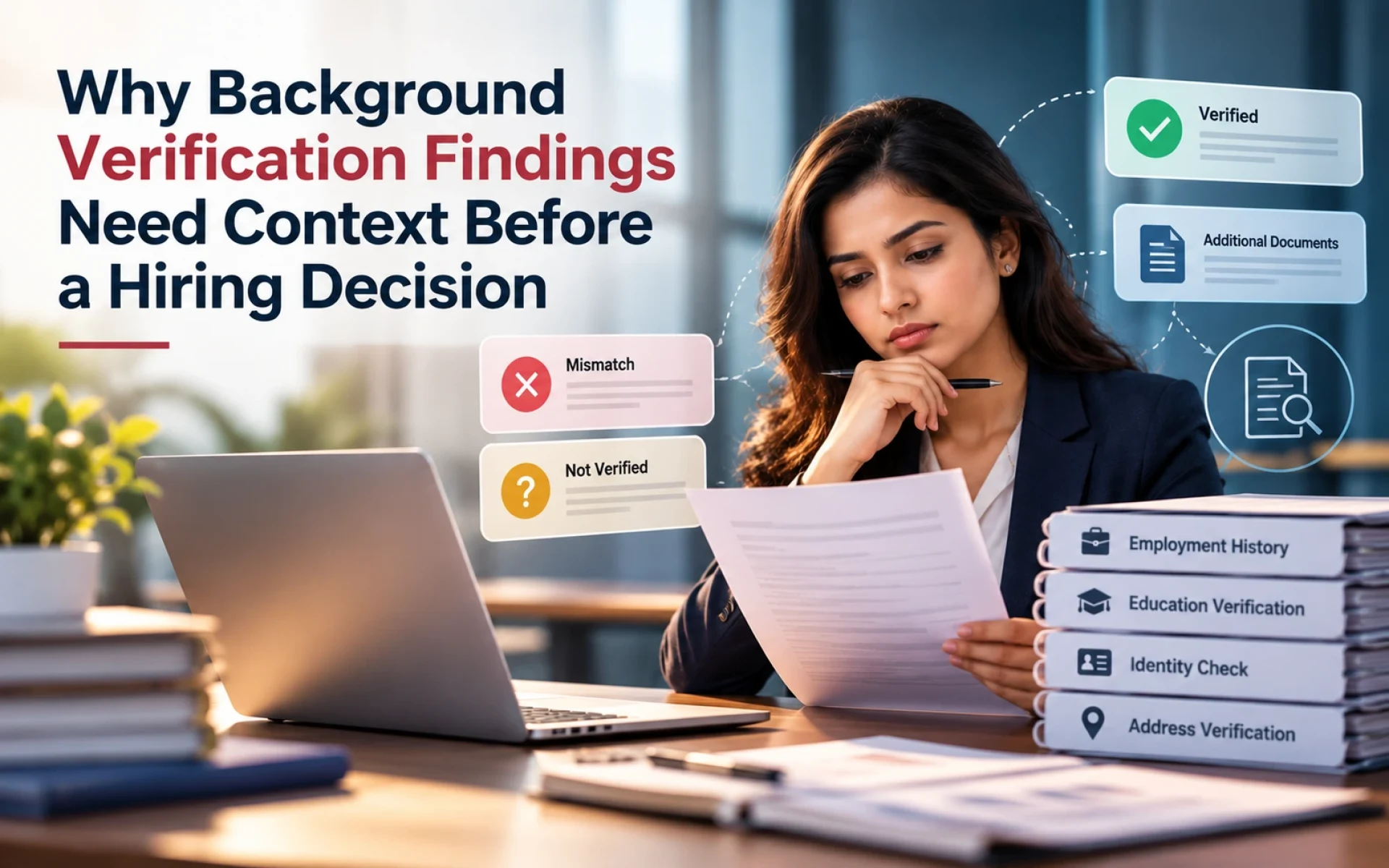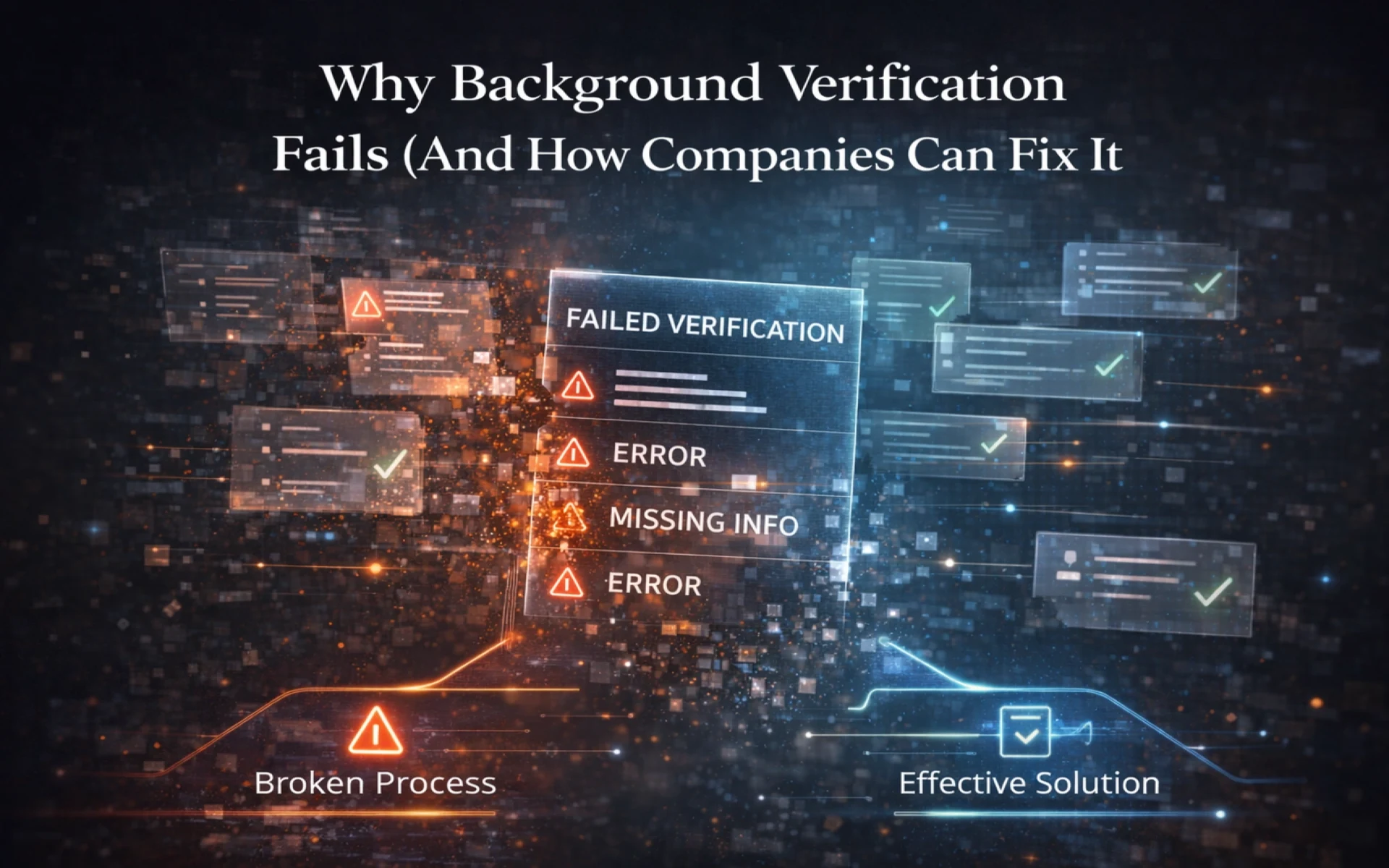
Background verification is designed to help organisations identify discrepancies in credentials, employment history, identity, and other relevant information before or during employment. Yet simply running a background check does not guarantee that every potential issue will be identified.
Verification can become ineffective when the process is poorly designed, checks are too narrow, information is incomplete, findings are not reviewed, or hiring teams work around established procedures.
This guide examines common reasons background verification processes can fall short in practice and what companies can do to strengthen each part of the process.
Failure One: Treating Verification as a Formality
One of the biggest weaknesses in a BGV programme is treating verification as a checklist rather than as a meaningful source of information for the hiring process.
A report may be generated and filed without the relevant findings being reviewed carefully. Similarly, an overall status may receive more attention than the individual results and discrepancies within the report.
The solution is to establish a clear process for reviewing verification results. HR and relevant decision-makers should understand what different statuses mean, which findings require additional investigation, and how those findings should be considered in accordance with organisational policy.
A verification report only creates value when its findings are appropriately reviewed and incorporated into the decision-making process.
Failure Two: Incomplete or Shallow Checks
A verification programme can provide limited value if its scope does not reflect the requirements of the role. Organisations may focus on easily accessible information while overlooking other checks that are relevant to the position.
Examples of process gaps can include:
- Employment verification based on limited or insufficient source information
- Education verification that relies only on candidate-provided documents
- Relevant address or court-record checks being excluded without assessing whether they are appropriate
- Employment gaps or inconsistencies being left without clarification
The right verification scope depends on the role, industry, risk factors, and applicable requirements. The objective is not to run every possible check on every candidate, but to ensure that relevant checks are not omitted without a clear reason.
Failure Three: Slow Turnaround Forcing Shortcuts
Long verification timelines can create pressure for recruiters and hiring managers, particularly when candidates are expected to join quickly.
If checks remain incomplete close to the proposed joining date, organisations may decide to proceed before the verification process is finished or reduce the scope of checks to meet hiring timelines.
A better approach is to improve the process itself. Digital document collection, parallel workflows, automated status tracking, clear escalation procedures, and reliable verification partners can help reduce avoidable delays.
At the same time, organisations should recognise that some checks depend on third-party responses and cannot always be completed immediately. Setting realistic turnaround expectations is therefore just as important as improving operational speed.
Failure Four: Findings That Go Nowhere
Sometimes the verification process works as intended: it identifies a discrepancy. The problem occurs when nobody has a defined process for deciding what happens next.
A discrepancy may remain unresolved because it is not assigned to anyone, the organisation has no documented review criteria, or the relevant decision-maker does not receive enough context to assess it.
Companies can address this by creating a clear review and escalation process. Relevant findings should be routed to designated personnel, assessed against documented criteria, and followed by an appropriate and recorded outcome.
Not every discrepancy represents fraud or misconduct. Differences in dates, names, job titles, addresses, or records may have legitimate explanations. The review process should therefore focus on establishing the facts before reaching an employment decision.
Failure Five: Over-Reliance on Self-Reported Information
Candidate-provided information is an important starting point for BGV, but verification should not simply reproduce the candidate's claims without independent validation where independent sources are available and appropriate.
For example, a document supplied by a candidate can provide useful information, but additional verification may be needed to confirm the relevant details through an employer, educational institution, authorised database, or other appropriate source.
The objective is to use independent sources wherever practical and relevant to the check.
This creates a stronger verification process because the information is assessed against sources beyond the candidate's own submission.
Failure Six: No Consistency Across Candidates
Verification becomes difficult to manage fairly when the scope of checking changes arbitrarily from one candidate to another.
For example, conducting extensive checks for one candidate while performing only basic checks for another comparable candidate can create inconsistent outcomes and make the organisation's process harder to explain.
A documented verification policy can establish which checks apply to different roles or risk categories. This provides HR teams with a consistent framework while still allowing appropriate review of individual discrepancies.
Consistency does not mean every candidate must undergo exactly the same checks. It means that differences in verification scope should have a documented and relevant basis, such as role responsibilities, access levels, regulatory requirements, or client requirements.
Failure Seven: Weak Vendor Selection and Oversight
When verification is outsourced, the quality of the process also depends on the capabilities and practices of the BGV provider.
A provider that offers limited source coverage, unclear reporting, poor communication, or inadequate data-handling processes can create challenges even when the organisation has a strong internal policy.
Companies should therefore evaluate BGV providers based on factors such as:
- Verification methodology and source quality
- Scope and relevance of checks
- Data-protection and security practices
- Reporting and discrepancy-handling processes
- Turnaround and communication standards
- Technology and case-tracking capabilities
- Ability to support the organisation's hiring volume
Vendor oversight should continue after onboarding the provider. Organisations can periodically review service performance, turnaround, exception rates, reporting quality, and adherence to agreed processes.
Building Verification That Actually Works
The common thread across these failure points is that background verification works best when it is treated as an ongoing process rather than a single administrative event.
An effective BGV programme should aim to be:
- Relevant — checks should match the role and purpose
- Structured — processes and responsibilities should be clearly defined
- Independent — information should be validated through appropriate sources
- Consistent — comparable roles should follow documented standards
- Transparent — candidates should understand relevant verification requirements
- Actionable — discrepancies should have a defined review and escalation path
Technology can support this framework by automating routine workflows, tracking cases, maintaining records, and improving visibility. Human judgement remains important when information is ambiguous, sources conflict, or a finding requires additional context.
Key Takeaways
Here are the essential points to carry forward from this guide:
- Background verification can become ineffective when it is treated as a formality rather than a meaningful decision input.
- Verification scope should be appropriate to the role and should not omit relevant checks without a clear reason.
- Slow processes can create pressure to proceed before verification is complete, making efficient workflow design important.
- Every material discrepancy should have a defined review and escalation process.
- Candidate-provided information should be independently validated where appropriate and possible.
- Consistent, documented standards help organisations manage verification more effectively.
- BGV providers should be evaluated on methodology, source quality, data handling, reporting, and service performance.
Conclusion
Background verification does not become effective simply because a check has been initiated or a report has been generated. Its value depends on the quality of the checks, the reliability of the sources, the way findings are reviewed, and how consistently the overall process is managed.
The most common weaknesses—shallow verification, incomplete checks, slow workflows, unresolved discrepancies, inconsistent standards, and inadequate vendor oversight—can be addressed through better process design.
The solution is not necessarily more paperwork or more checks. It is a better-designed verification framework: relevant checks, reliable sources, efficient workflows, clear review procedures, consistent standards, and appropriate human oversight.
When these elements work together, background verification becomes a meaningful part of responsible hiring and risk management rather than simply another item on the recruitment checklist.
Background verification is only as effective as the process behind it. Better checks, reliable sources, and thoughtful review turn verification into a meaningful hiring safeguard.
Make verification that holds. CaseXpert builds depth, speed and independent source verification into every report, and flags findings clearly so your team can act on them before the hire, not after. Talk to our verification specialists or send an enquiry to get started.