Modern hiring relies heavily on two systems: the Applicant Tracking System (ATS), which helps filter and organise candidates, and the interview, which allows hiring teams to assess skills, communication and role fit. Together, they create a structured and efficient recruitment process.
But clearing an ATS and performing well in an interview does not necessarily mean a candidate's background has been verified.
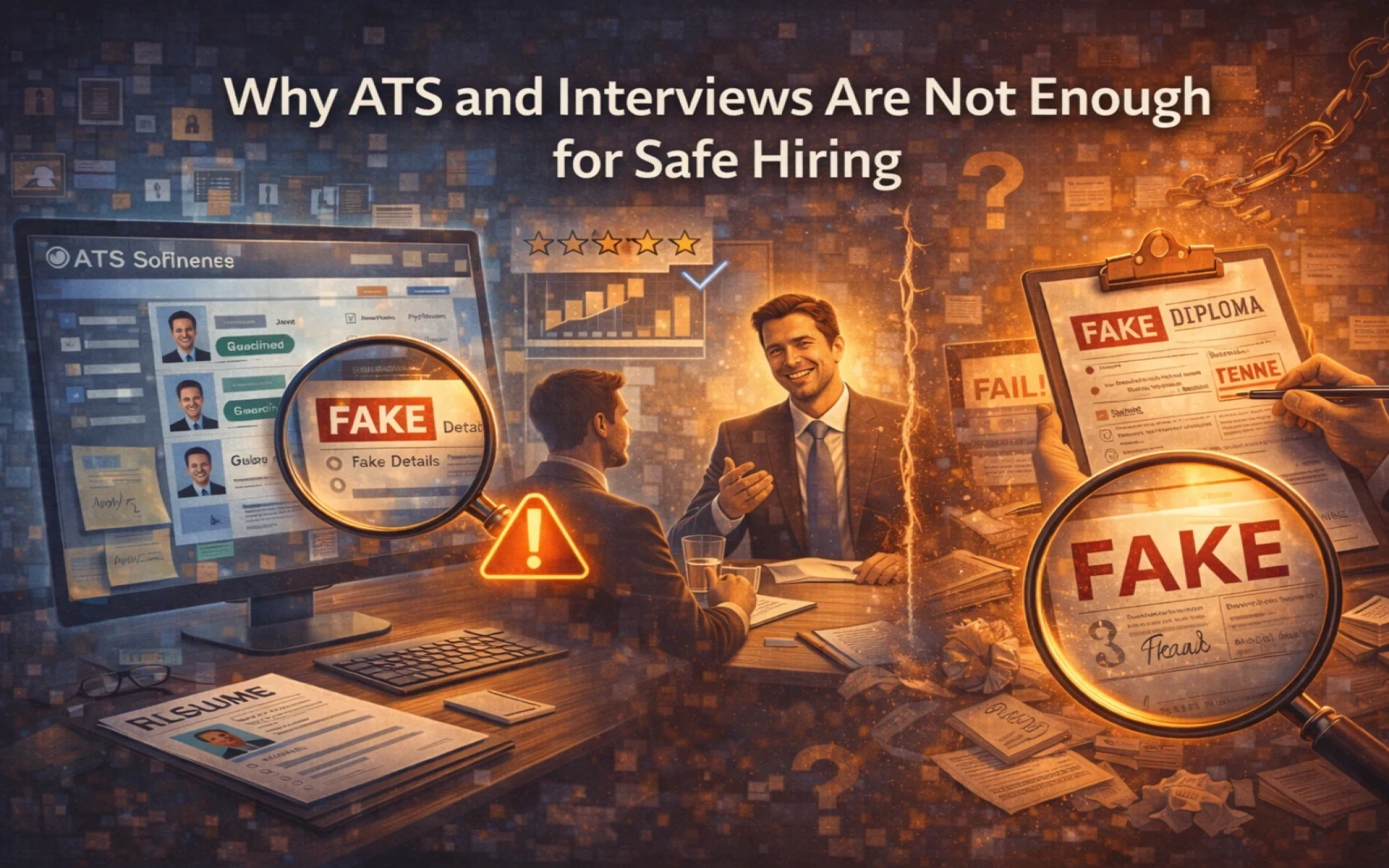
Both stages rely substantially on information provided or presented by the candidate. An ATS can identify whether a resume matches a job description, while an interview can reveal how effectively a candidate communicates and explains their experience. Neither is designed to independently confirm whether the candidate's employment history, qualifications, identity or other material claims are accurate.
That is where background verification becomes an important part of a responsible hiring process.
This guide explains what ATS platforms and interviews can—and cannot—establish, why relying on them alone can create blind spots, and how independent verification can strengthen hiring decisions.
What an ATS Actually Does
An Applicant Tracking System is primarily a recruitment workflow and candidate-screening tool. It can parse resumes, identify keywords, apply predefined criteria, rank applicants and help recruiters manage large volumes of applications.
Its value is clear: an ATS brings speed, structure and consistency to the early stages of recruitment.
However, an ATS generally works with the information supplied in the candidate's application. It can determine whether a resume contains relevant skills, job titles, qualifications or keywords, but it does not independently establish whether those claims are genuine.
A candidate who lists the right experience and keywords can therefore perform well in an ATS-driven screening process regardless of whether every detail of the underlying history has been independently confirmed.
The ATS answers:
"Does this candidate's profile appear to match the role?"
It does not necessarily answer:
"Are the claims in this profile accurate?"
What an Interview Actually Tests
Interviews provide something an ATS cannot: human interaction.
They allow hiring teams to assess communication, problem-solving, behavioural responses, technical understanding and how candidates explain their previous work. Structured interviews can be particularly valuable when the same role-related criteria are applied consistently across candidates.
But interviews also have limitations.
A candidate may confidently describe a project, leadership responsibility or previous position without providing independent evidence that confirms the claim. Strong communication can make an account sound credible, but credibility is not the same as verification.
An interview can help answer:
- Can the candidate explain their experience clearly?
- Do their skills appear relevant to the role?
- Can they reason through realistic situations?
- Do their responses demonstrate the expected knowledge or behaviour?
It cannot, by itself, establish whether every historical claim on the resume is accurate.
The Critical Question Neither Tool Fully Answers
When an ATS and interview are used together, hiring teams can develop a detailed picture of a candidate's suitability.
But an important question may still remain:
Is the candidate's professional story supported by independent evidence?
Was the stated employment actually held? Were the dates accurate? Was the qualification genuinely awarded? Did the candidate hold the stated designation? Are there material discrepancies that the recruitment process has not uncovered?
These questions sit outside the primary purpose of both ATS screening and interviewing.
That does not make either tool ineffective. It simply means they should not be expected to perform a function they were not designed to perform.
Why ATS + Interviews Can Create False Confidence
The combination of technology and human judgement can sometimes create the impression that a candidate has passed two completely independent checks.
In reality, both stages may be evaluating substantially the same underlying information.
The ATS evaluates information supplied by the candidate.
The interviewer then asks the candidate to explain that information.
If the original information is inaccurate, evaluating it twice does not necessarily make it accurate.
This is why a candidate who has successfully cleared resume screening and performed strongly in interviews may still require independent verification before a final hiring decision—particularly for roles involving sensitive information, financial responsibility, regulated activities or significant organisational access.
Common Issues That Can Remain Hidden
Some discrepancies are difficult to identify through resumes and interviews alone.
These may include:
- Inflated job titles or responsibilities
- Incorrect employment dates
- Unverified employment history
- Qualifications or certifications that cannot be confirmed
- Employment at organisations the candidate did not actually work for
- Significant gaps that have been inaccurately represented
- Misstated professional achievements
- Identity or address discrepancies
- Other role-specific concerns that require independent checks
Not every discrepancy indicates intentional fraud. Some result from administrative errors, differences in job-title conventions or incomplete records.
That is precisely why independent verification should be followed by a fair review process rather than an automatic assumption of wrongdoing.
What Independent Background Verification Adds
Background verification introduces something missing from the ATS and interview stages: independent evidence.
Depending on the role and the organisation's policy, verification may include:
- Employment verification — confirming previous employers, designations and employment periods
- Education verification — validating degrees, diplomas or certifications with relevant institutions
- Identity verification — confirming identity information through appropriate sources
- Address verification — where relevant to the role or organisational policy
- Criminal record checks — where legally permissible, relevant and appropriate
- Professional or regulatory checks — for roles requiring specific licences, registrations or credentials
The objective is not to assume that candidates are dishonest. It is to distinguish candidate-provided information from independently verified information.
That distinction becomes increasingly important as hiring decisions involve greater access, responsibility and risk.
Verification Should Complement, Not Replace, Interviews
Background verification is not a substitute for a good recruitment process.
A candidate can have completely accurate credentials and still be unsuitable for a particular role. Likewise, a candidate may have a minor documentation discrepancy that has a straightforward explanation.
The strongest hiring process therefore uses different stages for different purposes:
ATS → identifies potential fit at scale
Interview → evaluates skills, behaviour and role suitability
Assessment → tests relevant capabilities where appropriate
Verification → validates material claims and credentials
Final decision → considers the complete picture
Each stage answers a different question.
The goal is not to make one tool responsible for everything. It is to make the stages work together.
How to Add Verification Without Slowing Hiring
One common concern is that adding background verification will increase time-to-hire.
That largely depends on when and how verification is initiated.
When verification is treated as a completely separate step after every other hiring activity, it can become a bottleneck. When it is integrated into the recruitment workflow at an appropriate stage—such as after shortlisting or alongside offer preparation—many checks can progress in parallel.
A structured process can therefore combine:
- Automated candidate screening
- Structured interviews
- Digital document collection
- Consent-based verification
- Real-time verification status
- Exception and discrepancy management
This allows organisations to maintain recruitment efficiency without treating verification as an afterthought.
What "Vetted" Should Really Mean
One of the most important distinctions for HR teams is the difference between assessed and verified.
A candidate who clears an ATS has been screened against defined criteria.
A candidate who performs well in an interview has been assessed through conversation and role-related questions.
A candidate whose material credentials and employment claims have been independently checked has undergone verification.
These are different stages, and using the word "vetted" without making that distinction can create unnecessary confidence.
A strong hiring process does not distrust every candidate. It simply recognises that candidate-provided information should be assessed and, where appropriate, independently validated before the organisation relies on it.
Building a More Complete Hiring Process
The answer is not to reduce reliance on ATS platforms or interviews. Both remain valuable parts of modern recruitment.
The improvement comes from giving each tool the right job.
Use the ATS to manage scale and identify relevant candidates. Use interviews to understand capability, communication and suitability. Use assessments where practical skills need to be demonstrated. Then use background verification to validate the material facts that matter to the hiring decision.
This creates a more complete evidence base for HR and hiring managers.
Instead of asking one tool to determine whether someone is suitable, the organisation builds a process in which fit, capability and factual accuracy are evaluated separately and then considered together.
The CaseXpert Perspective
At CaseXpert, background verification is designed to complement—not replace—the recruitment process.
The objective is to help organisations move beyond candidate-provided information and establish greater confidence in the facts behind important hiring decisions. By bringing employment, education, identity and other relevant verification checks into a structured workflow, organisations can identify discrepancies earlier and make decisions with better information.
The goal is not to create unnecessary friction for candidates.
It is to create a verification process that is clear, consent-driven, efficient and proportionate to the role.
Key Takeaways
- An ATS can screen and rank candidates, but it does not independently verify the information in a resume.
- Interviews provide valuable insight into skills and suitability but cannot establish the accuracy of every historical claim.
- Evaluating the same candidate-provided information twice does not make it independently verified.
- Background verification adds an independent layer for validating material employment, education, identity and role-specific information.
- Verification should complement structured recruitment rather than replace interviews or assessments.
- Integrating verification into the hiring workflow can reduce delays while strengthening decision-making.
- The most complete hiring process evaluates fit, capability and factual accuracy as distinct elements.
Conclusion
An ATS and a strong interview process are essential components of modern recruitment, but neither was designed to independently verify a candidate's entire professional history.
The ATS helps determine whether a candidate appears to match the role. The interview helps determine whether the candidate can demonstrate the required skills, knowledge and communication. Background verification answers a different question: do the material claims behind the candidate's application hold up against independent evidence?
That distinction matters.
Rather than treating verification as a final administrative formality, organisations can integrate it into the broader hiring workflow alongside screening, interviews and assessments. The result is not a process built on suspicion, but one built on better information.
Because a candidate can interview exceptionally well and still have discrepancies in their background. And while an ATS can identify the right keywords, only appropriate verification can help establish whether the underlying claims are accurate.
An ATS can find the right profile. An interview can reveal the right potential. Verification helps establish whether the story behind both is supported by facts.
Add the pillar your funnel is missing. CaseXpert verifies employment, credentials, identity and risk against independent sources - the third pillar that turns a thorough-feeling process into genuinely safe hiring. Talk to our verification specialists or send an enquiry to get started.