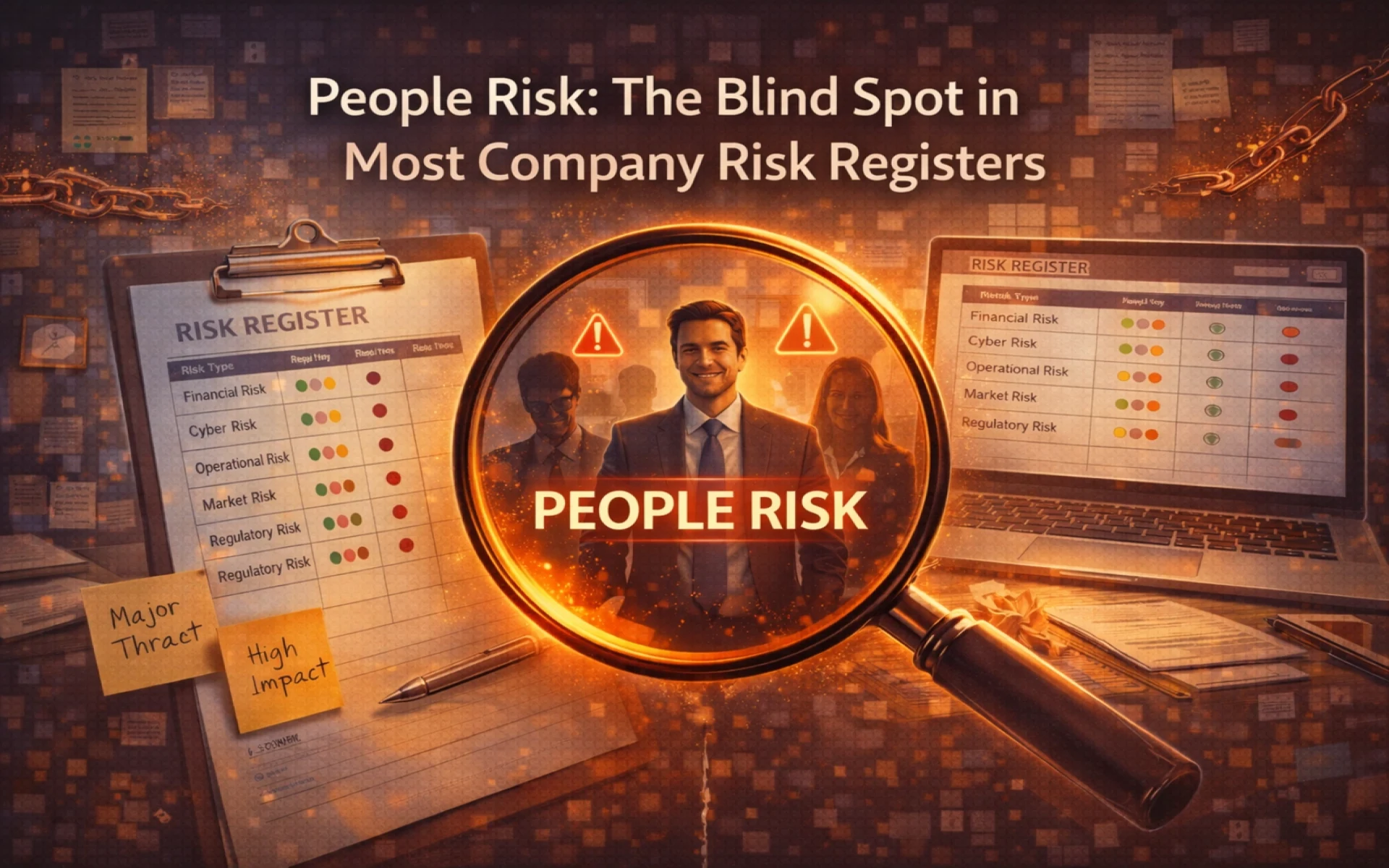
Open the risk register of almost any mature organisation and you will find detailed attention to financial risk, cybersecurity, operational risk, regulatory exposure and reputational risk. Each category typically has an owner, defined controls, mitigation plans and, in larger organisations, visibility at the leadership or board level.
Yet one category that cuts across many of these risks is often missing or buried within another function: people risk.
People risk is the exposure created when an organisation hires, engages or grants access to individuals whose identity, qualifications, history, behaviour or potential conflicts have not been adequately assessed.
The issue is not that employees should be viewed as inherently risky. It is that organisations routinely extend access, authority and trust to people without treating that trust as something that also requires appropriate controls.
A person may have access to sensitive data, financial systems, customers, intellectual property or operational processes within days of joining. If important claims about that person were never independently validated, the organisation has created a risk exposure before it has even recognised one.
This guide explains what people risk means, why it is often overlooked, how it connects with wider enterprise risk, and why background verification can form an important control within a broader people-risk framework.
What Is People Risk?
People risk refers to risks arising from the individuals an organisation employs, contracts with or otherwise gives access to its systems, information, assets or decision-making processes.
It can include risks associated with:
- Misrepresented qualifications or employment history
- Identity discrepancies
- Undisclosed conflicts of interest
- Inappropriate access or authority
- Fraudulent or dishonest conduct
- Failure to meet role-specific requirements
- Inadequate screening for sensitive positions
- Insider-risk exposure
- Poorly managed third-party or contractor access
Importantly, people risk is not limited to deliberate wrongdoing.
A person may unintentionally create significant exposure because they lack the qualifications they claimed to have, do not possess the experience required for a sensitive role, or were placed into a position without the appropriate checks.
The common thread is simple:
The organisation has extended trust or access without having sufficient information to assess the associated risk.
Why People Risk Is Often Missing From Risk Registers
People risk can be difficult to assign to a single function.
HR may own recruitment and employee processes. Information security may own access controls. Compliance may manage regulatory requirements. Legal may oversee employment and contractual exposure. Enterprise risk may maintain the overall risk register.
As a result, responsibility can become fragmented.
There is also a practical challenge: financial losses can be quantified relatively easily, while the potential impact of a people-related risk may be uncertain until an incident occurs.
Another factor is cultural. Organisations understandably do not want to treat employees as a source of risk. But managing people risk does not mean distrusting employees. It means recognising that access, authority and trust create risk regardless of who holds them.
The same principle already applies to financial systems, privileged accounts and sensitive data. People should not be an exception simply because the subject is more personal.
How People Risk Connects to Enterprise Risk
People risk rarely exists in isolation.
An individual may have access to systems, financial information, customer data, intellectual property or operational authority. If that access is granted without appropriate controls, a people-related issue can contribute to wider organisational exposure.
For example:
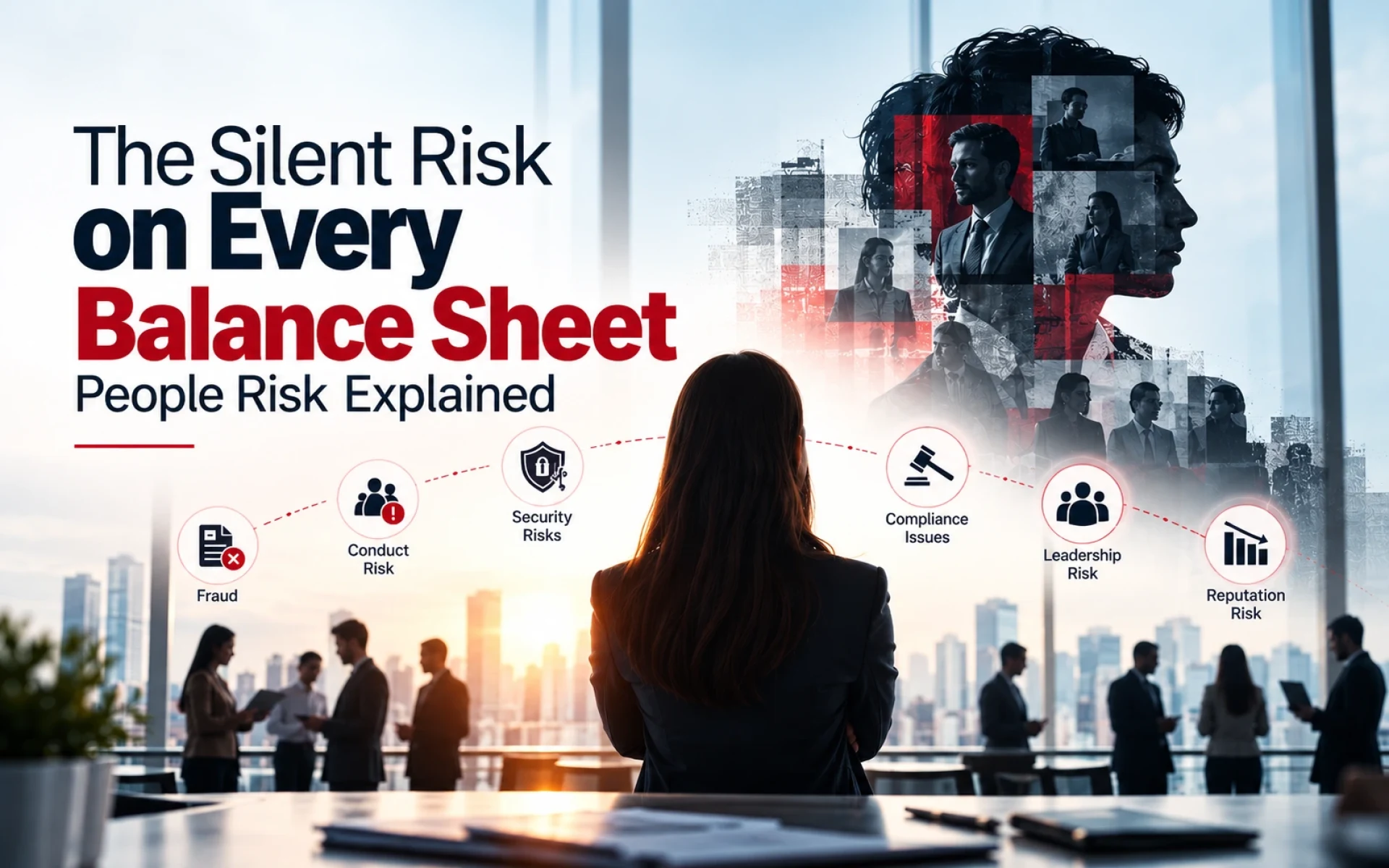
- Cybersecurity risk: inappropriate access, weak security practices or insider activity can contribute to security incidents.
- Fraud risk: employees or contractors with access to financial processes can create opportunities for financial misconduct.
- Compliance risk: unsuitable personnel in regulated roles can expose an organisation to regulatory concerns.
- Operational risk: inadequate qualifications, experience or role suitability can affect business continuity and service quality.
- Reputational risk: serious misconduct involving an employee can create reputational consequences for the organisation.
This does not mean background verification can prevent every incident in these categories. It cannot.
What it can do is provide an additional control at one important point in the risk lifecycle: before or while the organisation decides how much trust and access to extend to an individual.
Background Verification as a People-Risk Control
Background verification is often treated as an HR process designed simply to validate resumes.
A broader risk-management perspective looks at it differently.
Verification can help an organisation independently validate relevant information before granting a person access, responsibility or authority. Depending on the role and applicable requirements, this may include:
- Identity verification
- Employment verification
- Education verification
- Address verification
- Professional credential checks
- Role-specific criminal record checks where legally permissible
- Directorship or regulatory checks where relevant
- Other risk-based screening appropriate to the position
The purpose is not to create a presumption of dishonesty.
It is to reduce uncertainty around information that matters to the organisation's decision.
In risk-management terms, verification therefore becomes a preventive control, rather than simply an administrative recruitment step.
Not Every Role Requires the Same Level of Screening
One of the most important principles in people-risk management is proportionality.
A junior role with limited access should not necessarily be subjected to exactly the same checks as a senior executive with access to sensitive financial information, customer data or strategic systems.
A risk-based framework can establish different verification levels based on factors such as:
- Access to sensitive information
- Financial authority
- Regulatory responsibility
- Customer or public-facing responsibility
- Access to critical systems
- Seniority and decision-making authority
- Exposure to vulnerable individuals
- Contractual or client requirements
This allows organisations to focus deeper screening where the potential impact of a people-related risk is greater.
The objective is not maximum verification for everyone.
It is appropriate verification for the level of risk involved.
The Senior-Role Blind Spot
One of the more important questions for organisations is whether verification standards actually increase with responsibility.
In some organisations, senior candidates may receive less scrutiny because of their experience, reputation, professional network or the urgency of filling leadership positions.
That can create a mismatch between risk exposure and control strength.
A senior individual may have greater access to:
- Financial information
- Confidential business strategy
- Customer databases
- Intellectual property
- Privileged systems
- Decision-making authority
- Sensitive relationships
From a risk perspective, greater authority can justify greater diligence—not less.
A mature people-risk framework therefore bases verification depth on the position's risk profile rather than simply on seniority, familiarity or the candidate's perceived reputation.
Put People Risk on the Risk Register
If people risk is treated as a genuine enterprise risk, it should be visible and measurable.
A people-risk entry might define:
Risk:
Inadequate screening or assessment of employees and contractors may result in unsuitable individuals receiving access, authority or sensitive information.
Potential impact:
Financial loss, operational disruption, regulatory exposure, data risk, reputational damage or other business consequences.
Key controls:
Risk-based background verification, identity validation, access controls, conflict-of-interest declarations, role-specific screening and ongoing monitoring where appropriate.
Risk owner:
A clearly designated business owner, with appropriate involvement from HR, compliance, security and enterprise risk functions.
Key indicators:
Verification coverage, unresolved discrepancies, exceptions to screening policy, turnaround times, high-risk findings and control gaps.
The exact structure will vary by organisation, but the principle is important: if a risk is not visible, owned and measured, it is difficult to manage consistently.
Verification Is Only One Part of People-Risk Management
Background verification is important, but it should not be presented as a complete solution to people risk.
A comprehensive framework may also include:
- Role-based access controls
- Segregation of duties
- Conflict-of-interest declarations
- Employee conduct policies
- Security awareness training
- Whistleblower mechanisms
- Periodic access reviews
- Contractor and vendor controls
- Ongoing compliance monitoring
- Clear disciplinary and escalation procedures
Verification helps answer an important question before trust is extended:
"What do we independently know about this person that is relevant to the role?"
Access controls and other safeguards then help manage the risk throughout the individual's relationship with the organisation.
Measure What the Organisation Actually Controls
Once people risk is formally recognised, organisations can begin identifying measurable control indicators.
For example:
- What percentage of eligible hires complete verification?
- Which roles require enhanced screening?
- How many checks remain incomplete at joining?
- How many material discrepancies are identified?
- How quickly are discrepancies resolved?
- How often are policy exceptions approved?
- Are senior and sensitive roles receiving the appropriate level of screening?
- Are contractors and third-party personnel covered by the same risk framework?
These metrics do not eliminate people risk.
They provide visibility into whether the organisation's controls are actually operating as intended.
From Blind Spot to Managed Risk
The purpose of recognising people risk is not to create a culture of suspicion.
It is to bring people-related exposure into the same structured risk framework that organisations already apply to technology, finance, operations and compliance.
Once the risk is identified, the organisation can determine:
- What could go wrong?
- Which roles or people create the greatest exposure?
- What controls already exist?
- Where are the control gaps?
- How should verification and other safeguards be applied?
- How will effectiveness be measured?
That shift—from informal assumptions to defined controls—is what turns people risk from a blind spot into a managed business risk.
How CaseXpert Supports a People-Risk Approach
CaseXpert helps organisations bring structured background verification into their broader approach to workforce risk.
Rather than treating verification as a one-time administrative task, organisations can use relevant checks to establish greater confidence in candidate-provided information before extending access and responsibility.
Depending on the role and screening policy, verification can cover areas such as employment, education, identity, address and other relevant checks.
The objective is straightforward: help organisations make people-related decisions using verified information rather than assumptions alone.
Key Takeaways
- People risk is the exposure created by individuals who receive access, authority or trust within an organisation.
- It can contribute to wider cybersecurity, fraud, compliance, operational and reputational risks.
- People risk is often fragmented across HR, security, compliance and enterprise risk functions.
- Background verification can serve as an important preventive control within a broader people-risk framework.
- Verification should be proportionate to the risk associated with the role rather than identical for every employee.
- Senior and sensitive roles should be assessed according to their access and potential impact, not simply their perceived reputation.
- People risk should be visible, owned and measured through appropriate risk indicators.
- Background verification is one control—not a substitute for access management, conduct controls or ongoing risk management.
Conclusion
People risk is easy to overlook because it sits at the intersection of several functions. HR manages people. Security manages access. Compliance manages obligations. Enterprise risk manages the wider risk landscape.
But the boundaries between these functions do not eliminate the underlying exposure.
Whenever an organisation gives someone access to information, systems, money, customers or decision-making authority, it is making a decision about trust. That decision should be supported by appropriate controls.
Background verification can provide one important layer of that control by independently validating information that matters to the role. Combined with access management, policy controls, monitoring and clear accountability, it becomes part of a broader people-risk strategy.
The goal is not to treat people as problems to be controlled.
It is to make sure that trust is supported by evidence, access is matched to risk, and people-related exposure is managed as deliberately as every other material business risk.
People are not the risk. Unmanaged trust is.
Bring people risk into the open. CaseXpert gives risk and HR leaders a verification programme they can govern as a real control - with defined coverage, depth and reporting that turns people risk from a blind spot into a managed exposure. Talk to our verification specialists or send an enquiry to get started.