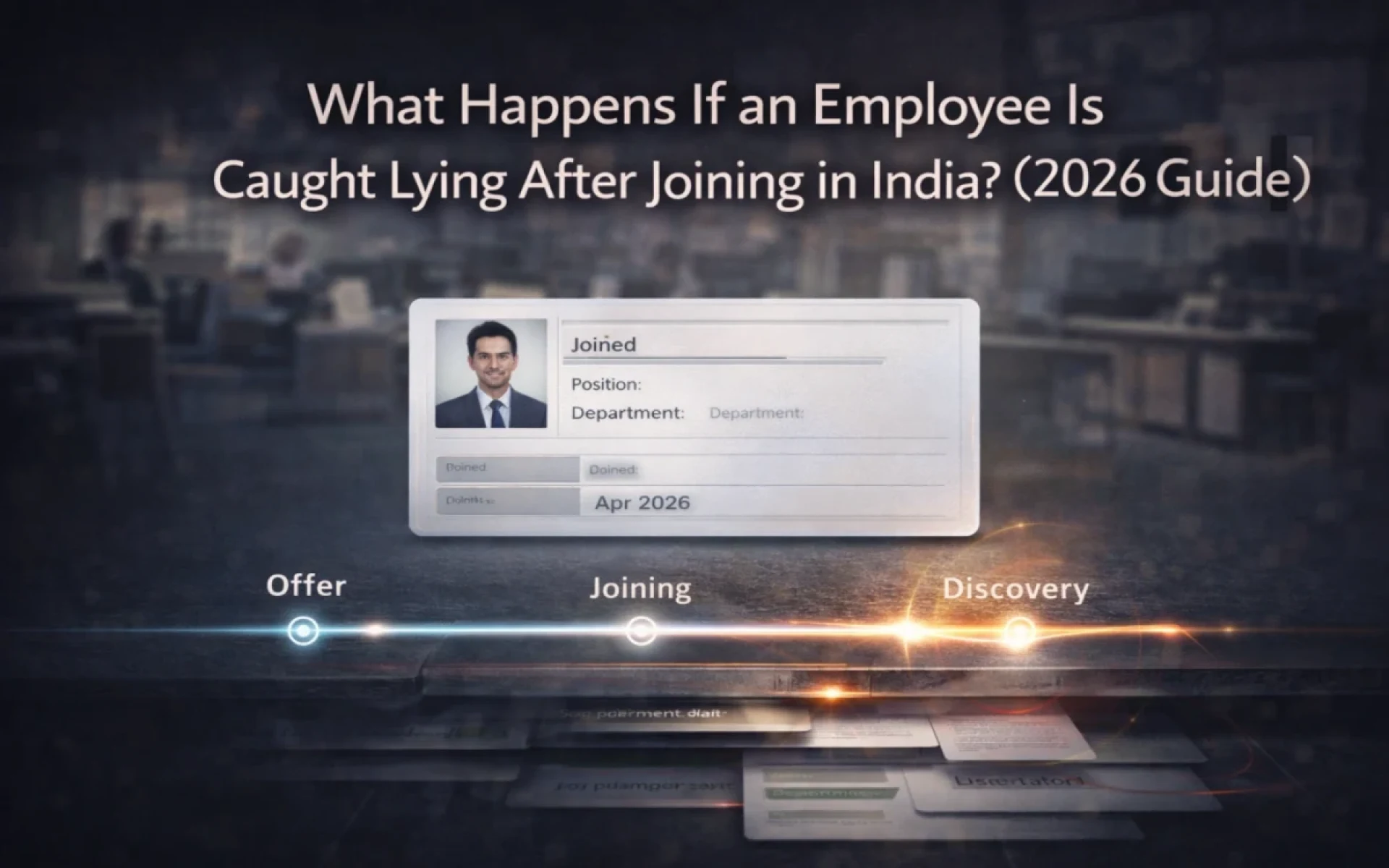
It is one of the more unsettling discoveries an employer can make: an employee, already months into the job, is found to have lied to get there. A degree that was never earned. Employment that never happened. A previous dismissal for misconduct, concealed. The person is now embedded ??? with access, responsibilities and colleagues ??? and the company has to decide what its rights and obligations actually are.
This 2026 guide walks through what happens, legally and practically, when an employee is caught lying after joining in India. It covers the difference between trivial and material lies, the rights employers do and do not have, the process that protects a termination, and the steps that turn a difficult discovery into a defensible outcome rather than a costly dispute.
First, Distinguish the Lie #
Not every untruth justifies the same response, and the first task is to characterise what was actually discovered. There is a vast difference between a candidate who rounded up a salary figure or softened a reason for leaving, and one who fabricated an entire qualification or invented a job that never existed. The former may not even warrant action; the latter goes to the foundation of the employment relationship.
Material lies are those that, had the truth been known, would have changed the decision to hire ??? a forged degree for a role requiring it, concealed experience that was a hiring criterion, a hidden termination for serious misconduct. These are the discoveries that genuinely engage an employer's rights. Minor exaggerations, while disappointing, usually do not.
The Legal Footing: Misrepresentation #
When an employee obtains a job through material misrepresentation, the employer's strongest position is that the employment was secured by fraud ??? the consent to hire was given on the basis of false information. Where appointment terms include a declaration that the information provided is true and complete, and a condition that the offer depends on satisfactory verification, a confirmed material lie breaches the very basis of the appointment.
A material lie discovered after joining is not just a performance issue. It can go to whether the employment was validly obtained at all.
This is why the accurate-information declaration in offer and appointment letters matters so much. It converts 'the employee lied' from a vague grievance into a concrete breach of a term the employee signed, which is a far firmer foundation for any action that follows.
Due Process Still Applies #
Having grounds is not the same as having a free hand. Indian employment principles require fair procedure before acting against an employee, and the more protected the employee's status, the more demanding that process. The employee must be informed of the specific allegation, shown the basis for it, and given a genuine opportunity to respond before any decision is finalised.
Skipping this step is the most common way a justified action becomes an unjustified one in the eyes of a tribunal. Even a clear-cut fabrication, acted on without process, can produce a successful wrongful-termination claim ??? not because the lie was acceptable, but because the response was procedurally defective.
Confirmed and Probationary Employees Differ #
The employee's status materially affects the process required. A probationary employee can generally be dealt with more readily, though still fairly. A confirmed employee, and especially one protected as a 'workman' under industrial law, attracts stronger procedural safeguards. Identifying which framework applies is essential before acting, because applying the wrong level of process is itself a source of legal risk.
This distinction often determines whether a domestic inquiry or a more formal procedure is appropriate. When the stakes or the employee's protections are significant, this is the point at which legal guidance is genuinely worth obtaining.
Possible Outcomes Beyond Termination #
Termination is the most common response to a confirmed material lie, but it is not the only one. Depending on severity, the employer might issue a warning, require the employee to furnish genuine missing credentials, or reassign them ??? though for fundamental fabrications, continued employment is often untenable. In cases involving forged documents, the conduct may also have implications beyond the employment relationship.
The right outcome depends on the nature of the lie, the role, the employee's status and the company's policy. What matters is that the response is proportionate, consistent with how comparable cases are treated, and documented ??? not improvised case by case.
What Not to Do #
Certain reactions reliably make things worse. Acting impulsively without confirming the finding or hearing the employee invites a claim. Broadcasting the employee's wrongdoing internally or to outsiders risks defamation. Treating one employee's lie harshly while overlooking another's creates an inconsistency that can be used against the company. And ignoring a serious confirmed lie out of conflict-aversion stores up a larger negligent-retention problem for later.
- Do not act before the finding is confirmed and the employee is heard
- Do not communicate the matter more widely than necessary
- Do not apply a harsher standard than you have applied to comparable cases
- Do not ignore a serious, confirmed misrepresentation to avoid confrontation
Preventing the Problem in the First Place #
Almost every post-joining discovery of a lie traces back to verification that was incomplete, skipped or done after joining. The cleanest protection is to verify thoroughly before the start date, so that material lies surface as candidate-stage discrepancies rather than as embedded-employee crises. Pre-joining verification turns a difficult termination into a simple decision not to hire.
Where checks must run into the joining period, conditional appointment terms and accurate-information declarations preserve the employer's position. The discovery of a lie after joining is far less painful when the paperwork anticipated the possibility and the verification was simply completing rather than never done.
Turning Discovery Into a Defensible Outcome #
When an employee is caught lying after joining, the path to a clean outcome is methodical: confirm the lie is real and material, identify the employee's legal status, rely on the misrepresentation and conditional basis, give a fair hearing, choose a proportionate and consistent response, communicate narrowly, and document every step. Each element both improves fairness and strengthens defensibility.
Handled this way, even an uncomfortable discovery becomes manageable. The employer removes a genuine risk lawfully, the action withstands challenge, and the organisation learns to close the verification gap that let the lie through in the first place.
Key Takeaways #
Here are the essential points to carry forward from this guide:
- Distinguish material lies that would have changed the hire from minor exaggerations.
- Material misrepresentation can mean the employment was obtained by fraud ??? a strong basis to act.
- Fair due process before any decision is non-negotiable, and scales with employee status.
- Respond proportionately and consistently; document the finding, the hearing and the rationale.
- Thorough pre-joining verification is the best prevention ??? it catches lies before they embed.
Conclusion #
Discovering that an employee lied to get hired is jarring precisely because they are already inside the organisation. But the path forward in India is well established: characterise the lie, confirm it is material, rely on the misrepresentation and conditional basis, follow fair process appropriate to the employee's status, respond proportionately and document everything. A serious, confirmed lie handled this way leads to a defensible outcome.
The deeper lesson is preventive. Lies discovered after joining are almost always lies that pre-joining verification would have caught. Verify thoroughly before the start date, back it with conditional terms and accurate-information declarations, and most of these crises never happen ??? because the fabrication surfaces as a discrepancy in a report, long before it becomes a problem at someone's desk.
A lie caught before joining is a decision not to hire. The same lie caught after joining is a crisis ??? which is exactly why verification belongs before the start date.
Catch lies before they embed. CaseXpert verifies credentials, employment and history against independent sources before the start date ??? surfacing material lies as candidate-stage discrepancies, not embedded-employee crises. Talk to our verification specialists or send an enquiry to get started.