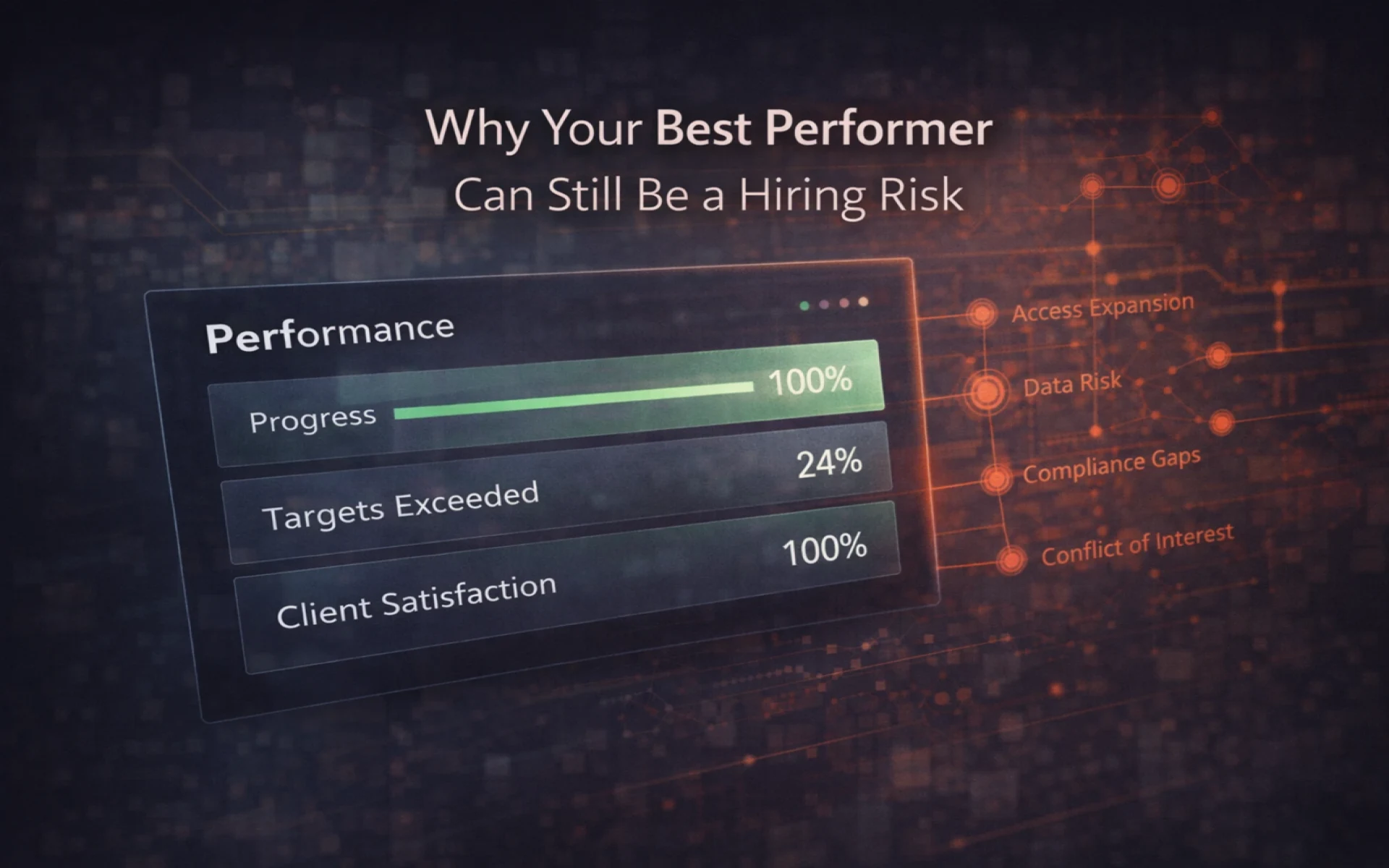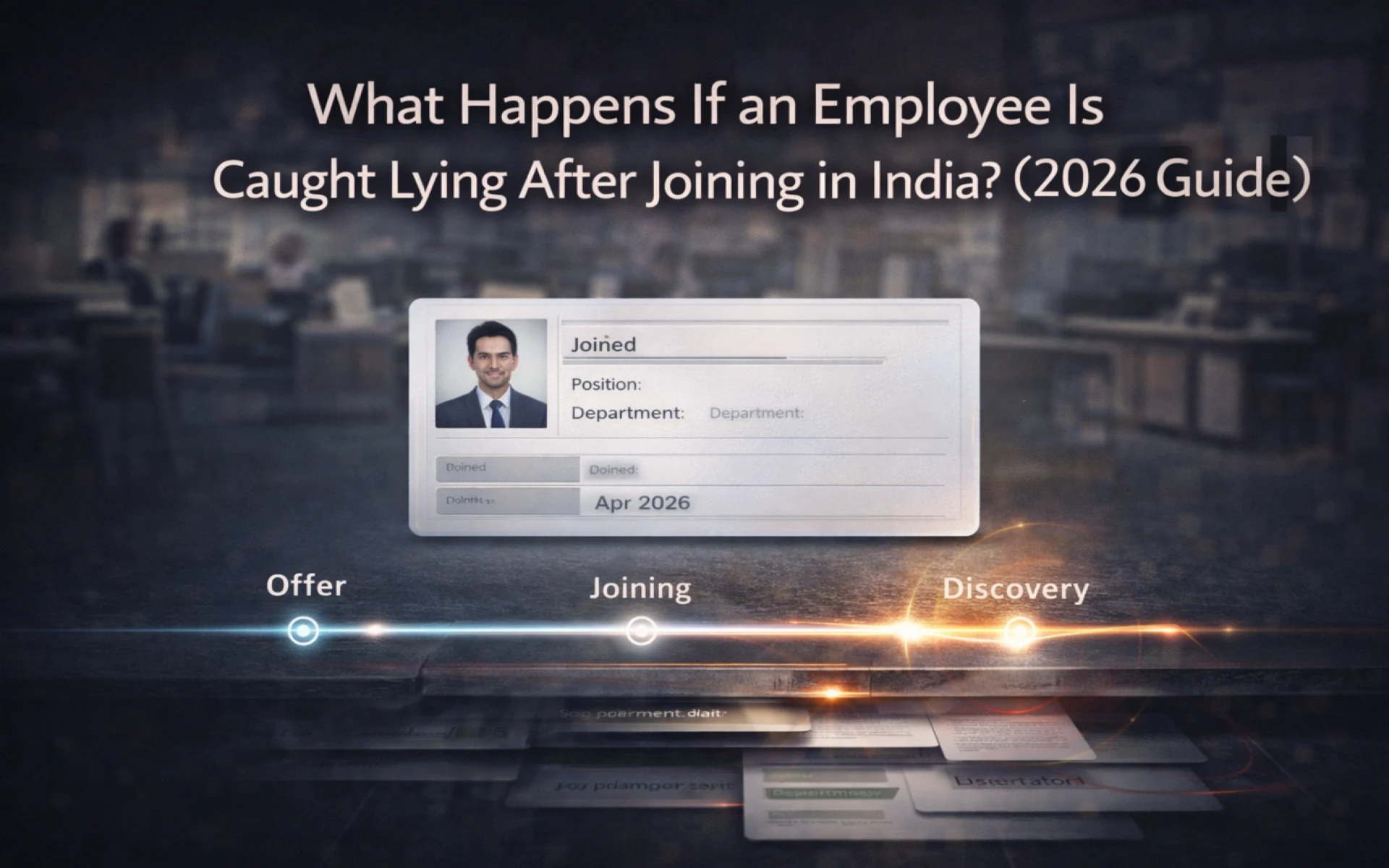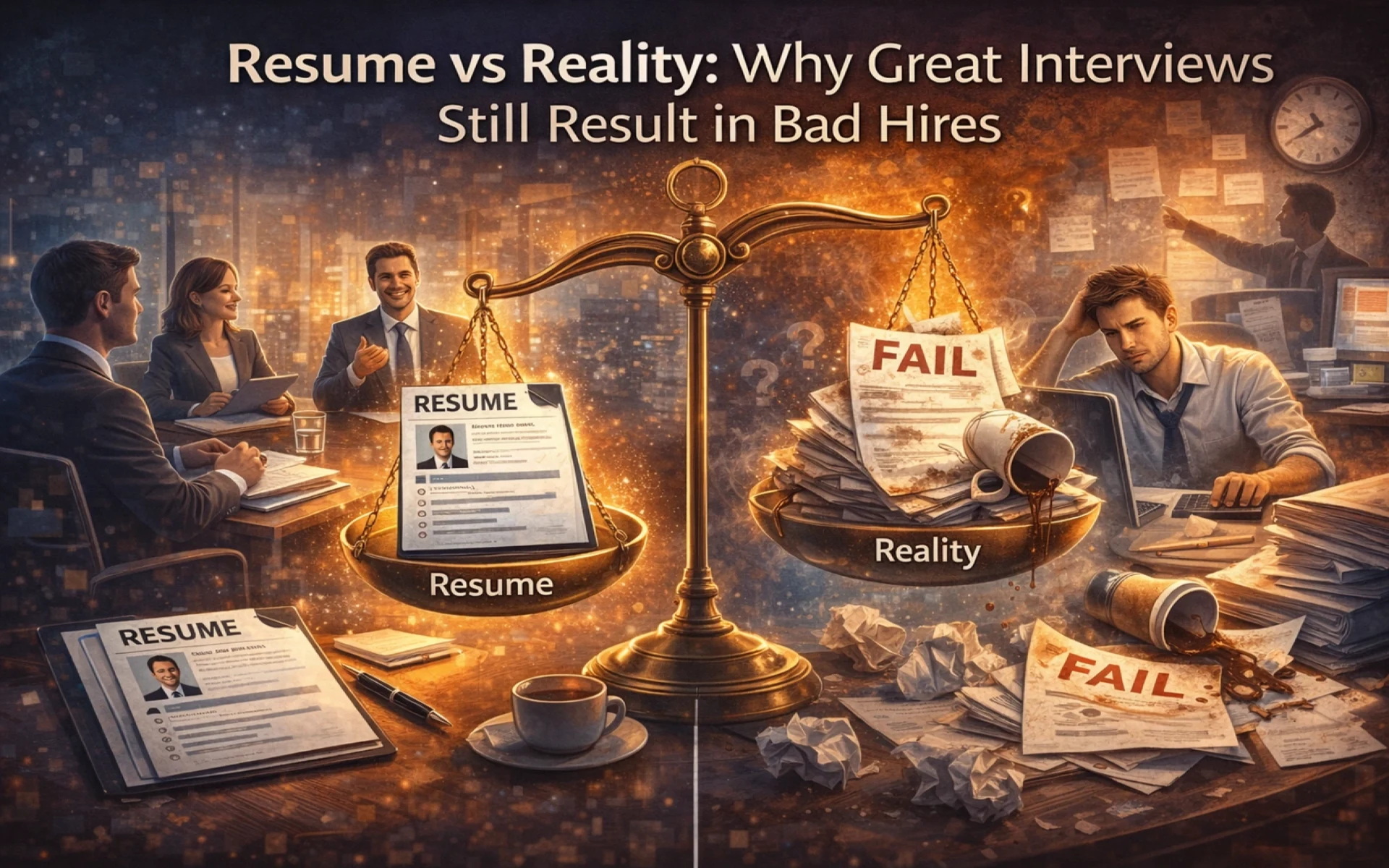
Every hiring manager has experienced some version of it: a candidate who interviewed exceptionally well, whose resume appeared to be an almost perfect match, and who answered every question with confidence and clarity — only for problems to emerge weeks or months after joining.
Sometimes the issue is poor performance. Sometimes the candidate simply isn't the right cultural or role fit. And sometimes, the problem goes deeper: important details in the candidate's resume or professional history do not match reality.
This gap between what a candidate presents during recruitment and what the organisation ultimately discovers after hiring is one of the most challenging problems in modern recruitment.
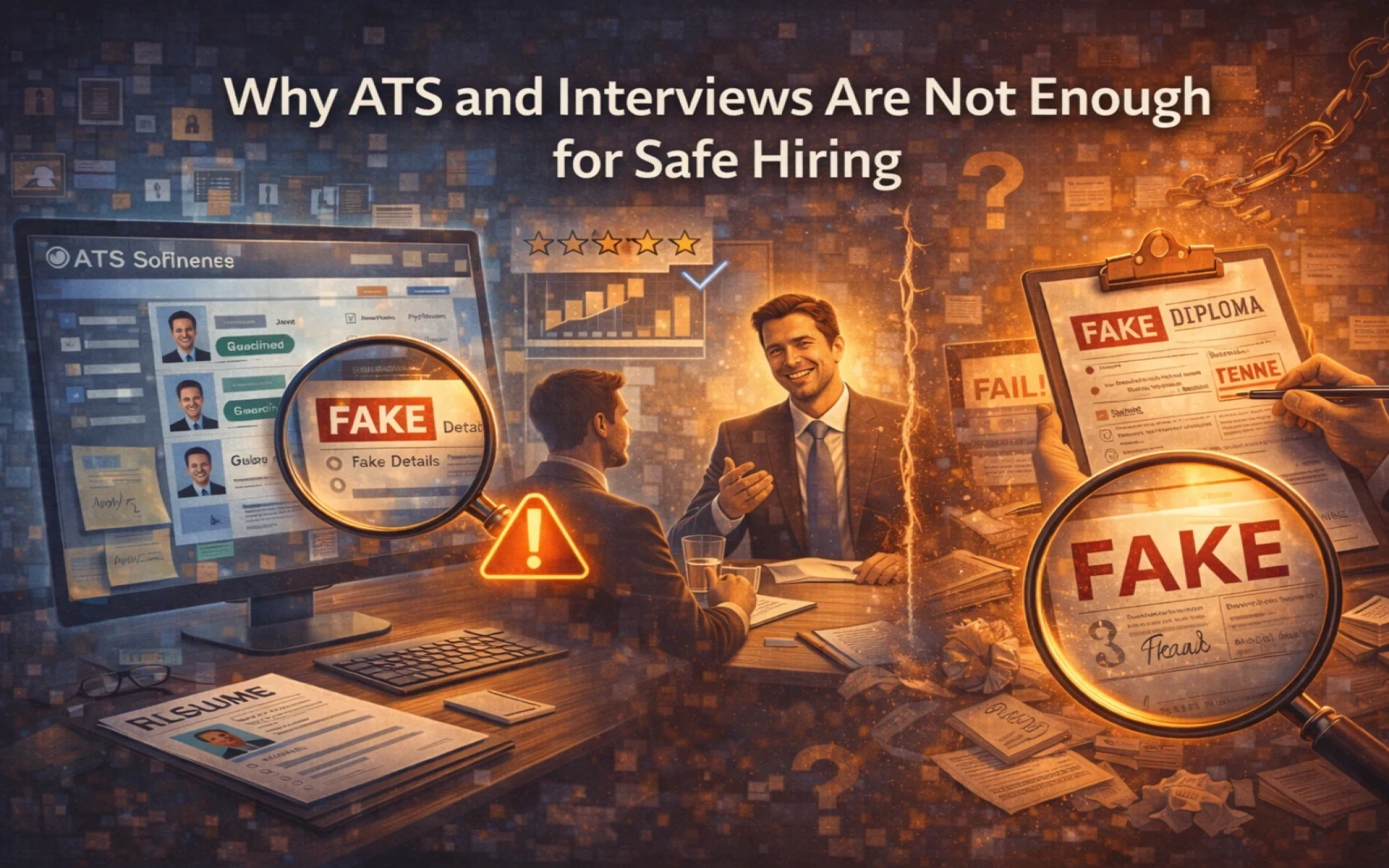
The solution is not to distrust candidates or abandon interviews. Interviews remain an important part of evaluating communication, problem-solving and role-specific capability. The problem arises when resumes and interviews are treated as sufficient evidence for claims that can and should be independently verified.
This guide explores why strong interviews can still result in poor hiring outcomes — and how organisations can close the gap between candidate presentation and verified reality.
What a Resume Actually Tells You
A resume is a candidate's representation of their professional history. It provides recruiters with useful information about experience, education, skills, responsibilities and career progression.
But a resume is still a self-reported document.
It does not independently establish that:
- The candidate held every position listed
- Employment dates are completely accurate
- Job titles match official designations
- Claimed responsibilities were actually performed
- Reported achievements were personally delivered
- Qualifications and certifications were genuinely obtained
This does not mean resumes are unreliable. It means they should be treated as claims that inform the hiring process, rather than as independently verified records.
A polished resume may reflect exceptional experience. It may also reflect exceptional presentation skills. Without verification, the document itself cannot reliably distinguish between the two.
Why Interviews Don't Tell the Whole Story
Interviews add another layer of information. They allow hiring teams to assess communication, technical understanding, problem-solving, behavioural responses and how candidates approach real workplace situations.
But interviews have limitations too.
A candidate can be highly articulate without having every experience described on their resume. Someone can confidently explain a project they participated in without having led it. A well-prepared candidate can also provide compelling answers based on anticipated interview questions.
The issue is therefore not that interviews are ineffective.
It is that interviews primarily assess what candidates demonstrate during the interview, while background verification addresses whether important claims about their past can be independently confirmed.
These are different questions.
The Claims That Can Survive Even a Great Interview
Some forms of misrepresentation are particularly difficult to identify through conversation alone because they concern historical facts rather than interview performance.
Common examples include:
- Inflated job titles — presenting a role as more senior than the official designation
- Extended employment dates — adjusting dates to minimise career gaps
- Exaggerated responsibilities — presenting team-level work as individual ownership
- Inflated achievements — claiming responsibility for outcomes delivered by a larger team
- Unverified qualifications — listing degrees or certifications that cannot be confirmed
- Unreported employment history — leaving out roles that may raise questions
- Incorrect reasons for leaving — presenting a departure differently from the underlying record
A candidate may answer interview questions convincingly while these discrepancies remain completely invisible.
That is why strong interviewing and independent verification should complement each other rather than compete with each other.
Why Experienced Hiring Managers Can Still Miss Red Flags
It is tempting to believe that experience alone makes someone highly effective at detecting dishonesty.
In reality, hiring decisions are influenced by normal human judgement and cognitive biases.
A strong first impression can influence how subsequent answers are interpreted. A prestigious employer on a resume may create an assumption of competence. Excellent communication can make claims feel more credible. Interviewers may also unconsciously search for information that confirms an initial positive impression.
None of this means hiring managers are careless.
It means that human judgement works best when it is supported by structured processes and objective evidence.
A well-designed hiring process therefore does not ask managers to detect every inconsistency themselves. It gives them additional mechanisms for validating information that matters.
When a Great Interview Creates False Confidence
One of the biggest risks is confusing interview performance with overall candidate reliability.
Consider a candidate who:
- Has an impressive resume
- Communicates confidently
- Gives detailed answers
- Demonstrates strong technical knowledge
- Provides convincing examples of previous work
All of these are valuable signals.
But none independently confirms that the candidate actually held the positions, earned the qualifications or performed the responsibilities listed on their resume.
The result can be false confidence.
The hiring team feels that several pieces of evidence point in the same direction when, in reality, much of the information originated from the same source: the candidate.
A resume and a LinkedIn profile that tell the same story are consistent, but they are not necessarily independent verification.
The Real Cost of the Resume-Reality Gap
The consequences of a bad hire extend well beyond the cost of replacing an employee.
Depending on the role, organisations may also face:
- Lost productivity
- Additional recruitment costs
- Management time spent addressing performance issues
- Team disruption
- Client or customer impact
- Access and information-security concerns
- Compliance exposure
- Reputational damage
- Delays to important projects
The risk can be even greater when a candidate has misrepresented qualifications, employment history or experience for a sensitive position.
This is why verification should not be viewed simply as an administrative HR task. It is part of risk management and informed hiring.
What Actually Closes the Gap?
The most effective way to reduce the difference between candidate claims and verified information is to introduce independent evidence into the hiring process.
Depending on the role and the organisation's requirements, this may include:
- Employment verification
- Education verification
- Identity verification
- Address verification
- Professional reference checks
- Credential verification
- Role-specific checks where appropriate
The principle is simple:
The more important a claim is to the hiring decision, the more valuable independent verification becomes.
If a degree is essential for a regulated role, verify the qualification. If a specific employment history is central to the candidate's suitability, verify the employment. If a professional licence is required, validate it through an appropriate authoritative source.
Verification should be proportionate to the role and conducted with appropriate consent and data-handling safeguards.
Structured Hiring Is Stronger Than a Single Decision Point
A strong hiring process does not rely on one perfect interview, one impressive resume or one background check.
Instead, different stages answer different questions.
| Hiring Stage | What It Helps Assess |
|---|---|
| Resume screening | Claimed experience and qualifications |
| Interview | Communication, knowledge and role fit |
| Skills assessment | Demonstrated capability |
| References | Additional perspective on past work |
| Background verification | Independent validation of relevant claims |
| Final review | Overall evidence before the hiring decision |
This layered approach creates a more complete picture.
The objective is not to make hiring unnecessarily complicated. It is to ensure that important decisions are not based entirely on information that has never been independently tested.
How HR Can Reduce the Resume-Reality Gap
HR teams can strengthen their hiring process with a few practical changes.
1. Identify Claims That Matter
Not every detail on a resume needs the same level of scrutiny. Identify which qualifications, experiences and credentials are material to the role.
2. Standardise Verification
Define which checks apply to different role categories and apply those standards consistently.
3. Verify Before Risk Becomes Expensive
Where practical, complete relevant verification before the candidate becomes fully embedded in the organisation.
4. Give Candidates an Opportunity to Clarify
A discrepancy does not automatically mean fraud. Dates, titles and records can differ for legitimate reasons. Give candidates an appropriate opportunity to explain material discrepancies before making an adverse decision.
5. Document the Process
Maintain a clear record of what was checked, what was found, what was clarified and how the final decision was reached.
6. Keep Interview and Verification Findings Separate
An excellent interview should not automatically compensate for an unresolved material verification issue. Likewise, a minor administrative discrepancy should not automatically outweigh strong evidence of capability.
Each piece of information should be evaluated according to what it actually establishes.
How CaseXpert Helps Close the Gap
Recruitment teams need more than a strong interview process to make informed hiring decisions. They also need confidence that important candidate claims can be independently validated.
CaseXpert helps organisations bring structured background verification into the hiring workflow, supporting checks across relevant areas such as employment, education, identity and other role-specific requirements.
The goal is not to make HR suspicious of every candidate.
It is to give hiring teams better evidence before making important people decisions.
When candidate claims, interview performance and independent verification all contribute to the hiring process, organisations can make decisions with greater clarity and fewer avoidable surprises.
Key Takeaways
- A resume provides valuable information, but it remains largely self-reported.
- Interviews assess important qualities but cannot independently validate every historical claim.
- Strong communication and interview performance can sometimes create false confidence.
- Material claims about employment, education and credentials should be independently verified where appropriate.
- A discrepancy does not automatically mean fraud; candidates should have an appropriate opportunity to clarify material differences.
- Structured hiring combines interviews, assessments, references and verification rather than relying on one signal.
- Background verification helps reduce the gap between what a candidate says and what an organisation can independently confirm.
Conclusion
A great interview is a positive signal — but it is only one signal.
The candidate who communicates brilliantly may also have an impressive and completely accurate professional history. But the interview itself cannot establish every fact contained in a resume. That is why organisations should avoid treating interview performance as a substitute for verification.
The strongest hiring processes combine human judgement with independent evidence.
Use the resume to understand the candidate's claimed experience. Use the interview to explore their capabilities and fit. Use assessments and references where relevant. Then verify the important facts before making a decision that affects the organisation, the team and the candidate.
Because the real question is not simply whether someone can tell a convincing career story.
It is whether the important parts of that story can be independently confirmed.
A great interview tells you how a candidate performs in the interview. A strong hiring process goes one step further and verifies the story behind it.
Hire the reality, not the resume. CaseXpert verifies employment, credentials, titles and history against independent sources - so your decisions rest on confirmed facts rather than a candidate's polished presentation. Talk to our verification specialists or send an enquiry to get started.