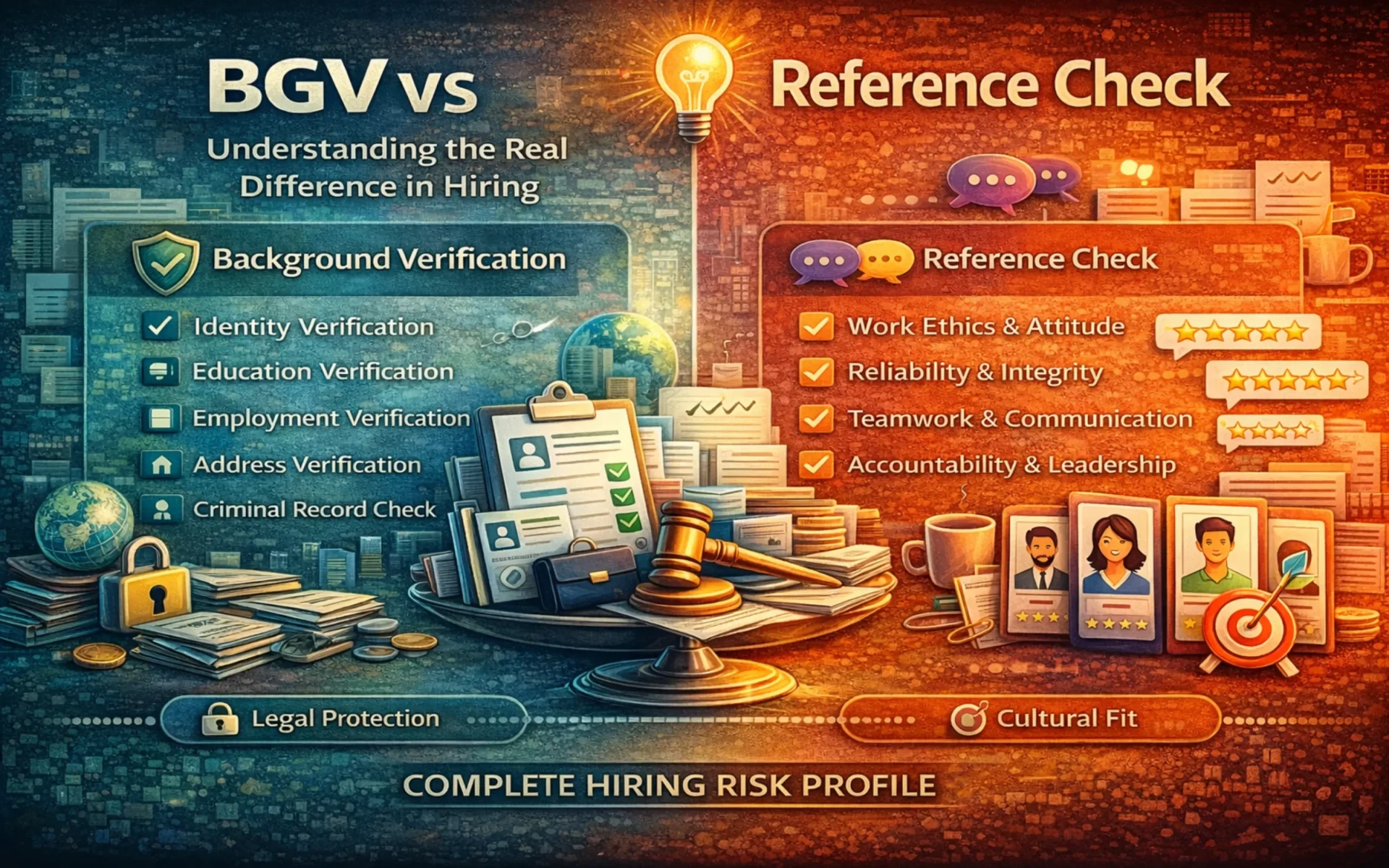
Background verification and reference checks are often mentioned together in hiring conversations, but they serve different purposes and provide different types of information.
A reference check gathers qualitative insights from people who have worked with or supervised a candidate. Background verification (BGV) focuses on validating information such as identity, education, employment history, address details, and other checks relevant to the role.
Understanding the difference helps organizations design a screening process that combines factual verification with meaningful professional insight.
What Does a Reference Check Actually Measure?
A reference check is a conversation with a person who can provide professional insight into a candidate's previous work or conduct. This may include a former manager, supervisor, colleague, or another professional reference.
Reference checks are generally used to understand areas such as:
- Work performance
- Professional conduct
- Strengths and development areas
- Responsibilities handled
- Communication and collaboration
- Reliability
- Leadership or management style
- Whether the referee would consider working with the candidate again
Because references are often provided by the candidate, employers should consider the context and limitations of the information received.
A reference check is therefore primarily qualitative. It helps answer questions such as:
“How did this person perform and work with others?”
However, reference feedback should not be treated as a substitute for independent verification of factual information.
What Does Background Verification Independently Confirm?
Background verification focuses primarily on validating information provided by a candidate through appropriate and, where possible, independent sources.
Depending on the organization's requirements and the role, BGV may include checks such as:
- Identity verification
- Address verification
- Education verification
- Employment verification
- Professional reference checks
- Relevant criminal or court-record checks
- Compliance and sanctions screening
- Other role-specific verification
For example, an employment verification may compare the candidate's stated employer, designation, and employment dates with information obtained through an appropriate employer or verification source.
The key distinction is that BGV is primarily designed to validate factual information, while reference checks provide additional professional context.
In simple terms:
Reference check: “What was this candidate like to work with?”
Background verification: “Can the candidate's stated information be independently verified?”
BGV vs Reference Check: Key Differences
| Factor | Background Verification | Reference Check |
|---|---|---|
| Primary purpose | Validate candidate information | Gather professional insight |
| Type of information | Primarily factual | Primarily qualitative |
| Typical sources | Institutions, employers, records, authorized databases | Managers, supervisors, colleagues, references |
| Education validation | Yes, where included | Generally no |
| Employment validation | Yes, where included | May provide supporting context |
| Identity validation | Yes, where included | No |
| Work-style insight | Limited | Stronger |
| Performance insight | Limited | Stronger |
| Fraud/discrepancy detection | Designed to identify factual discrepancies | Not its primary purpose |
| Role in hiring | Verification and risk assessment | Context and professional insight |
The two methods address different parts of the hiring decision and are therefore better viewed as complementary rather than interchangeable.
Where Each Method Helps — and Where It Has Limitations
Reference checks can be particularly useful when an employer wants to understand a candidate's working style, responsibilities, collaboration, leadership approach, or professional conduct.
However, reference feedback alone may not establish whether a candidate's educational qualifications, employment dates, designation, or other factual claims are accurate.
Background verification is designed to address those factual questions. However, it also has limitations. A BGV report generally cannot tell an employer everything about a candidate's personality, communication style, leadership ability, or day-to-day performance.
This is why combining appropriate verification checks with structured reference conversations can provide a more complete picture.
Why References Alone May Not Be Enough
A positive reference does not necessarily confirm every factual claim made by a candidate.
For example, a former manager may provide strong feedback about a candidate's work ethic while being unaware that the candidate has overstated their employment tenure or educational qualification elsewhere in their application.
Similarly, a professional reference may provide valuable insight into performance but may not have access to official employment, education, identity, or legal records.
Using references as the only screening mechanism can therefore leave certain factual discrepancies unidentified.
The appropriate approach depends on the organization's hiring policy, the sensitivity of the role, and the types of risks it needs to manage.
Building a Hiring Process That Uses Both
Organizations do not necessarily have to choose between BGV and reference checks. A well-structured hiring process can use both for different purposes.
1. Use BGV to Validate Relevant Facts
Verify information that is material to the role, such as identity, qualifications, employment history, or other applicable checks.
2. Use Structured Reference Checks for Professional Context
Ask consistent, role-relevant questions about performance, responsibilities, collaboration, and professional conduct.
3. Review Discrepancies Carefully
A discrepancy should not automatically be treated as evidence of fraud or misconduct. Employers should assess the nature of the discrepancy and provide an appropriate opportunity for clarification where required by their process.
4. Document the Process
Maintaining consistent records of verification results and reference feedback can help organizations apply their screening policies consistently and support appropriate internal review.
A Practical Example of the Difference
Consider a candidate who states that they worked for three years as a Project Lead at a particular company.
During a reference conversation, a former colleague may describe the candidate as reliable, collaborative, and effective at managing projects.
However, that conversation may not establish the candidate's exact employment dates or official designation.
An employment verification conducted through an appropriate source could reveal that the candidate worked at the company for eight months and held a different designation.
The two checks therefore provide different information:
The reference check provides professional context. The employment verification tests the accuracy of the candidate's stated employment information.
Neither check is designed to replace the other.
When Should Companies Use BGV and Reference Checks?
The appropriate screening combination depends on the role and the organization's requirements.
BGV may be particularly relevant where employers need to validate qualifications, employment history, identity, address information, or other role-specific information.
Reference checks can add value where employers want additional insight into previous responsibilities, professional conduct, performance, or working relationships.
For sensitive positions, organizations may use several complementary checks as part of a broader, role-based screening framework.
Key Takeaways
- BGV and reference checks serve different purposes.
- BGV primarily focuses on validating factual information provided by candidates.
- Reference checks provide qualitative insight into previous work and professional conduct.
- A reference check does not necessarily validate educational qualifications, employment dates, or identity information.
- BGV does not provide a complete picture of personality, working style, or performance.
- The two methods are complementary rather than interchangeable.
- Screening requirements should be based on the role, organizational policies, applicable requirements, and the type of risk being assessed.
- Discrepancies identified during verification should be reviewed carefully rather than automatically treated as proof of misconduct.
Conclusion
The difference between background verification and reference checks is important because they answer different hiring questions.
A candidate can receive excellent feedback from a former manager while still having an inaccurate employment date or qualification on their resume. Conversely, a candidate can have fully verifiable credentials while a reference raises useful questions about their working style or previous responsibilities.
BGV is primarily concerned with verifying relevant facts, while reference checks provide professional context and qualitative insight.
Verify, don't assume. CaseXpert independently confirms identity, education, employment and records so your hiring rests on facts, not friendly opinions. Talk to our verification specialists or send an enquiry to get started.