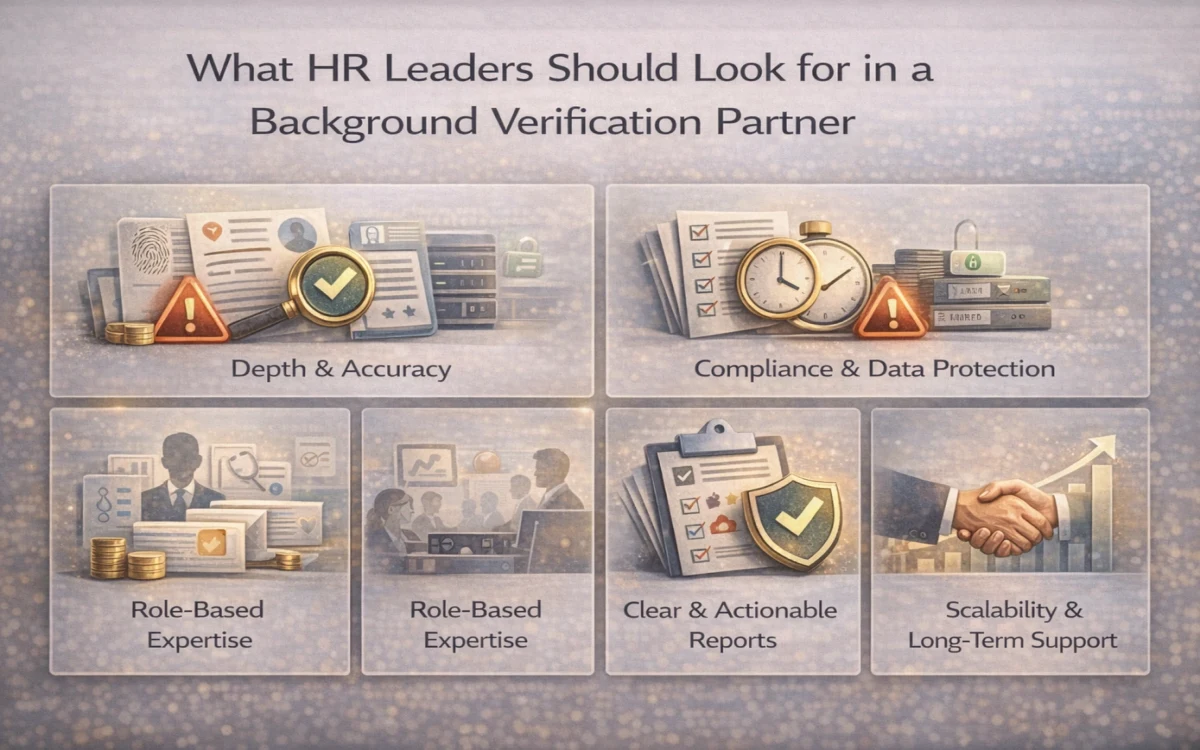
Choosing a background verification partner is one of the more consequential decisions an HR team makes, because the quality of the partner directly determines the quality of protection the company receives. A weak partner returns shallow reports that miss real risks; a strong one becomes a reliable safeguard around every hire. Yet many companies choose on price alone and discover the difference too late.
This article sets out what HR leaders should look for in a background verification partner: the capabilities that matter, the questions to ask, and the warning signs to avoid. Making this choice well is the difference between verification that genuinely protects and verification that merely appears to.
Depth and Accuracy of Checks #
The first and most important criterion is the depth and accuracy of the checks themselves. A good partner confirms credentials directly with institutions, validates employment with real sources, searches records across the right jurisdictions, and maps timelines to catch concealment. Shallow checks that merely confirm the easy facts provide false comfort, not protection.
Ask prospective partners exactly how they verify each component, what sources they use, and how they handle records that are not digitised. The quality of these answers reveals whether their reports will catch real risk or just look reassuring.
Speed and Real-Time Visibility #
A strong partner delivers thorough verification fast, running checks in parallel and providing real-time visibility into the status of every case. Speed matters because slow verification delays onboarding and tempts teams to cut corners, while visibility lets HR manage exceptions proactively rather than waiting in the dark.
Ask to see how a partner reports status. Real-time tracking is a strong signal of a modern, well-run operation; opaque processes are a warning sign.
Balance is key: the right partner is fast without being shallow, achieving speed through technology and parallel processing rather than by cutting checks.
Compliance and Data Protection #
Because verification handles sensitive personal data, a partner's approach to compliance and data protection is critical. They should build consent into every case, handle data securely and lawfully, limit collection to what is relevant, and maintain audit-ready records. A partner with weak data practices creates legal exposure rather than reducing it.
- Robust, documented consent processes
- Secure, lawful and limited data handling
- Alignment with India's data-protection expectations
- Audit-ready records for every case
Fair and Transparent Discrepancy Handling #
How a partner handles discrepancies reveals their quality and integrity. The best partners investigate findings carefully, give candidates a fair opportunity to clarify, and report results clearly with honest classification ??? verified, discrepant or unable to verify. Avoid partners who deliver opaque verdicts without the context HR needs to make fair, defensible decisions.
Fair discrepancy handling protects both the company and candidates, and it is a hallmark of a partner who understands that verification carries real consequences for real people.
Coverage and Scalability #
A partner must be able to cover the geographies and check types your hiring requires, and to scale with your volume. PAN-India coverage, the ability to handle distributed and remote hires, and capacity to absorb hiring surges without sacrificing quality are all important. A partner who cannot scale becomes a bottleneck precisely when you need them most.
Consider your future needs as well as your current ones ??? the right partner grows with you rather than constraining your growth.
Reporting Clarity and Support #
Verification is only useful if its results are clear and actionable. A good partner provides reports that HR can readily interpret and act on, and offers support in understanding findings and reaching decisions. The human relationship matters: a true partner feels like an extension of your team, not a black box returning cryptic results.
Evaluate the clarity of sample reports and the quality of support offered. These practical factors often separate a partner you can rely on from a vendor you merely transact with.
It is worth involving the people who will actually use the reports in this evaluation. A report that looks comprehensive to a salesperson may still be hard for a hiring manager to act on under time pressure. Testing real sample reports with your own team surfaces these practical gaps before you commit, and ensures the partner you choose fits how your organisation genuinely works.
Warning Signs to Avoid #
Finally, watch for warning signs: prices that seem too good to be true, vague answers about methods and sources, opaque reporting, weak data practices, and an inability to scale or cover your needs. These signals often indicate shallow checks that will fail you when it matters. The cheapest option frequently proves the most expensive.
- Prioritise depth, accuracy and honest methods
- Require speed with real-time visibility
- Insist on strong compliance and data protection
- Choose fair discrepancy handling and clear reporting
Key Takeaways #
Here are the essential points to carry forward from this guide:
- Depth and accuracy of checks matter more than anything else.
- Look for speed delivered through technology, with real-time visibility.
- Strong consent and data protection are essential, not optional.
- Fair, transparent discrepancy handling signals a quality partner.
- Ensure coverage and scalability match your current and future needs.
- Beware too-cheap pricing, vague methods and opaque reporting.
Conclusion #
Choosing the right background verification partner determines the quality of protection your company receives. The criteria that matter ??? depth and accuracy, speed with visibility, compliance and data protection, fair discrepancy handling, coverage and scalability, and clear reporting ??? separate a partner who genuinely safeguards your hiring from one who merely appears to.
The most common mistake is choosing on price alone, which rewards shallow checks that fail precisely when they are needed. A modest difference in fee is trivial beside the cost of a risk that a weak partner misses.
Invest the effort to evaluate partners against these criteria, ask the hard questions about methods and sources, and watch for the warning signs. The right partner becomes a quiet, reliable layer of protection around every hire ??? which is exactly what verification is supposed to be.
The quality of your verification partner is the quality of your protection. Choose on depth and integrity, never on price alone.
Choose wisely. CaseXpert combines deep, accurate checks, real-time visibility, strong compliance and clear reporting across India. Talk to our verification specialists or send an enquiry to get started.