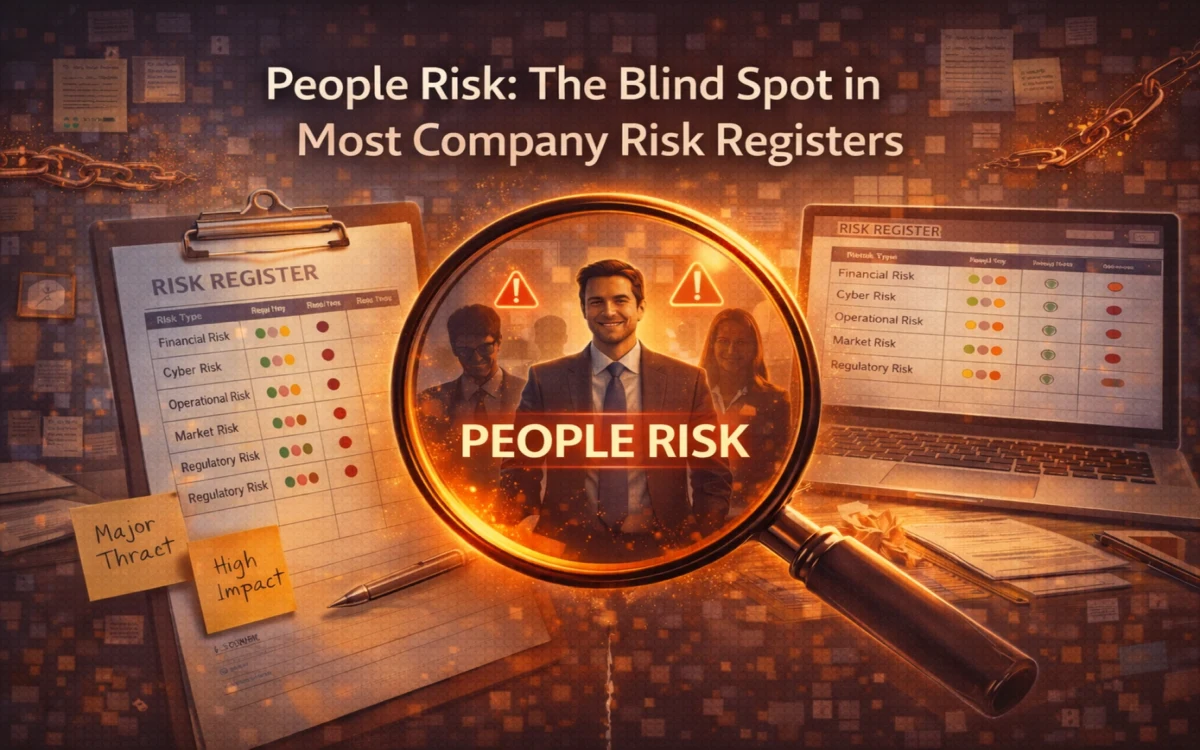
Most companies have a risk management strategy that carefully addresses financial, operational, cyber and compliance risks ??? yet quietly overlooks one of the most significant exposures of all: the people they hire. Every employee represents a potential risk, from fraud and data theft to negligence and reputational harm, and background verification is the control that manages this 'people risk'. It belongs squarely within risk management strategy, not isolated in HR.
This article argues for integrating background verification into every company's risk management strategy. It examines people risk as a core exposure, shows how verification functions as a risk control, and explains why treating verification as part of enterprise risk management strengthens the whole organisation.
People Risk Is a Core Exposure #
Every person a company employs is granted some measure of trust, access and authority ??? and with it, the potential to cause harm, whether through fraud, negligence, misconduct or misrepresentation. This 'people risk' is as real as financial or cyber risk, yet it is frequently absent from formal risk registers, treated as an HR matter rather than an enterprise exposure.
This blind spot is dangerous precisely because people risk can manifest anywhere in the organisation and can be severe. Recognising it as a core exposure is the first step to managing it properly through verification.
Verification as a Risk Control #
In risk management terms, background verification is a control that reduces the likelihood and impact of people risk. Just as access controls manage cyber risk and audits manage financial risk, verification manages the risk that a hire is not who or what they claim to be. Framing it this way places verification naturally within the risk management framework.
Verification is to people risk what access control is to cyber risk ??? the front-line control that prevents the exposure from materialising.
Like any control, verification's effectiveness depends on consistent application calibrated to the level of risk ??? which is exactly how risk management approaches controls generally.
Aligning Verification With Risk Appetite #
Risk management defines an organisation's risk appetite ??? how much risk it is willing to accept in pursuit of its goals. Verification should be calibrated to this appetite, applying deeper checks where the tolerance for people risk is lowest, such as roles with financial authority or data access, and lighter checks where the exposure is limited. This alignment makes verification proportionate and strategic.
Treating verification through the lens of risk appetite turns it from an undifferentiated HR step into a calibrated control that reflects the organisation's considered judgement about acceptable risk.
Verification in the Risk Register #
A mature risk management strategy documents key risks and their controls in a risk register. People risk belongs there, with verification recorded as its primary control. This makes the exposure visible to leadership, ensures it receives appropriate attention, and integrates verification into the governance and review processes that risk management provides.
- People risk documented as a recognised exposure
- Verification recorded as the primary mitigating control
- Regular review of control effectiveness
- Visibility of people risk at leadership level
Verification and Compliance Risk #
Verification also manages compliance risk ??? the risk of breaching regulatory or contractual obligations. In regulated sectors and for enterprise clients, inadequate verification is itself a compliance exposure. Integrating verification into risk management ensures these obligations are met systematically rather than left to chance, protecting the company from regulatory and contractual consequences.
This dual role ??? managing both people risk and compliance risk ??? makes verification a particularly efficient control, addressing multiple exposures through a single, well-designed process.
The Cost of Leaving People Risk Unmanaged #
When people risk is left out of risk management, it does not disappear ??? it simply goes unmanaged until it materialises. The resulting incidents, from fraud to breaches to scandals, are often more damaging precisely because they were never anticipated or controlled. Integrating verification into risk management closes this gap before it is exploited.
An organisation that rigorously manages every risk except the people it hires has a serious hole in its defences, however sophisticated its other controls.
Integrating Verification Into Strategy #
To integrate verification into risk management, companies should recognise people risk formally, record verification as its control in the risk register, calibrate verification to risk appetite, and review its effectiveness regularly. This elevates verification from an HR formality to a strategic control with leadership visibility ??? where it belongs.
- Recognise people risk as a core enterprise exposure
- Document verification as its primary control
- Calibrate verification to organisational risk appetite
- Review control effectiveness as part of risk governance
Key Takeaways #
Here are the essential points to carry forward from this guide:
- People risk ??? the risk that employees cause harm ??? is a core enterprise exposure.
- Verification is the front-line control that manages people risk.
- Calibrate verification to the organisation's risk appetite.
- Document people risk and verification in the risk register.
- Verification manages compliance risk as well as people risk.
- Unmanaged people risk does not disappear ??? it waits to materialise.
Conclusion #
Background verification belongs at the heart of every company's risk management strategy, because the people a company hires represent one of its most significant and least-managed exposures. People risk is as real as financial, cyber or compliance risk, and verification is the control that manages it.
Integrating verification into risk management ??? recognising people risk formally, recording verification as its control, calibrating it to risk appetite, and reviewing its effectiveness ??? transforms verification from an isolated HR task into a strategic safeguard with leadership visibility.
Companies that manage every risk except the people they hire leave a dangerous gap in their defences. Closing it by treating verification as enterprise risk management is one of the most sensible and high-return decisions a risk-aware organisation can make.
A company that manages every risk except the people it hires has a hole in its defences. Verification is how you close it.
Manage people risk. CaseXpert helps you treat verification as the enterprise risk control it is ??? calibrated, documented and built to protect. Talk to our verification specialists or send an enquiry to get started.