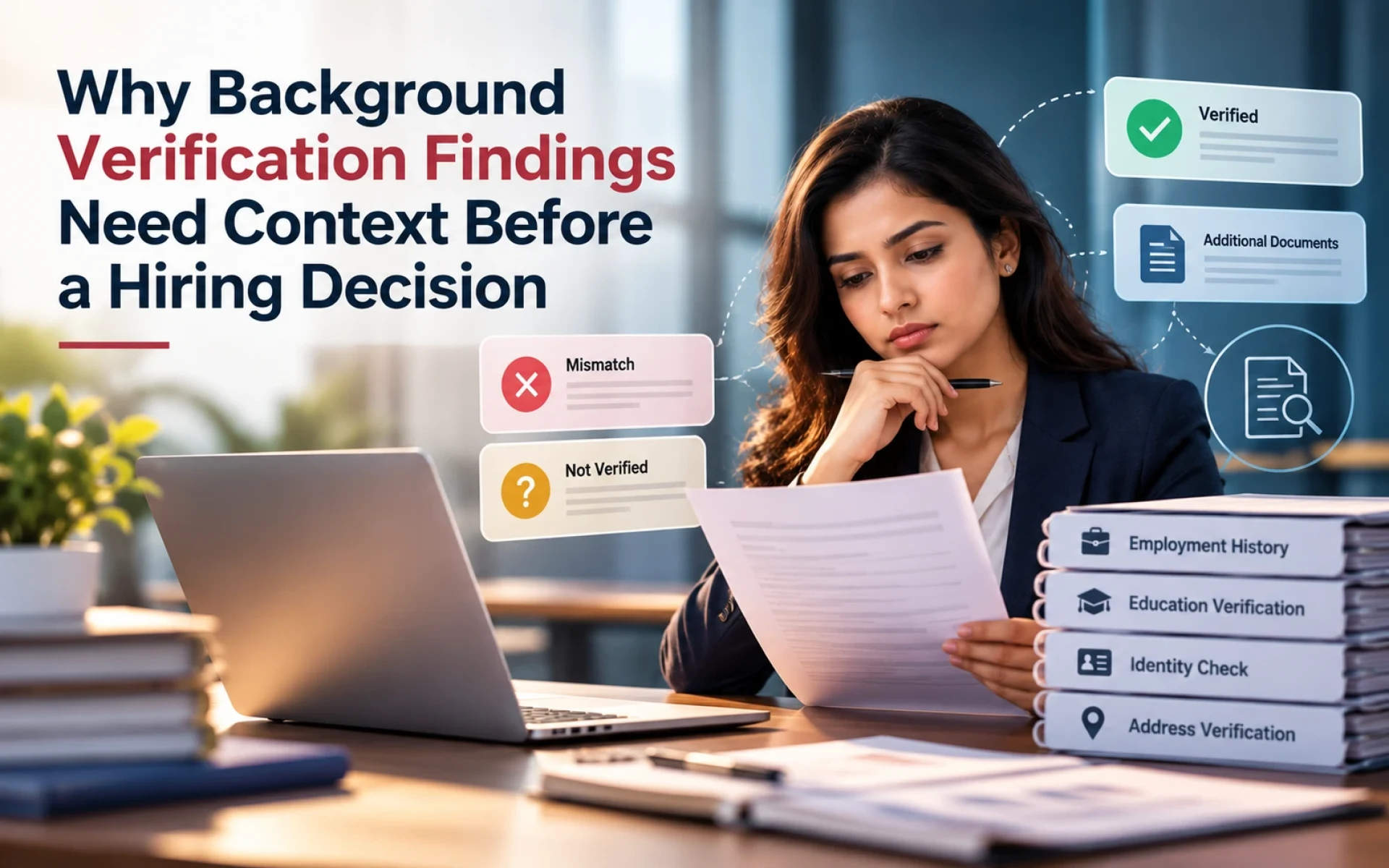
A background verification report is often most valuable when something does not match. The discrepancies and inconsistencies it surfaces — the red flags — can serve as early signals that a candidate’s information may require closer review. Knowing how to recognise and interpret these signals is what turns verification from a formality into a more informed hiring process.
This article explores common background verification red flags in India, explains what each one may indicate, and shows how HR teams can respond proportionately. The goal is not to treat every anomaly as proof of fraud, but to identify which signals deserve further investigation and which may have legitimate explanations.
Employment Timeline Inconsistencies
Among the common red flags are inconsistencies in an employment timeline. Overlapping employment dates may require clarification, unexplained gaps may need additional context, and dates that differ from employer records can indicate an inconsistency that warrants further review.
These findings should not automatically be interpreted as evidence of wrongdoing. For example, overlapping dates can sometimes result from notice periods, part-time arrangements, contractual work, or inaccurate record-keeping.
Cross-referencing candidate-provided information with appropriate independent sources helps HR teams understand whether an inconsistency is a genuine concern or simply an issue that needs clarification.
Education and Credential Discrepancies
Credentials that cannot be verified, qualifications that do not match institutional records, or documents that appear inconsistent with the information provided by the candidate can be important verification findings.
A certificate may appear authentic without necessarily confirming that the underlying qualification is genuine. Where appropriate, education verification should rely on relevant issuing institutions or authorised verification channels rather than appearance alone.
Possible red flags include:
- Qualification details that do not match institutional records
- Degree or certificate information that cannot be verified
- Differences in course names, dates, or awarding institutions
- Documents that appear inconsistent or potentially altered
A discrepancy should be investigated before conclusions are drawn.
Identity and Document Anomalies
Identity information forms an important foundation for background verification. Mismatched names, inconsistent personal details across documents, or documents that appear altered may require additional confirmation.
However, these differences can have legitimate explanations. A name change, spelling variation, clerical error, or difference in how information is recorded across systems does not automatically indicate fraud.
Common areas that may require clarification include:
- Names that differ across documents
- Inconsistent dates of birth or other personal details
- Documents that appear altered or inconsistent
- Address information that cannot be independently verified
The appropriate response is to confirm the information through relevant sources rather than assuming the discrepancy represents deliberate misrepresentation.
Reluctance and Evasiveness
Candidate cooperation can also affect the verification process. Repeatedly failing to provide required information, giving inconsistent explanations, or delaying the submission of relevant documents may create a need for follow-up.
However, reluctance should be interpreted carefully. Candidates may have legitimate privacy concerns, may need additional time to obtain older documents, or may face difficulties obtaining records from previous employers or institutions.
The important factor is the overall pattern and the context surrounding it. Persistent unexplained inconsistencies may warrant additional review, but candidate behaviour alone should not be treated as proof of dishonesty.
Adverse Records and Misrepresented History
Where relevant to the role and verification scope, adverse findings or differences between disclosed information and verified records may require careful review.
For example, an employment record may differ from the candidate’s stated history, or a relevant court-record finding may require further investigation. The significance of any such finding depends on factors including accuracy, relevance, context, and the requirements of the role.
A court or criminal-record finding should not automatically be treated as proof of wrongdoing. Similarly, an employment discrepancy should not automatically be interpreted as deliberate concealment.
HR teams should review the underlying information carefully and follow consistent internal procedures before making an employment decision.
How to Respond to a Red Flag
A red flag is a prompt for investigation, not an automatic verdict. The appropriate response is proportionate to the nature of the finding and its relevance to the role.
Where appropriate, the candidate can be given an opportunity to clarify a discrepancy or provide supporting information. HR teams should then assess the available evidence against established internal criteria.
- Classify the finding based on its nature and relevance
- Review the underlying evidence and verification source
- Give the candidate an appropriate opportunity to clarify where relevant
- Distinguish genuine discrepancies from explainable differences
- Apply consistent internal criteria to the final decision
This approach helps organisations avoid both extremes — overlooking meaningful findings and treating minor discrepancies as evidence of misconduct.
Distinguishing Real Flags From Innocent Ones
One of the most important parts of background verification is distinguishing meaningful discrepancies from legitimate anomalies.
Many differences can have straightforward explanations: a name change after marriage, a company that has closed or changed its name, a clerical error in an older record, differences in date formatting, or an employment gap related to education or personal circumstances.
Treating every anomaly as proof of fraud can result in unfair or inaccurate conclusions.
The value of a structured verification process lies in evaluating findings based on their severity, relevance, source, and context. A single minor mismatch may require nothing more than clarification, while multiple significant inconsistencies across independent checks may warrant deeper review.
Looking at findings together — rather than in isolation — can provide a more complete picture and support more informed decision-making.
Key Takeaways
Here are the essential points to carry forward from this guide:
- Employment timeline inconsistencies may require additional clarification.
- Educational credentials should be verified through appropriate sources rather than appearance alone.
- Identity and document discrepancies should be investigated before conclusions are drawn.
- Delays or reluctance during verification should be considered in context.
- Adverse records and differences in disclosed history require careful, role-relevant assessment.
- A red flag is a signal for further investigation, not an automatic hiring verdict.
- Consistent policies and evidence-based review help HR teams handle discrepancies fairly.
Conclusion
Red flags are an important part of background verification because they identify information that may need closer examination. Employment inconsistencies, credential discrepancies, identity anomalies, incomplete information, and differences between disclosed and verified records can all provide useful signals for HR teams.
Just as important as identifying a red flag is knowing how to respond to it. A discrepancy should lead to investigation and, where appropriate, clarification — not an automatic assumption of fraud or misconduct.
Companies that train their teams to identify and assess verification findings carefully can use background verification as an early-warning mechanism while maintaining a fair and consistent hiring process.
Context is essential when interpreting red flags. The same finding can have very different significance depending on the role, the source of the information, the age of the record, and the explanation provided. A name variation, employment gap, or timeline difference may have a legitimate explanation, while a pattern of material inconsistencies across independent sources may warrant closer review.
A red flag is not a verdict — it is a question. The skill lies in asking it fairly and letting the evidence, not the assumption, guide the decision.
Catch the warning signs. CaseXpert surfaces and clearly flags discrepancies so your team can investigate fairly and decide with confidence. Talk to our verification specialists or send an enquiry to get started.