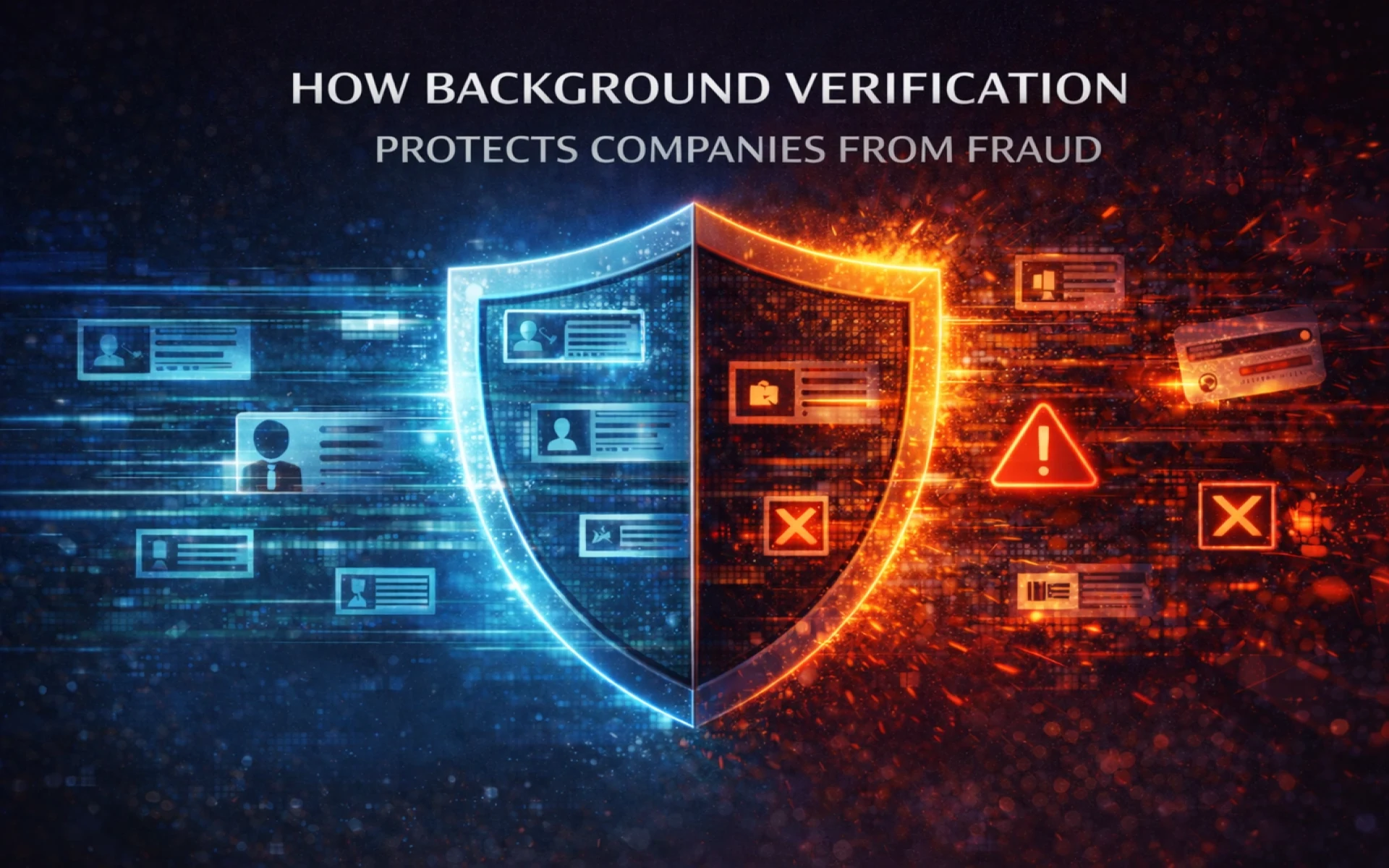
Fraud in hiring can take many forms, from inaccurate resumes and fabricated credentials to identity-related misrepresentation and undisclosed employment information. Background verification helps organisations reduce these risks by comparing candidate-provided information with relevant independent sources.
Rather than relying solely on resumes, interviews, or candidate declarations, verification introduces an additional layer of evidence into the hiring process. This can help HR teams identify discrepancies before making an employment decision and address potential risks in a structured way.
This article explains how background verification can help companies detect fraud-related discrepancies, the types of issues it may uncover, and how organisations can build appropriate verification into their hiring processes.
Resume and Credential Fraud
Resume and credential discrepancies can include inflated job titles, inaccurate employment dates, fabricated employers, or qualifications that cannot be verified.
Background verification helps identify these issues by comparing information provided by candidates with appropriate independent sources, such as previous employers, educational institutions, or authorised records.
A candidate may present information convincingly during an interview, but independent verification provides an additional way to assess whether important claims can be supported.
This can be particularly relevant for roles where qualifications, experience, or specialist credentials are important to the position.
Identity Fraud
Identity-related discrepancies can create a significant concern during hiring. Examples may include inconsistent personal information across documents or information that does not match the identity details provided during the recruitment process.
Identity verification helps establish that the information being checked relates to the individual being considered for employment.
This is important because subsequent checks — such as education or employment verification — need to be associated with the correct person. Where inconsistencies are identified, they should be investigated and clarified rather than automatically treated as evidence of fraud.
Employment History Fraud
Employment history can be misrepresented in several ways, including inaccurate job titles, altered employment dates, fabricated experience, or unexplained inconsistencies in an employment timeline.
Independent employment verification can help organisations compare candidate-provided information with available employer records.
Possible areas of review include:
- Confirming relevant previous employers
- Validating employment dates and roles
- Identifying inconsistencies in employment timelines
- Reviewing unexplained gaps or overlaps
- Clarifying differences between candidate-provided and verified information
An employment discrepancy does not automatically indicate deliberate deception. Notice periods, contractual work, record-keeping differences, and other legitimate circumstances can sometimes explain apparent inconsistencies.
Insider Risk and Relevant History
Background verification can also form part of an organisation’s broader approach to managing people-related risk.
Depending on the role, this may involve reviewing relevant employment history, identity information, qualifications, or appropriate records. Positions involving access to sensitive systems, financial information, customer data, or other critical resources may require a verification scope tailored to their responsibilities and applicable requirements.
However, no background check can identify or prevent every future insider-risk event. Verification is one component of a broader risk-management framework that may also include access controls, monitoring, policies, training, and ongoing governance.
How Verification Helps Detect Fraud
One of the key strengths of background verification is the use of information from sources beyond the candidate’s own declarations.
When relevant claims are compared against independent or authorised sources, inconsistencies that may not be apparent from a resume or interview can become visible.
For example:
- A claimed qualification may not match institutional records
- Employment dates may differ from information provided by a former employer
- Personal details may be inconsistent across verification documents
- A timeline may contain gaps or overlaps requiring clarification
Cross-referencing multiple relevant checks can provide a more complete picture than relying on a single source of information.
The objective is not to assume that every discrepancy represents fraud, but to identify information that requires further review.
Building Fraud-Resistant Hiring Practices
Companies can incorporate background verification into their hiring process in a consistent and proportionate way.
- Define verification checks according to the role and its requirements
- Establish the candidate’s identity before linking information across checks
- Compare important claims with appropriate independent sources
- Review discrepancies and provide clarification opportunities where appropriate
- Apply consistent internal criteria when evaluating findings
- Maintain appropriate records of the verification process
A consistent approach can reduce the possibility of important checks being overlooked while helping HR teams handle findings more systematically.
The Value of Cross-Referencing
The value of background verification can increase when relevant information from different checks is considered together.
For example, an employment claim may be compared with the candidate’s stated timeline, education history, and other relevant information. If different sources contain conflicting information, those differences can be investigated before a decision is made.
Cross-referencing does not mean assuming that inconsistencies are fraudulent. Instead, it gives HR teams additional evidence with which to understand the candidate’s history.
The more relevant and reliable the verification sources, the better positioned an organisation may be to identify information that requires clarification.
Key Takeaways
Here are the essential points to carry forward from this guide:
- Background verification can help identify discrepancies associated with resume and credential fraud.
- Identity verification helps ensure that subsequent checks relate to the correct individual.
- Employment verification can uncover differences in roles, dates, and employment history.
- Role-appropriate checks can form part of a broader approach to managing people-related risk.
- Independent sources provide evidence beyond candidate-provided information.
- Cross-referencing relevant checks can help identify inconsistencies that require further investigation.
- A discrepancy should be investigated rather than automatically treated as proof of fraud.
- Background verification reduces hiring-related risk but does not eliminate fraud or future insider risk entirely.
Conclusion
Background verification helps companies address fraud-related hiring risks by introducing independent evidence into the recruitment process. Across resume discrepancies, credential issues, identity inconsistencies, and employment-history concerns, verification provides HR teams with additional information to review before making an employment decision.
Its value comes not from treating every discrepancy as fraud, but from identifying information that deserves closer examination. When relevant checks are performed consistently and findings are reviewed in context, organisations can make hiring decisions based on a stronger evidence base.
For companies looking to reduce hiring-related fraud risk, background verification can therefore serve as an important part of a broader risk-management and hiring framework. It works alongside interviews, reference checks, access controls, policies, and ongoing employee-management practices rather than replacing them.
The goal is simple: verify important claims, investigate meaningful discrepancies, and make hiring decisions based on evidence rather than assumptions.
Fraud can thrive when important information is never tested. Verification adds an independent layer of evidence — helping companies identify discrepancies at the point where they can still be investigated and addressed.
Replace trust with proof. CaseXpert's independent, multi-source verification defeats resume, identity and employment fraud before it reaches your team. Talk to our verification specialists or send an enquiry to get started.