Employee screening done well is often invisible — it quietly helps organisations identify relevant hiring risks while allowing suitable candidates to move through the process without unnecessary friction. Done poorly, screening can either overlook important discrepancies or frustrate candidates through delays, inconsistent requirements, and unclear communication.
The difference comes down to following practical, well-structured screening practices that growing companies can adopt regardless of size.
This article sets out employee screening best practices that matter for companies in India: building appropriate consent and data-protection practices into the process, tailoring checks to the role, running them efficiently, handling findings fairly, and reviewing screening practices as the organisation grows. Together, these practices create a more structured approach to screening that supports the business while respecting candidates.
Build Consent and Compliance In From the Start
An important starting point is to establish the appropriate legal and organisational framework before screening begins. Depending on the checks being conducted and the applicable requirements, this may include obtaining appropriate consent or authorisation, providing relevant information to candidates, limiting data collection to defined purposes, and applying suitable security and access controls.
The exact requirements can vary according to the type of information being processed, the purpose of the verification, applicable law, contractual requirements, and organisational policies.
Building these considerations into the screening workflow from the beginning is generally more effective than addressing them only after a process has been established.
Tier Checks by Role Risk
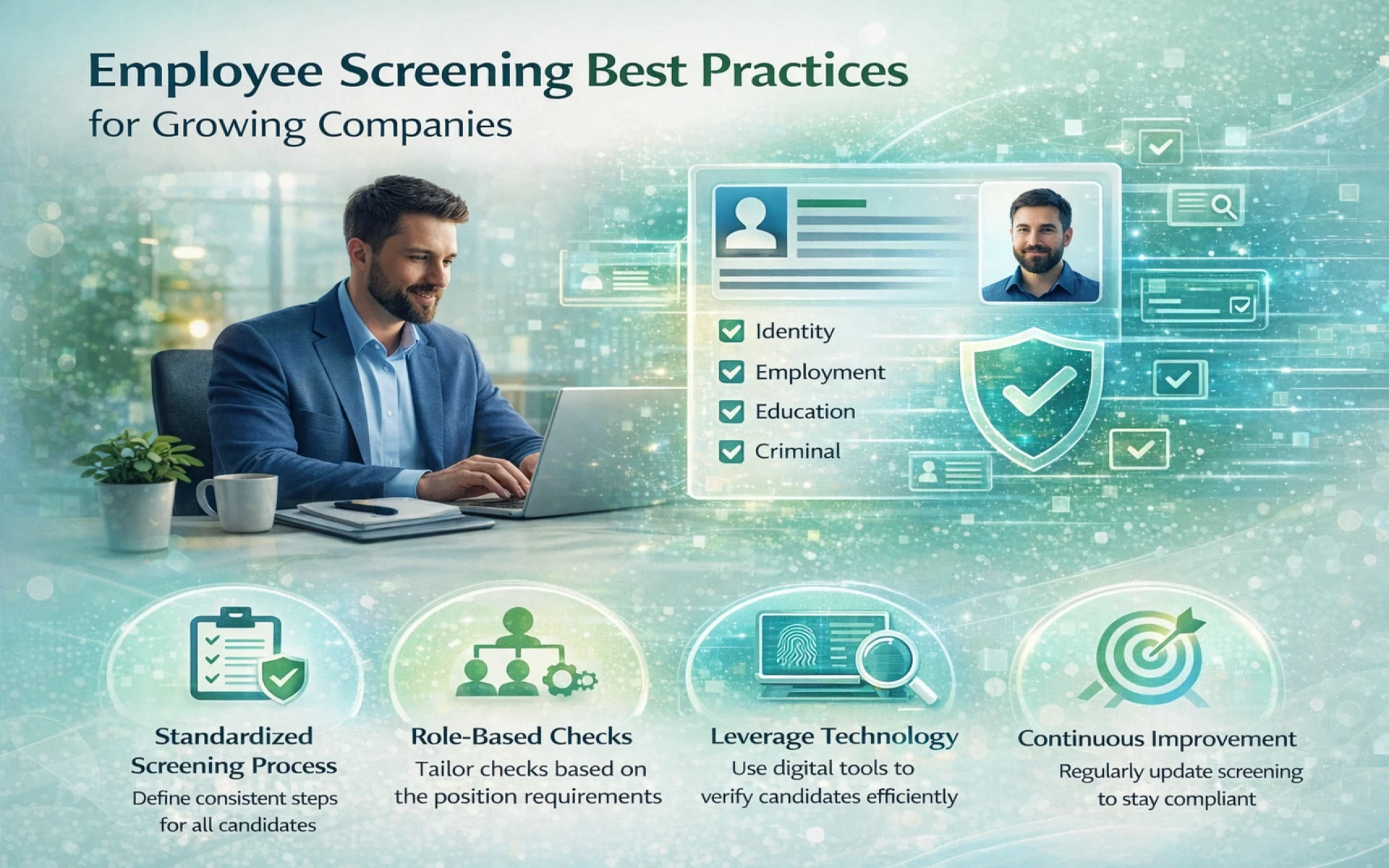
Not every position requires the same depth of screening. A practical approach is to consider factors such as the role’s responsibilities, access to sensitive information, financial authority, customer exposure, and applicable industry requirements.
Based on these factors, organisations can establish proportionate verification packages for different categories of roles.
Role-based screening can help companies focus resources where they are most relevant while avoiding unnecessary checks for positions that do not require them.
Verify the Components That Matter
Effective screening should focus on information that is relevant to the role and the organisation’s verification objectives.
Depending on the position and scope, checks may include identity, address, education, employment history, and relevant records.
- Identity verified through appropriate sources
- Education verified through relevant institutions or authorised channels
- Employment history validated and timelines reviewed
- Records checks selected according to the role and applicable requirements
- Address information verified through appropriate methods where relevant
The exact screening package should be determined by the role, the organisation’s policy, and the requirements that apply to the particular verification.
Run Screening Efficiently
Screening should provide useful information without creating unnecessary delays in the hiring process.
Companies can improve efficiency by starting the process at an appropriate stage, collecting required information through a structured workflow, running compatible checks in parallel where possible, and using status tracking to identify cases requiring additional action.
Verification timelines can vary depending on the type of check, availability of records, and response times from verification sources. A technology-enabled workflow can help reduce avoidable administrative delays while keeping the process organised.
Efficiency matters because unnecessarily complicated screening can create friction for both HR teams and candidates. A clear and well-managed process makes thorough screening easier to maintain as hiring volumes increase.
Handle Findings Fairly and Consistently
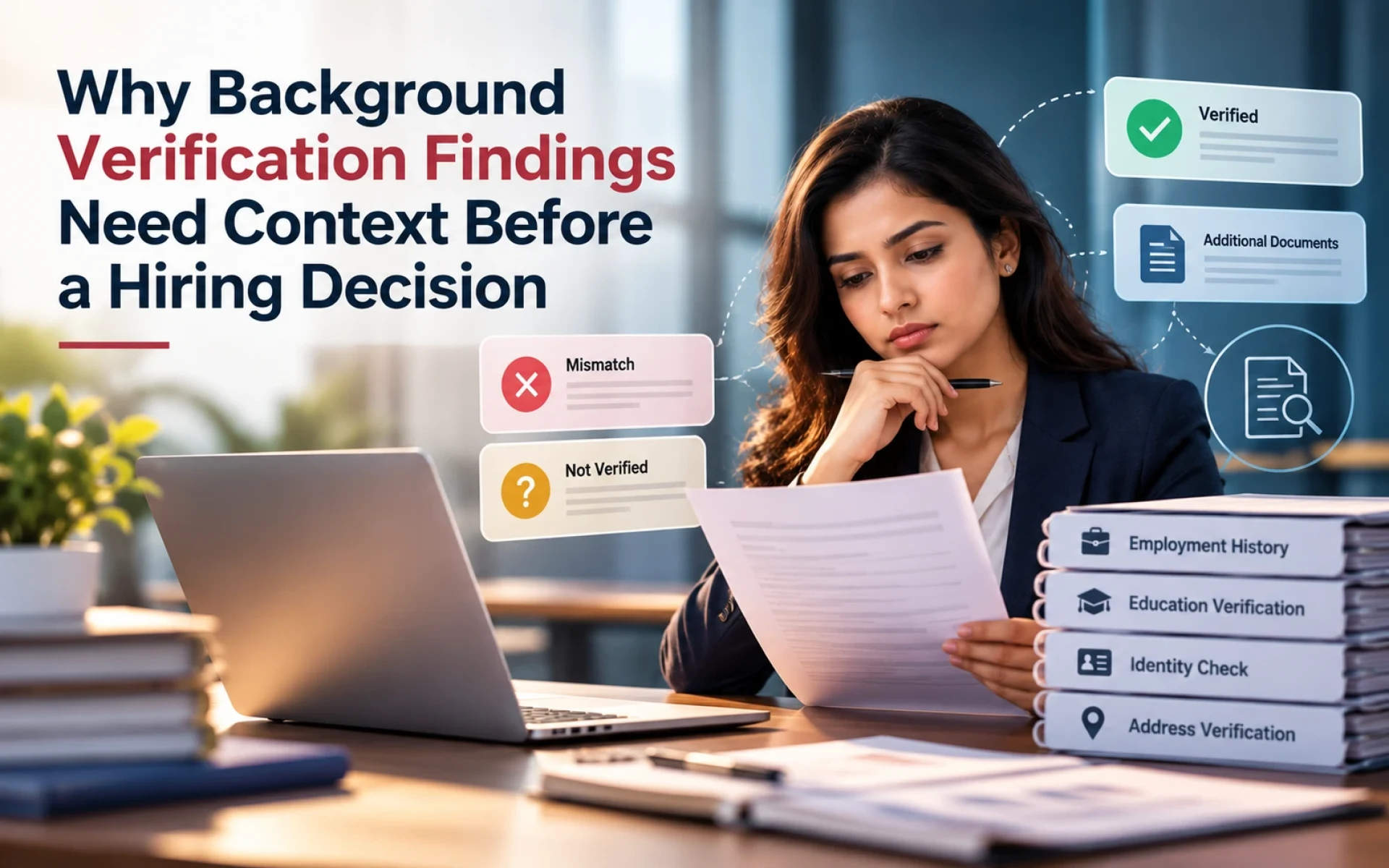
When a discrepancy is identified, it should be reviewed rather than automatically treated as proof of fraud or misconduct.
A structured approach can include assessing the nature and relevance of the finding, reviewing the underlying evidence, allowing appropriate clarification where relevant, and applying established internal criteria consistently.
Fair and consistent handling is important because the same type of finding should not be interpreted differently simply because different people are reviewing it.
Organisations should also distinguish between an adverse finding, a discrepancy, and an inability to verify information. These outcomes can have different meanings and should not automatically lead to the same response.
Treat Screening as an Ongoing Discipline
Background verification is often conducted before or during onboarding, but an organisation’s screening framework should also be reviewed as its workforce, roles, systems, and risk profile change.
For certain roles or circumstances, organisations may consider additional or periodic verification where there is an appropriate business, contractual, regulatory, or policy basis.
The objective should not be to re-check everyone automatically. Instead, companies should establish clear criteria for when additional verification may be appropriate.
- Build appropriate consent, privacy, and data-handling practices into the process
- Tailor screening to role responsibilities and relevant risk factors
- Start verification at an appropriate stage and manage checks efficiently
- Handle findings using consistent review criteria
- Review screening policies as the organisation and its requirements evolve
Communicating Screening to Candidates
An often-overlooked best practice is communicating clearly with candidates about the screening process.
Candidates are more likely to engage smoothly when they understand what information is being requested, what types of checks may be conducted, why the information is relevant, and how the organisation intends to handle it.
Clear communication can reduce confusion, encourage timely submission of required information, and help candidates raise legitimate questions before they become process delays.
Transparency can also contribute to a better candidate experience. A screening process that is clearly explained is less likely to feel unexpected or intrusive.
Communication should also allow candidates to provide relevant context when an apparent discrepancy arises. A name variation, employment gap, or difference in an old record may have a legitimate explanation that is not immediately visible from the verification data alone.
Key Takeaways
Here are the essential points to carry forward from this guide:
- Establish appropriate consent, privacy, and data-handling practices from the beginning.
- Tailor screening checks to the role rather than applying the same package to everyone.
- Focus on information that is relevant to the verification objective.
- Use structured workflows and tracking to manage screening efficiently.
- Review discrepancies carefully instead of treating every finding as misconduct.
- Apply consistent criteria when evaluating verification findings.
- Communicate clearly with candidates throughout the process.
- Review screening practices as the organisation, workforce, and requirements evolve.
Conclusion
Strong employee screening is not simply a collection of individual checks. It is a structured process that considers data protection, role requirements, verification scope, efficiency, candidate communication, and consistent handling of findings.
Growing companies often begin with informal screening and face greater complexity as hiring volumes increase. Establishing a clear screening framework early can help create consistency without introducing unnecessary bureaucracy.
The most effective approach is proportionate. Companies should verify information that is relevant to the role, use appropriate sources, handle candidate information responsibly, and review findings based on evidence and context.
Technology and specialist verification providers can further support this process by helping organisations manage document collection, verification workflows, status tracking, and reporting more efficiently.
Good screening should therefore be noticeable in the quality of the process, but not unnecessarily burdensome for the people moving through it.
Finally, communication should work in both directions. Candidates benefit from understanding the process, while employers benefit from hearing relevant explanations when a discrepancy appears. Treating screening as a structured and respectful process can help organisations improve both the accuracy of verification and the overall candidate experience.
Great screening is structured and proportionate — helping organisations identify relevant risks while giving candidates a fair, clear, and consistent verification experience.
Screen smarter. CaseXpert helps growing companies run consistent, compliant, role-based screening that protects the business and respects candidates. Talk to our verification specialists or send an enquiry to get started.