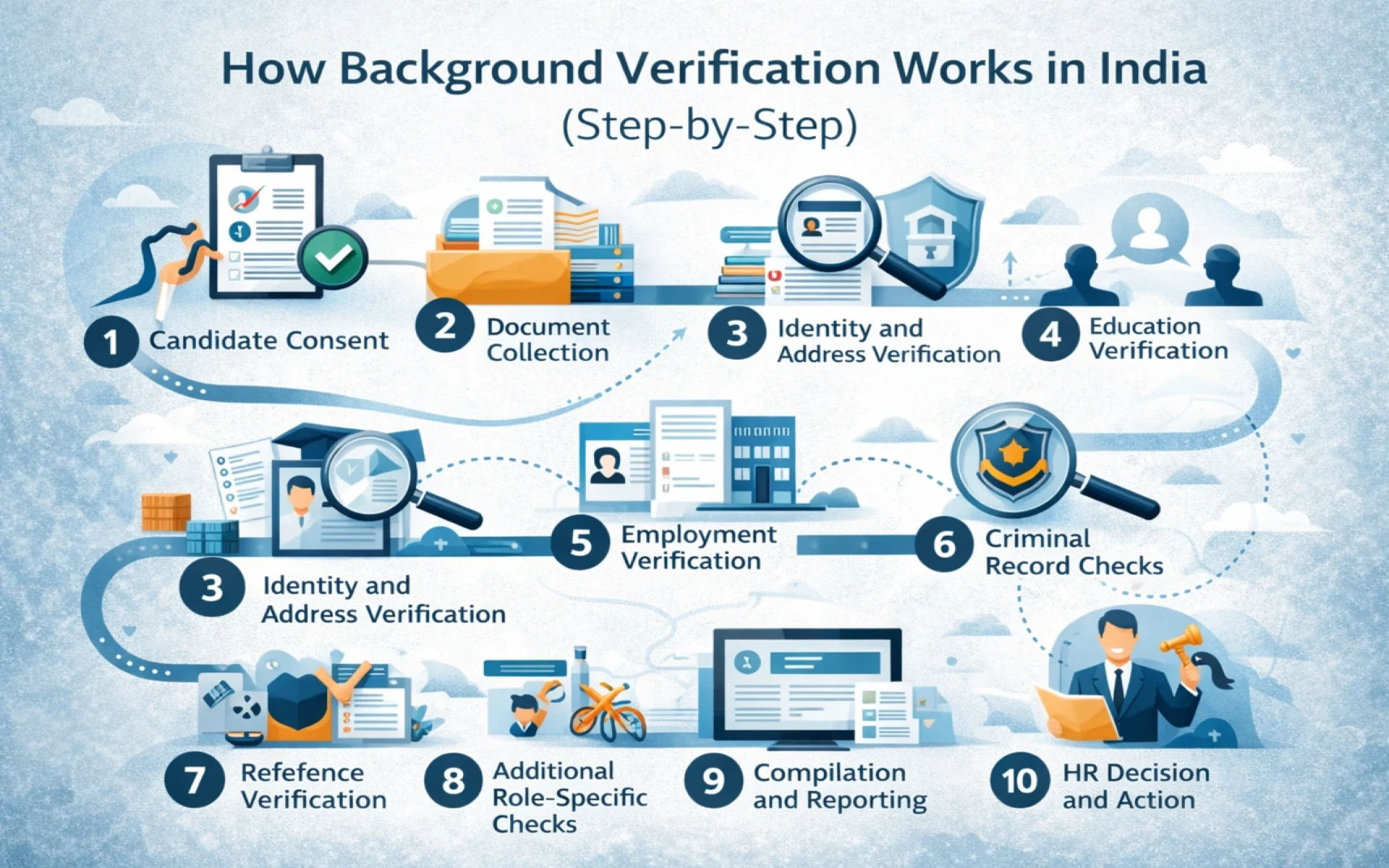
Background verification can look like a black box from the outside: a candidate submits documents, time passes, and a report appears. In reality, it is a structured, multi-stage process with clear inputs, defined checks, and a logical flow. Understanding how it works helps HR teams set expectations, prepare candidates, and interpret results more effectively.
This step-by-step guide walks through how background verification works in India—from the initial authorisation and document collection through individual verification checks to the final report. Whether you manage verification in-house or through a verification partner, understanding the process can make BGV easier to manage and more transparent.
Step 1: Consent and Document Collection
The process typically begins with the organisation defining the scope of verification and providing the candidate with the relevant disclosures and authorisations. Where consent is the applicable legal basis, appropriate consent is obtained before the relevant checks are conducted.
The candidate may then provide supporting documents and information, such as identity documents, educational certificates, employment records, and address details, depending on the scope of the verification.
This stage establishes the information required for subsequent checks. Complete and accurate submissions can help reduce delays, while missing documents, unclear information, or inconsistencies may require additional clarification.
Step 2: Identity and Address Verification
Once the required information is available, identity details may be validated using appropriate government-issued or officially recognised documents, such as PAN, Aadhaar, passport, or other accepted identification documents.
Where address verification is part of the scope, the candidate's current or relevant previous address may also be verified using appropriate methods, which can include database checks, document validation, digital verification, or physical verification where required.
Identity information is particularly important because it helps ensure that subsequent records and findings are associated with the correct individual.
Step 3: Education Verification
Educational qualifications are verified against information provided by the candidate. Depending on the institution and verification method, this may involve confirmation with universities, colleges, examination boards, authorised databases, or other relevant sources.
The verifier may check details such as:
-
Institution name
-
Qualification or degree
-
Course or programme
-
Dates of attendance or completion
-
Roll number or registration details, where applicable
Foreign qualifications may require additional verification steps depending on the country, institution, and nature of the credential.
Because response times vary between institutions and verification sources, education checks can sometimes take longer than other components.
Step 4: Employment Verification
Employment verification helps confirm the candidate's previous work history against the information provided during recruitment.
Depending on the scope, the verifier may confirm:
-
Previous employer
-
Designation or job title
-
Employment start and end dates
-
Location or department, where relevant
-
Reason for leaving, where appropriate and lawfully obtainable
-
Other employment details relevant to the verification
Where multiple employers are being checked, the information can also help identify inconsistencies in employment timelines, unexplained gaps, or overlapping employment periods that may require clarification.
Step 5: Criminal and Court Record Checks
Where criminal or court-record verification is relevant to the role and included within the scope of the BGV process, appropriate records and sources may be searched in accordance with applicable laws and procedures.
The scope of such checks can vary based on factors such as the role, jurisdiction, available records, and the verification methodology being used.
Importantly, a court-record or criminal-record finding should not automatically be treated as proof of wrongdoing or as an automatic reason for rejection. Findings should be reviewed for accuracy, relevance, context, and applicable organisational policy before an employment decision is made.
Step 6: Report Compilation and Decision
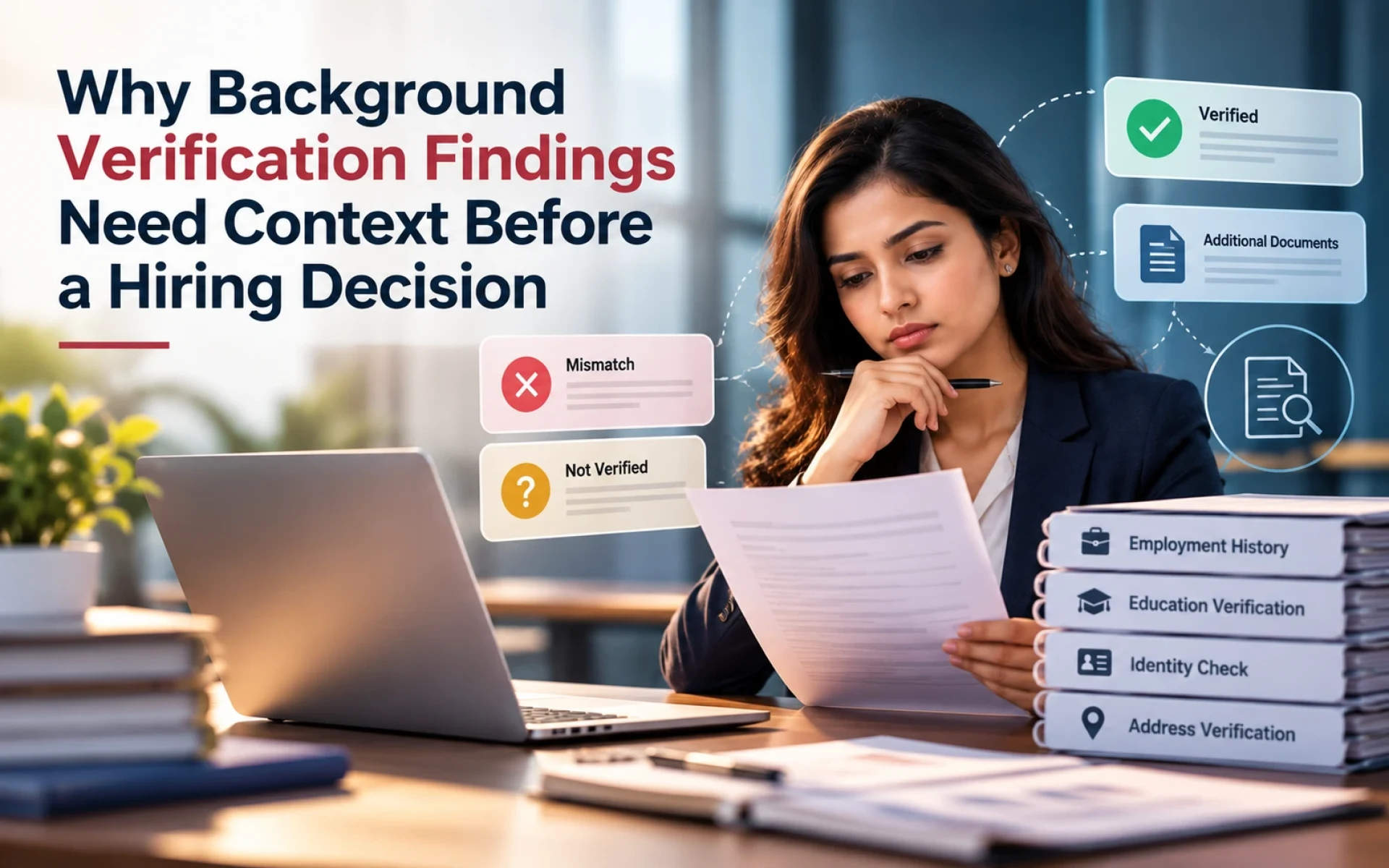
After the individual checks are completed, the findings are consolidated into a background verification report. Different providers may use different status categories, but reports commonly distinguish between outcomes such as verified, discrepancy, pending, or unable to verify.
A typical workflow may involve:
-
Recording the outcome of each verification check
-
Flagging discrepancies or incomplete results
-
Seeking additional information or clarification where appropriate
-
Assessing relevant findings against the role and organisation's policy
-
Making and documenting the employment decision
A discrepancy does not necessarily mean that a candidate has provided false information. Differences in dates, names, addresses, institutional records, or employment documentation may have legitimate explanations and should be assessed in context.
How Technology Speeds the Whole Process
Modern BGV platforms combine verification workflows with technology to reduce manual effort and improve visibility. Digital document collection, automated status tracking, workflow management, and integrations with relevant verification sources can help HR teams monitor the progress of multiple checks in one place.
Technology can also improve consistency by ensuring that predefined workflows and verification requirements are followed across candidates. Automated alerts and dashboards can help identify pending checks and reduce avoidable delays.
However, technology does not eliminate the need for human judgement. Automated systems can support routine validation and identify potential discrepancies, while experienced verification professionals can review exceptions, interpret ambiguous findings, and determine when additional clarification is appropriate.
The most effective approach combines automation with human oversight—using technology for speed and consistency while retaining appropriate human review for complex or sensitive findings.
Key Takeaways
Here are the essential points to carry forward from this guide:
-
Background verification is a structured, multi-stage process involving different checks.
-
The process generally includes authorisation, information and document collection, verification, reporting, and review.
-
Identity information helps connect subsequent verification findings to the correct individual.
-
Education and employment checks may depend on responses from third-party institutions or previous employers.
-
Criminal and court-record checks should be conducted through appropriate sources and interpreted in context.
-
A discrepancy or inability to verify does not automatically establish fraud or wrongdoing.
-
Technology can improve speed, visibility, and consistency, but human review remains important for complex findings.
Conclusion
Background verification in India is far from a mysterious black box—it is a structured sequence of information collection, verification checks, review, and reporting that helps organisations assess relevant candidate information.
Once HR teams understand each stage, they can prepare candidates more effectively, anticipate potential delays, and interpret verification results with greater clarity.
For candidates, understanding the process can also make BGV more transparent. Knowing what information is being verified, why particular checks are relevant, and how discrepancies may be reviewed can help create a more predictable experience for everyone involved.
Ultimately, effective background verification is not simply about collecting documents or running automated checks. It is about establishing a structured process for confirming relevant information, identifying discrepancies, and supporting informed employment decisions.
Verification is not magic - it is method. Understand each step, and a confusing process becomes a confident, repeatable one.
See the full picture. CaseXpert runs each stage transparently with real-time tracking and clear, decision-ready reports across India. Talk to our verification specialists or send an enquiry to get started.