Few situations test an HR team like a background verification failure that surfaces after an offer letter has already been issued. The candidate may have resigned from their previous organisation, informed their family and network, and started preparing for a new role. Then a verification report raises a concern: an employment period does not match, a qualification cannot be confirmed, or a previous employment detail appears materially different from what was declared.
At that point, HR has to balance several competing considerations: protecting the organisation, treating the candidate fairly, following internal policy, and understanding the legal implications of an offer that may already have been accepted.
The key is not to react to the word “failed.” A verification exception is a finding that needs to be assessed. Some discrepancies are administrative or explainable; others may indicate deliberate misrepresentation.
This guide explains what companies should do when background verification fails after an offer has been rolled out, how to assess the finding, when to involve legal counsel, how to communicate with the candidate, and how to redesign the hiring process to reduce post-offer surprises.
Note: This article provides general informational guidance and is not legal advice. The legal effect of an offer letter, its conditions, and any subsequent employment action can depend on the specific facts, contract language and applicable law. Organisations should seek qualified legal counsel where appropriate.
Why Background Verification Failures Happen After an Offer
The timing of a verification failure is often a process issue rather than an isolated HR mistake.
Many organisations conduct background verification alongside offer issuance or after the candidate has accepted an offer. Recruiters may be under pressure to close candidates quickly, particularly for difficult-to-fill roles, while verification teams need additional time to complete employment, education, identity or address checks.
This creates a gap between hiring confidence and verification certainty.
A candidate may therefore receive an offer before every verification check has been completed. When a discrepancy eventually surfaces, the organisation has already created expectations on both sides.
The long-term solution is to examine where verification sits in the hiring workflow. If critical checks repeatedly finish after offers are issued, the organisation should consider whether the sequencing, turnaround time or offer conditions need to change.
First: Understand What Actually Failed
The most important mistake HR can make is treating every verification exception as an automatic disqualification.
A background verification report can contain different types of findings:
- A minor difference in employment dates
- A discrepancy in job title
- A previous employer that cannot be reached
- A qualification that requires additional verification
- An unexplained employment gap
- Employment that cannot be substantiated
- A qualification that appears inconsistent with the candidate's declaration
- Potentially material misrepresentation
These findings do not necessarily carry the same significance.
Administrative discrepancy
A one-month difference in employment dates could result from differences between HR records, payroll records and the candidate's understanding of their joining or relieving date.
Verification limitation
A company may have closed, changed its name, outsourced HR operations or stopped responding to verification requests. A lack of response is not automatically proof that the candidate's claim is false.
Material discrepancy
A significant difference in employment history, qualification, designation or other information that was important to the hiring decision may require much closer review.
Confirmed misrepresentation
Where independent evidence establishes that a material credential or employment claim was deliberately misrepresented, the organisation may have legitimate grounds to reconsider the hiring decision, subject to the offer terms, company policy and applicable law.
The question should therefore be:
What did the verification establish, how reliable is the evidence, and does the finding materially affect the hiring decision?
Do Not Treat “Verification Failed” as the Final Verdict
Background verification is an evidence-gathering process. A report may identify a discrepancy, but HR should understand what that discrepancy actually means before taking adverse action.
Before making a decision, review:
- The original candidate declaration
What exactly did the candidate state on the application or verification form? - The verification finding
What information could not be confirmed or what information contradicted the declaration? - The source of the finding
Was it obtained from an official institutional record, employer record, document review or another source? - The reliability of the evidence
Could the discrepancy be caused by an administrative or record-keeping issue? - The materiality of the issue
Did the information influence the candidate's eligibility, compensation, seniority or selection? - The candidate's explanation
Has the candidate been given a reasonable opportunity to clarify the finding?
This approach prevents a potentially explainable discrepancy from being treated as proven fraud.
Give the Candidate an Opportunity to Respond
Before finalising an adverse decision, HR should communicate the relevant discrepancy to the candidate and provide an appropriate opportunity to respond.
This is particularly important where the finding could result in an offer being withdrawn.
A candidate may be able to provide information that changes the interpretation of the result:
- A legal name change may explain a record mismatch
- A company merger may explain a different employer name
- A contractual role may have been recorded differently
- A university may require additional information to locate an old record
- An employer may have provided an incorrect date
- A verification request may have reached the wrong department
The purpose of this step is not to give candidates an opportunity to manufacture an explanation. It is to ensure that the organisation is making its decision using complete and reasonably verified information.
Document the communication, the candidate's response and any additional evidence provided.
Review the Offer Letter Before Taking Action
An offer letter is an important part of this situation because its wording can affect the organisation's position.
Many organisations make employment offers subject to conditions such as:
- Successful completion of background verification
- Accuracy of information provided during recruitment
- Submission of required documents
- Satisfactory verification of employment and qualifications
- Compliance with company policies
Where an offer clearly states that employment is conditional upon satisfactory verification, the organisation may have a clearer contractual basis for dealing with a material adverse finding.
However, the presence of a verification clause does not mean every discrepancy automatically justifies withdrawal. The organisation should still consider the wording of the clause, the facts of the case, the candidate's response and applicable law.
If the offer letter is silent or ambiguous, legal review may be particularly important before the company takes action.
Decide Whether to Withdraw, Hold or Proceed
Once the evidence has been reviewed and the candidate has had an opportunity to respond, HR can determine the appropriate next step.
Option 1: Proceed
Proceeding may be appropriate where the discrepancy is minor, adequately explained or does not materially affect the hiring decision.
Option 2: Place the Process on Hold
If verification is incomplete or additional evidence is required, the organisation may pause the joining process while the issue is investigated.
Option 3: Request Additional Documentation
Where appropriate, HR may ask the candidate for supporting documentation or clarification that can help resolve the discrepancy.
Option 4: Escalate for Legal Review
Legal or privacy counsel should be considered where the issue is serious, disputed, potentially sensitive, or could expose the organisation to contractual, employment or regulatory risk.
Option 5: Withdraw the Offer
Where a material misrepresentation has been independently established and the organisation's contractual terms and applicable law support withdrawal, the company may decide not to proceed.
The decision should be based on evidence and policy—not simply on the existence of a “failed” verification status.
Communicate the Decision Professionally
If an offer is withdrawn, communication should remain factual, professional and proportionate.
Avoid language that labels the candidate a fraudster unless the organisation has an appropriate evidentiary and legal basis to make such a statement.
A written communication should generally:
- Refer to the relevant condition of the offer
- State that verification identified a material discrepancy
- Explain the decision at an appropriate level of detail
- Avoid unnecessary personal or accusatory language
- Identify any applicable next steps
- Preserve the organisation's internal documentation
The objective is to communicate the decision clearly without turning a sensitive employment matter into a confrontation.
Document the Entire Decision Trail
Post-offer verification cases should have a clear internal record.
HR should retain appropriate documentation showing:
- What information the candidate provided
- What verification was conducted
- What discrepancy was identified
- What evidence supported the finding
- What the candidate was asked
- How the candidate responded
- What policy or contractual condition was applied
- Who reviewed or approved the decision
- Why the final outcome was reached
Documentation helps demonstrate that the organisation followed a consistent process rather than making an arbitrary decision.
It also creates valuable information for improving the hiring workflow.
Avoid Inconsistent Treatment Between Candidates
Consistency matters.
If background verification is a standard condition for a particular role or employee category, the organisation should apply the process consistently. Selectively overlooking material discrepancies for some candidates while acting on similar findings for others can create fairness, governance and legal concerns.
Consistency does not necessarily mean that every case must produce the same outcome. Different facts can reasonably produce different decisions.
What should remain consistent is the process used to evaluate those facts.
When Should HR Involve Legal Counsel?
Not every verification discrepancy requires a lawyer. However, legal review becomes particularly valuable when:
- The candidate disputes a material finding
- The offer letter does not clearly address verification
- The candidate has already joined
- The issue involves potentially sensitive personal information
- The organisation is considering adverse employment action
- There is a potential contractual dispute
- The matter could result in litigation or a formal complaint
- The organisation is uncertain about applicable employment or privacy requirements
The earlier legal counsel is involved in genuinely high-risk cases, the easier it can be to avoid an unnecessarily complicated dispute later.
Fix the Hiring Process After the Incident
A post-offer verification failure should not be treated only as an individual candidate issue.
It should also trigger a process review.
Ask:
Why did this finding reach HR after the offer had already been issued?
The answer may reveal:
- Verification started too late
- Vendor turnaround times were too long
- Critical checks were not prioritised
- The offer letter lacked appropriate conditions
- Recruiters were unclear about when verification should begin
- Escalation rules were not defined
- The organisation lacked a clear discrepancy-review process
Addressing these gaps reduces the probability of similar situations occurring again.
Move Critical Verification Earlier
For roles where credentials, employment history or regulatory requirements are particularly important, organisations may consider initiating relevant verification before the final offer or making the offer expressly conditional upon satisfactory completion.
This does not mean every verification process must be completed before every offer.
Instead, HR should determine which checks are decision-critical and ensure that the hiring workflow accounts for them.
A well-designed process can look like:
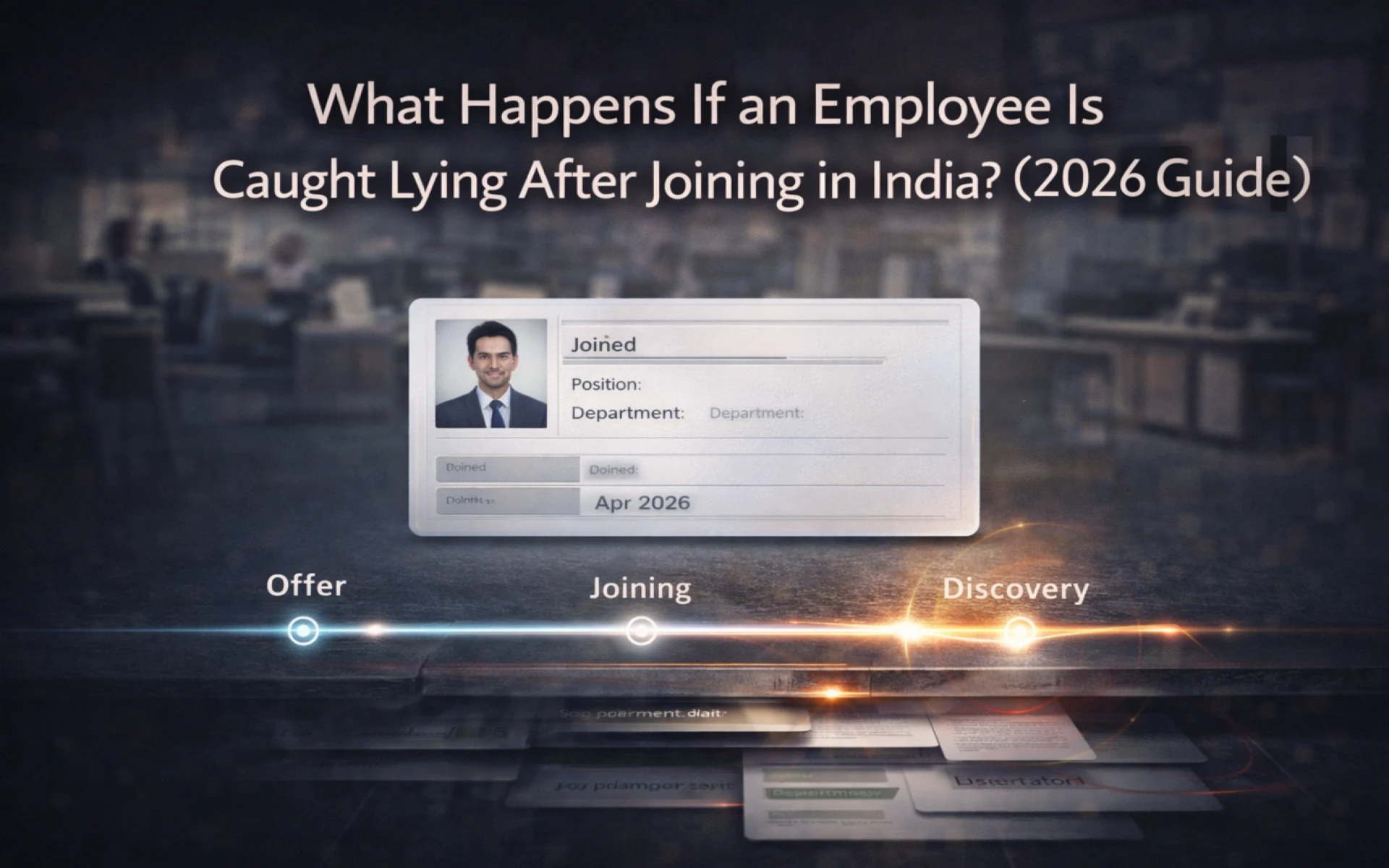
Candidate shortlisted → Consent and notice → Verification initiated → Critical checks reviewed → Offer issued/confirmed → Remaining checks completed → Joining
The exact sequence will depend on the organisation, role and applicable requirements.
How CaseXpert Can Help
The purpose of background verification is not simply to produce a “clear” or “failed” label. The value lies in giving HR reliable information early enough to make an informed decision.
CaseXpert helps organisations structure background verification across employment, education, identity and other relevant checks, with status visibility and documented verification outcomes.
A structured verification workflow can help HR teams:
- Start checks at the appropriate stage of hiring
- Track verification progress
- Identify discrepancies earlier
- Review exceptions systematically
- Maintain an auditable verification trail
- Reduce avoidable post-offer surprises
The goal is not to reject more candidates. It is to give HR better information before a verification issue becomes a hiring crisis.
A Practical HR Checklist
When a background verification failure arrives after an offer, HR can use this checklist:
1. Stop and review the finding
Do not treat the automated or vendor status as the final decision.
2. Verify the evidence
Understand the source, reliability and significance of the discrepancy.
3. Compare it with the candidate's declaration
Identify exactly what was stated and what differs.
4. Give the candidate an opportunity to respond
Allow reasonable clarification or supporting evidence where appropriate.
5. Review the offer terms
Check the conditions relating to background verification and accuracy of information.
6. Assess materiality
Determine whether the issue genuinely affects the hiring decision.
7. Escalate where necessary
Involve legal, compliance or privacy specialists for higher-risk cases.
8. Document the decision
Record the evidence, response, policy and rationale.
9. Communicate professionally
Keep the decision factual, clear and proportionate.
10. Improve the process
Identify why the verification did not finish before the offer and address the underlying workflow issue.
Key Takeaways
- A failed background verification does not automatically mean an offer should be withdrawn.
- HR should distinguish minor discrepancies, verification limitations and material misrepresentation.
- Candidates should have an appropriate opportunity to clarify potentially adverse findings.
- Offer-letter conditions can be important, but their legal effect depends on the actual wording and circumstances.
- Serious or disputed cases may require legal or privacy review.
- Verification decisions should be evidence-based, consistently applied and properly documented.
- Moving critical verification earlier in the hiring process can reduce post-offer surprises.
- A structured verification workflow gives HR better information before making consequential hiring decisions.
Conclusion
An adverse background verification result after an offer has been issued is difficult—but it does not have to become a crisis.
The right response is a disciplined one: verify the finding, assess its significance, give the candidate a fair opportunity to respond, review the offer terms, seek specialist advice where necessary, document the decision and communicate it professionally.
Just as importantly, organisations should learn from the incident. If verification repeatedly identifies material issues only after offers have been issued, the problem may be the hiring workflow itself.
The strongest approach is to make background verification an integrated part of the hiring process rather than a final administrative check. With appropriate consent, reliable verification, clear offer conditions and a structured discrepancy-review process, HR teams can make better-informed decisions while treating candidates fairly.
A failed verification should trigger a review—not a reflex. Verify the facts, understand the discrepancy, hear the candidate, and then make a documented decision.
Catch issues before the offer goes out. CaseXpert's fast, transparent verification surfaces material red flags early and documents every step - so your team can make conditional offers with confidence and act fairly when something does not check out. Talk to our verification specialists or send an enquiry to get started.