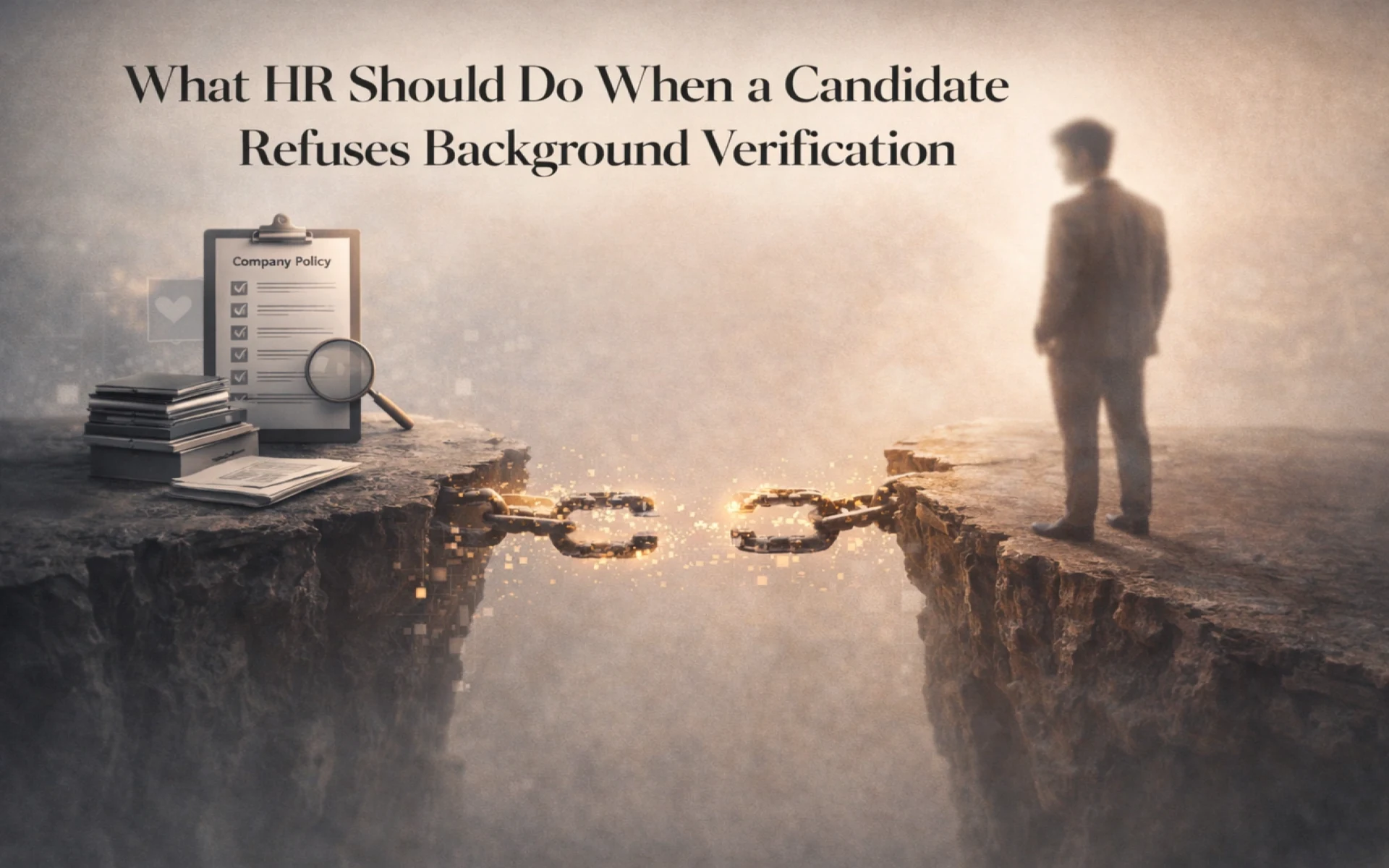
Most candidates complete background verification without hesitation. Occasionally, however, a candidate may decline to provide consent, withhold required documents, object to a particular check, or question why verification is necessary.
For HR teams, this can create an uncomfortable situation. A refusal does not automatically indicate that a candidate has something to hide. At the same time, an organisation may not be able to complete its hiring process if verification is an established requirement for the role.
The right response is neither immediate suspicion nor automatic accommodation. HR should understand the reason for the refusal, explain the verification process clearly, address legitimate concerns, and then apply the organisation's policy consistently.
This guide explains how HR teams can respond when a candidate refuses background verification while maintaining fairness, transparency, privacy, and appropriate hiring controls.
Why Candidates Refuse Background Verification
There is no single reason why a candidate may object to background verification.
Some candidates may be concerned about how their personal information will be collected, stored, shared, or retained. Others may question the relevance of a particular check to the position. A candidate who is still employed elsewhere may also be concerned about contacting their current employer before they have formally resigned.
There can also be cases where a candidate does not want certain information to be independently verified because it may reveal an inconsistency in their application.
The important point for HR is that refusal alone does not establish the reason.
Instead of assuming intent, HR should first ask:
- What part of the verification process concerns the candidate?
- Is the concern about privacy, scope, timing, or documentation?
- Does the candidate object to all verification or only a particular check?
- Can the concern be addressed without compromising a legitimate hiring requirement?
- Is the verification requirement consistently applied to candidates in comparable roles?
Understanding the reason creates a more defensible basis for deciding what to do next.
A Refusal Is Not Automatically a Red Flag
One of the most important principles for HR teams is to distinguish between refusal and misconduct.
A candidate expressing concern about data privacy is not necessarily suspicious. Similarly, a request to delay contact with a current employer may have a legitimate explanation.
At the same time, repeated refusal to provide information that is essential to a role, particularly after the process has been clearly explained, may create a practical barrier to completing the hiring process.
HR should therefore evaluate the circumstances rather than treating every refusal as evidence of dishonesty.
A useful distinction is:
Concern → Understand and address it.
Discrepancy → Verify and investigate it.
Refusal of a required check → Follow the organisation's established policy.
This approach prevents assumptions from becoming hiring decisions.
Start With Transparency, Not Suspicion
The first response should usually be a clear explanation of the verification process.
Candidates should understand:
- What checks will be conducted
- Why those checks are relevant
- What information will be collected
- How the information will be used
- Who may have access to it
- How the information will be protected
- How long information may be retained
- What process is available for raising questions or correcting inaccurate information
A candidate may object simply because they do not understand what the verification process involves.
Clear communication can therefore resolve concerns before they become a hiring issue.
Explain the Scope of the Background Check
The phrase "background verification" can sound broader than the actual process.
Instead of simply telling a candidate that a background check is required, HR should explain the specific checks relevant to the position.
For example, the process may include:
- Identity verification
- Employment verification
- Education verification
- Address verification
- Professional credential verification
- Reference checks
- Role-specific criminal or court-related checks, where appropriate and legally permissible
The organisation should avoid presenting verification as an unrestricted investigation into a candidate's personal life.
A clearly defined scope helps candidates understand that checks are connected to legitimate hiring requirements.
Address Genuine Privacy Concerns
Privacy concerns should be treated seriously.
If a candidate asks how their documents will be handled, HR should be able to explain the organisation's relevant privacy and security practices.
Depending on the organisation and applicable requirements, this may include explaining:
- How candidate information is collected
- Why it is required
- Where it is stored
- Who can access it
- Whether information is shared with a verification provider
- How security is maintained
- How long information is retained
- How applicable privacy rights or complaints can be exercised
If HR cannot answer these basic questions, the issue may indicate that the organisation's verification process itself needs improvement.
A well-designed verification programme should make these answers clear before a candidate is asked to provide sensitive information.
Consider Whether the Candidate's Concern Can Be Accommodated
Not every objection requires the hiring process to end.
For example, a candidate may agree to employment verification but ask that their current employer not be contacted until a specified stage. In some situations, HR may be able to accommodate this while using alternative evidence or verification methods, subject to company policy and applicable requirements.
Similarly, a candidate may question a check that appears unrelated to their role. HR can review whether that check is genuinely necessary rather than automatically insisting on it.
The objective should be proportionate verification.
The organisation should verify what is relevant and necessary for the role rather than collecting information simply because it is available.
When Refusal Becomes a Hiring Barrier
There may nevertheless be situations where background verification is a genuine condition of employment.
For example, an organisation may require certain checks for roles involving sensitive data, financial responsibilities, regulated activities, privileged system access, or specific contractual requirements.
If the candidate, after receiving a clear explanation and having reasonable concerns addressed, still refuses a check that is genuinely required for the position, the organisation may decide that it cannot proceed with the hiring process.
The important factor is consistency.
The organisation should be able to demonstrate that:
- The verification requirement was established before the candidate reached the decision stage.
- The requirement is relevant to the role.
- The candidate was informed about the process.
- The candidate had an opportunity to raise concerns.
- Reasonable questions were addressed.
- The same standard is applied to comparable candidates.
This makes the decision about an established hiring requirement rather than an assumption about the candidate's character.
Do Not Treat Refusal as Proof of Fraud
This distinction deserves special attention.
A candidate who refuses verification has not necessarily committed fraud.
HR should avoid statements or internal records that equate refusal with dishonesty unless independent evidence establishes a specific discrepancy or misrepresentation.
Instead, the record should accurately describe what happened:
"Candidate declined to provide consent for the required employment verification."
That is materially different from:
"Candidate refused because they were hiding fraudulent employment."
The first is a documented fact. The second is an unsupported conclusion unless evidence exists.
This distinction protects both the candidate and the organisation.
Handle Discrepancies Separately From Refusal
Sometimes a candidate initially refuses verification but later provides documents or information that contains inconsistencies.
At that point, HR should treat the discrepancy as a separate issue.
For example:
- Employment dates may differ between sources.
- A company may have changed its legal name.
- A job title may have been used informally while a different title appeared in official records.
- An education record may contain an administrative error.
- Two records may use different versions of a candidate's name.
Not every discrepancy is fraud.
The appropriate approach is to verify the information, give the candidate an opportunity to clarify where appropriate, and assess the materiality of the finding according to established policy.
Apply the Same Standard to Everyone
Consistency is one of the most important safeguards in handling verification refusals.
If background verification is mandatory for a particular category of roles, HR should avoid making ad hoc exceptions based on seniority, urgency, personal relationships, or how strongly a hiring manager wants a particular candidate.
A consistent process should define:
- Which roles require verification
- Which checks apply to each role
- When verification takes place
- How candidates are informed
- How objections are handled
- What happens if a required check cannot be completed
- Who makes the final decision
Consistency makes the process easier to explain and easier to defend.
Document the Conversation and Decision
HR should maintain an appropriate record of the verification process.
Documentation may include:
- The verification requirement communicated to the candidate
- The candidate's stated concern
- Information provided by HR
- Any reasonable accommodation considered
- The checks the candidate agreed to or declined
- Any relevant follow-up
- The final decision and its basis
Documentation should itself be handled according to the organisation's privacy and retention requirements.
The objective is not to create unnecessary paperwork. It is to ensure that an important hiring decision is based on facts rather than memory or assumptions.
Create a Clear Background Verification Policy
Many candidate disputes can be prevented before they happen by having a clear verification policy.
The policy should explain:
- When background verification is required
- Which checks may be conducted
- Why checks are relevant
- How candidate information is handled
- How verification results are reviewed
- How candidates can raise concerns
- What happens if a required check cannot be completed
- How discrepancies are handled
- Who is responsible for the final decision
Candidates should ideally receive the relevant information early enough to understand the process before reaching the final stage of hiring.
A Practical HR Response Framework
When a candidate refuses background verification, HR can follow a simple process:
Step 1: Ask Why
Understand whether the concern relates to privacy, timing, scope, documentation, or another issue.
Step 2: Explain
Clearly communicate what will be checked, why it is required, and how information will be handled.
Step 3: Review
Determine whether the candidate's concern can reasonably be accommodated without undermining the purpose of the verification.
Step 4: Verify
If the candidate agrees, complete the appropriate checks through reliable and authorised processes.
Step 5: Assess
If the candidate continues to refuse a required check, determine whether the organisation can proceed under its established policy.
Step 6: Document
Record the relevant facts and the basis for the final decision.
This approach keeps the process structured without turning a candidate's concern into an automatic accusation.
What HR Should Avoid
There are several approaches that can create unnecessary risk.
Do not assume guilt
Refusal alone does not establish fraud or misconduct.
Do not threaten or pressure unnecessarily
Candidates should understand the requirement and its consequences without being subjected to inappropriate pressure.
Do not collect unnecessary information
A refusal should not become an excuse to request additional personal information that is unrelated to the verification purpose.
Do not make arbitrary exceptions
If verification is mandatory for a role, exceptions should be governed by policy rather than personal preference.
Do not ignore privacy questions
If candidates are asking how their information will be protected, HR should have a clear answer.
Do not make decisions based solely on assumptions
A hiring decision should distinguish between documented facts, unresolved discrepancies, and speculation.
Key Takeaways
- A candidate's refusal to undergo background verification does not automatically indicate wrongdoing.
- HR should first understand the reason for the refusal rather than assume intent.
- Clear communication about scope, purpose, security, and data handling can resolve legitimate concerns.
- Verification should be proportionate to the role and its associated risks.
- If a required check is still refused after reasonable explanation, the organisation may need to decide whether it can proceed.
- Refusal and fraud should not be treated as the same thing without independent evidence.
- Any discrepancies should be investigated separately and fairly.
- Consistent policies help HR handle refusals more objectively.
- Appropriate documentation creates a clear record of how the decision was reached.
Conclusion
A candidate refusing background verification is not necessarily a warning sign. It is first an opportunity for HR to examine the concern, explain the process, and determine whether the verification requirement is genuinely necessary and appropriately designed.
If the candidate has a legitimate privacy concern, transparency and clear communication may resolve it. If the organisation can reasonably accommodate a timing or scope concern, doing so may allow the hiring process to continue without compromising the purpose of verification.
Where a core verification requirement remains necessary and the candidate continues to refuse it, the organisation may ultimately decide not to proceed. That decision should be based on the requirements of the role and the organisation's established policy—not an assumption that refusal itself proves misconduct.
The strongest approach is therefore neither automatic suspicion nor automatic acceptance. It is clear communication, proportionate verification, consistent policy, evidence-based assessment, and respect for candidate privacy.
A refusal is not a verdict. Understand the concern, explain the requirement, and make the decision on evidence.
Handle refusals with confidence. CaseXpert's transparent, consent-driven process gives candidates clear answers about scope and data handling - resolving most concerns up front and giving your HR team a consistent, documented standard to rely on. Talk to our verification specialists or send an enquiry to get started.