Remote and hybrid hiring has reshaped how Indian companies build their teams. Talent can now be sourced from any city, candidates may never set foot in an office, and onboarding often happens entirely online. This flexibility is powerful, but it also removes many of the informal checks that physical workplaces once provided ??? making structured background verification more important than ever.
When you cannot meet a candidate in person, verify their documents at a desk, or rely on a shared office to surface inconsistencies, independent verification becomes the primary safeguard against fraud and misrepresentation. This article explains how background verification supports safe, confident remote and hybrid hiring in India, and what to prioritise when your workforce is distributed.
Why Remote Hiring Raises the Stakes #
In a traditional office, subtle signals accumulate over time ??? a candidate's documents are seen, colleagues interact face to face, and inconsistencies often surface naturally. Remote hiring strips away these signals. A candidate may be hired, onboarded and granted system access without anyone ever confirming in person that they are who they claim to be.
This makes the formal verification process the main line of defence. Without it, remote hiring effectively asks a company to extend significant trust and access to someone it has only ever seen on a screen ??? a gap that determined fraudsters are well aware of and increasingly willing to exploit.
Identity Verification Becomes Critical #
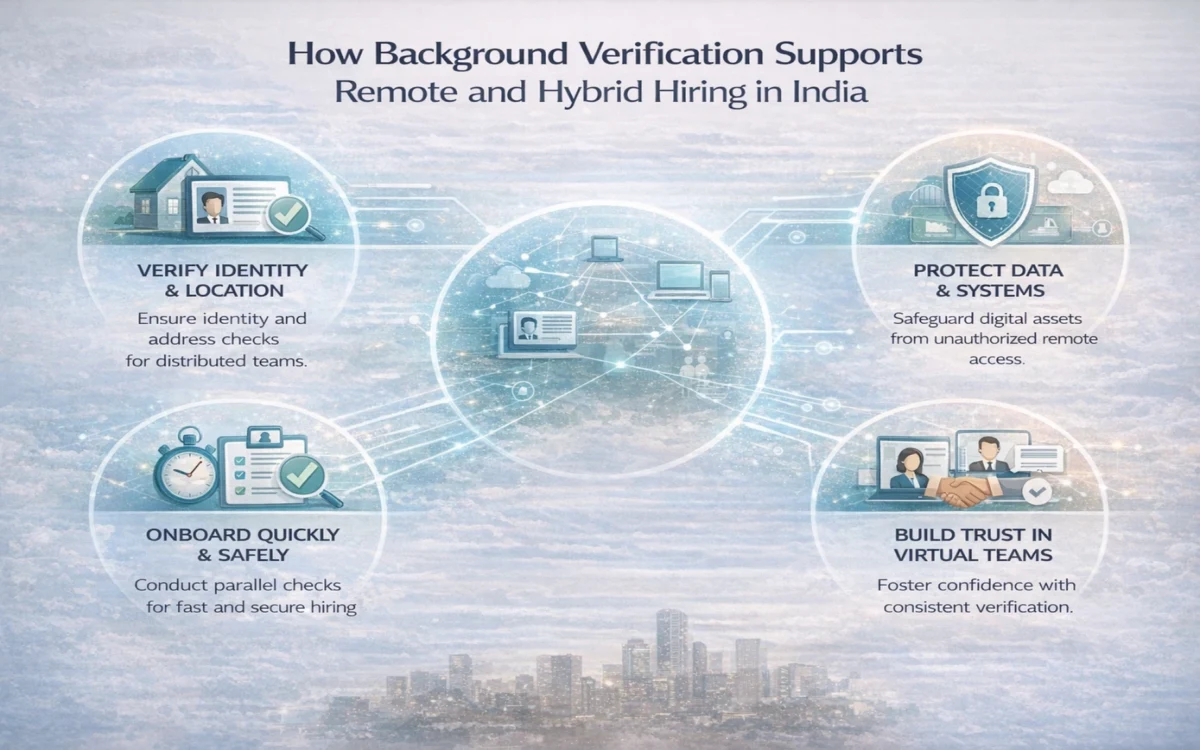
When hiring remotely, confirming that the person behind the screen genuinely matches their documents is the foundation of safe hiring. Identity verification against authoritative credentials anchors everything else, ensuring that the qualifications, employment history and records being confirmed belong to the actual individual being onboarded.
In remote hiring, identity fraud is the single biggest risk. Robust digital identity verification is non-negotiable when you never meet the candidate face to face.
Digital identity validation has matured to handle exactly this challenge, confirming credentials securely and remotely. For distributed teams, this capability is what makes confident remote hiring possible at all.
Verifying Distributed Employment Histories #
Remote candidates often bring employment histories spread across multiple cities or even countries, worked remotely themselves. Verifying these distributed histories requires reach and process discipline ??? confirming employers and dates regardless of geography, and mapping the timeline to expose gaps and overlaps that signal misrepresentation or undisclosed moonlighting.
Moonlighting is a particular concern in remote settings, where the lack of physical presence makes undisclosed parallel employment easier to conceal. Careful timeline analysis during verification is one of the most effective ways to surface it.
Address Verification Without a Physical Office #
Address verification takes on new significance when an employee will work from that address indefinitely. Confirming a candidate's stated location matters for compliance, payroll, equipment delivery and security. Remote-friendly verification methods ??? digital validation and contact-based confirmation ??? make this possible without a physical visit, though field confirmation remains available where roles demand it.
Knowing where your remote employees actually are is not bureaucratic box-ticking; it underpins legal compliance and the basic security of a distributed operation.
Securing Access in a Distributed Workforce #
Remote employees frequently receive system and data access early in onboarding, sometimes before they have ever been seen in person. This concentrates risk: an unverified remote hire with malicious intent can access sensitive systems from anywhere, with little oversight. Verification calibrated to the access a role carries is essential to contain this insider risk.
- Confirm identity before granting system access
- Calibrate verification depth to data and system access
- Use conditional access until verification completes
- Re-verify when remote roles gain elevated access
Building Trust Across Distance #
Beyond risk control, verification builds the trust that distributed teams depend on. When every remote hire is properly verified, colleagues can collaborate with confidence that the people they will never meet in person are genuine and qualified. In a workforce held together by screens rather than shared space, that assurance is quietly foundational.
Verification also signals professionalism to remote candidates themselves. A smooth, respectful digital verification experience sets the tone for a relationship that will be conducted largely online, reinforcing that the company is organised, serious and trustworthy.
Designing Verification for Remote Hiring #
To hire remotely with confidence, companies should make identity verification central, verify distributed histories thoroughly, confirm addresses through remote-friendly means, and calibrate checks to the access each role carries. A technology-driven verification partner is especially valuable here, delivering fast, fully digital verification that matches the pace and geography of remote hiring.
- Anchor every hire to a verified digital identity
- Verify distributed employment and map the timeline
- Confirm addresses using remote-friendly methods
- Tie verification depth to system and data access
Key Takeaways #
Here are the essential points to carry forward from this guide:
- Identity verification is the foundation of safe remote hiring; never grant access before confirming who the candidate is.
- Remote settings make moonlighting and distributed-history fraud easier to conceal.
- Address verification underpins compliance and security for distributed teams.
- Calibrate verification to the system and data access a remote role carries.
- Verification builds the trust that screen-based teams depend on.
- A fully digital, technology-driven process matches the pace of remote hiring.
Conclusion #
Remote and hybrid hiring has unlocked access to talent across India and beyond, but it has also removed the informal checks that physical workplaces once provided. In their place, structured background verification becomes the primary safeguard ??? confirming identity, validating distributed histories, and securing the access that remote employees receive.
The companies that thrive in distributed work are those that treat verification as core infrastructure for remote hiring, not an optional extra. Done well, it lets them tap talent anywhere with the same confidence they would have hiring across a desk.
As remote and hybrid models become permanent features of the Indian workplace, verification that is fast, digital and rigorous is what turns the promise of borderless hiring into a safe, sustainable reality.
When you never meet a candidate in person, verification is the only thing standing between confident remote hiring and blind trust.
Hire remotely with confidence. CaseXpert delivers fast, fully digital identity and background verification built for distributed and hybrid teams across India. Talk to our verification specialists or send an enquiry to get started.