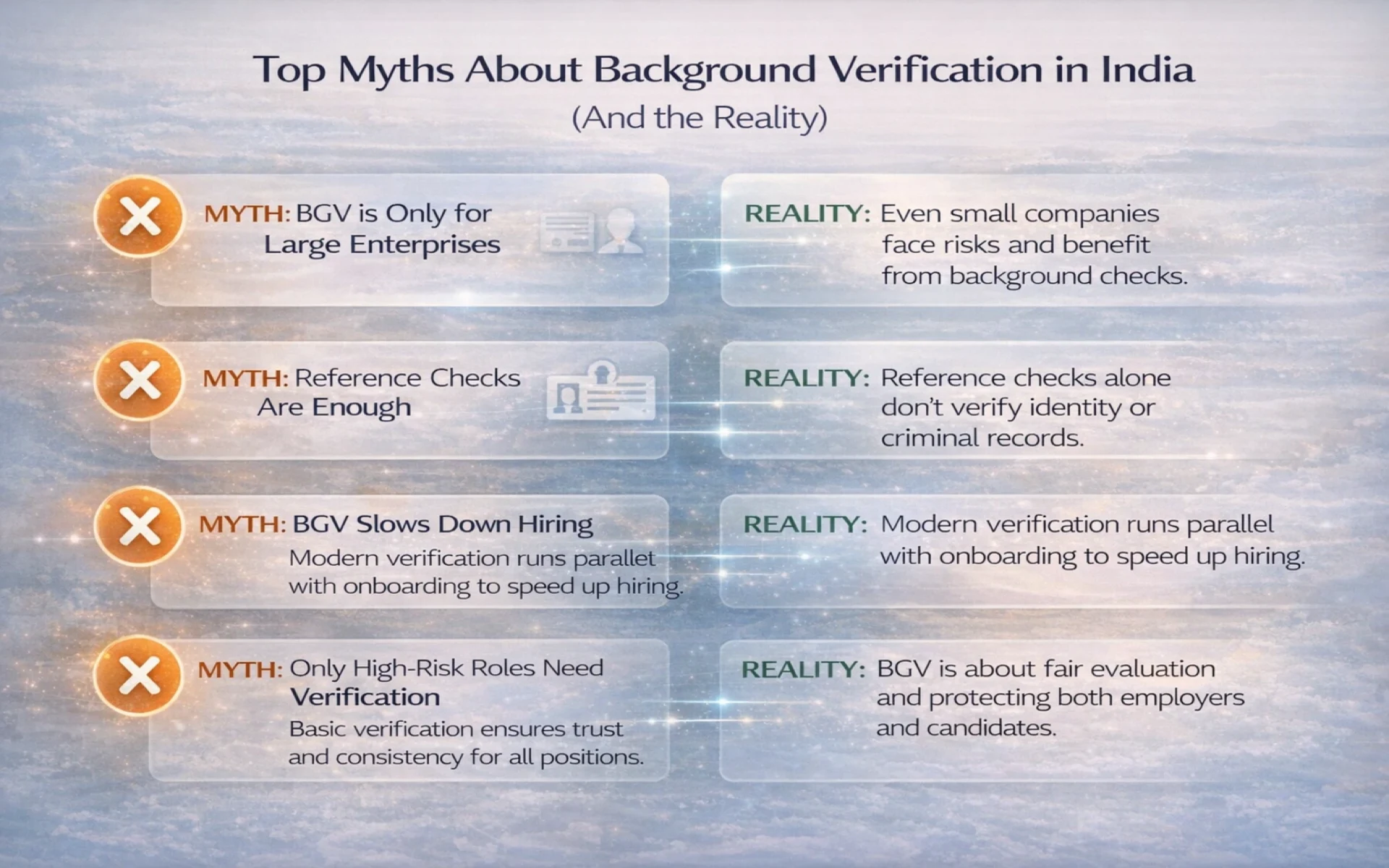
Background verification is surrounded by persistent myths that can lead companies to under-invest in it, candidates to misunderstand the process, and HR teams to design verification workflows poorly. Common misconceptions — such as the belief that verification is only for large companies, always causes delays, or is inherently intrusive — can discourage organisations from using appropriate screening practices.
This article addresses some of the most common myths about background verification in India and explains the reality behind them. Understanding what BGV can and cannot do helps companies design more appropriate screening processes and helps candidates approach verification with greater clarity.
Myth: Verification Is Only for Large Companies
Many small and mid-sized companies assume background verification is primarily a requirement for large corporations. In reality, organisations of different sizes may use verification depending on their roles, workforce, risk profile, client requirements, and internal policies.
For a smaller company, each employee may have significant responsibilities or access to business information, systems, customers, or finances. This can make appropriate verification relevant even when the organisation has a relatively small workforce.
Verification does not have to involve the same set of checks for every company or employee. A smaller organisation can use focused, role-appropriate checks rather than adopting an unnecessarily complex process.
Reality: Background verification can be relevant to organisations of any size when the checks are appropriate to the role and business requirements.
Myth: A Good Interview Is Enough
A strong interview can provide valuable insight into a candidate's communication, experience, problem-solving approach, and suitability for a role. However, an interview alone cannot independently verify every factual claim made during the hiring process.
Background verification serves a different purpose. Depending on the checks selected, it can help confirm information such as employment history, education, identity, address, or other relevant credentials.
This means interviews and verification should generally be viewed as complementary rather than interchangeable.
Reality: Interviews assess the candidate through interaction; appropriate verification can independently confirm relevant information provided during the hiring process.
Myth: Verification Is Always Slow and Delays Hiring
Some companies avoid background verification because they expect it to delay onboarding significantly.
The reality is more nuanced. Verification timelines vary depending on the checks involved, the availability and responsiveness of verification sources, the quality of candidate information, and the organisation's workflow.
Digital tools and parallel processing can make many verification workflows more efficient, but not every check can be completed at the same speed. Education and employment verification, for example, may depend on external institutions or previous employers.
Organisations can reduce avoidable delays by starting verification early, collecting complete information, tracking pending checks, and defining which checks need to be completed before joining or access.
Reality: Background verification can introduce some processing time, but a well-designed workflow can reduce unnecessary delays.
Myth: Verification Is Intrusive and Unfair to Candidates
Candidates may sometimes view background verification as an invasion of privacy, while employers may hesitate to conduct checks because of concerns about candidate experience.
The appropriate approach is to collect and verify information that is relevant to the hiring purpose and to handle personal information responsibly. Depending on the circumstances, appropriate notice, consent or other lawful grounds may apply, and requirements can vary based on the type of information, processing activity, organisation, and applicable law.
A responsible process should clearly communicate what information is being requested and why, while limiting collection to what is relevant and appropriate.
Candidates should also understand that a verification discrepancy does not automatically mean fraud or misconduct. Findings should be reviewed carefully and in context.
Reality: Responsible verification should be relevant, transparent, proportionate, and carried out with appropriate privacy and data-protection safeguards.
Myth: Verification Catches Everything Automatically
Another misconception is that once a verification provider is engaged, every possible issue will automatically be identified.
Background verification is not a guarantee that every form of misrepresentation, misconduct, or future risk will be detected. Its effectiveness depends on the scope of checks, the quality of available sources, the information provided, the verification methodology, and how findings are reviewed.
Key principles include:
- Verification should be calibrated to the role and its responsibilities.
- Relevant checks should be selected rather than using an identical package for everyone.
- Findings should be reviewed carefully and in context.
- Discrepancies should be distinguished from confirmed adverse findings.
- Provider processes and source quality matter.
Reality: Background verification is a risk-management tool, not an automatic guarantee that every potential issue will be discovered.
Myth: Verification Is a One-Time Event
Some organisations view BGV as something that happens only when a candidate is hired. In many cases, that may be sufficient for the organisation's defined process. However, circumstances can change after onboarding.
An employee may move into a more sensitive role, receive additional system access, take on financial responsibilities, or become subject to new contractual or regulatory requirements.
Where appropriate, organisations may therefore establish re-verification or ongoing screening policies for specific roles or circumstances. Such processes should have a clear purpose and should follow applicable legal, privacy, contractual, and organisational requirements.
Reality: Whether verification should be revisited depends on the organisation, role, access, applicable requirements, and internal policy. It is not automatically necessary for every employee.
Replacing Myths With Sound Practice
Dispelling common myths leads to a more balanced approach to background verification.
Organisations can:
- Use verification proportionately — Match checks to the role, responsibilities, access, and relevant risks.
- Combine interviews with verification — Use interviews for qualitative assessment and verification for appropriate factual checks.
- Start the process early — Begin relevant checks early enough to manage potential delays.
- Communicate clearly with candidates — Explain what information is being requested and how the process works.
- Protect personal information — Apply appropriate privacy and data-protection safeguards.
- Review findings carefully — Investigate discrepancies before making employment decisions.
- Reassess requirements when circumstances change — Consider additional verification where roles, access, or applicable requirements change.
Key Takeaways
Here are the essential points to carry forward from this guide:
- Background verification can be relevant to organisations of different sizes.
- Interviews and BGV serve different purposes and can complement each other.
- Verification timelines vary, but structured workflows can reduce avoidable delays.
- Responsible verification should be relevant, proportionate, transparent, and privacy-conscious.
- BGV does not automatically detect every possible risk or discrepancy.
- Re-verification may be appropriate for certain roles or circumstances but is not universally required.
- Verification findings should be reviewed carefully rather than treated as automatic proof of misconduct.
Conclusion
The myths surrounding background verification in India can create unnecessary resistance to a process that, when appropriately designed, can help organisations make better-informed hiring decisions.
Verification is not limited to large companies, nor is it a replacement for interviews. It can complement interviews by independently checking relevant candidate information. At the same time, it is not an automatic guarantee against fraud or misconduct, and its scope should be appropriate to the role and organisation.
A responsible BGV process should be proportionate, transparent, consistent, and supported by appropriate privacy and data-protection practices. Organisations should also recognise that verification requirements can change when employees move into different roles or receive additional responsibilities and access.
Ultimately, understanding what background verification can — and cannot — do allows companies to use it more effectively. Instead of treating BGV as either an unnecessary formality or a complete solution to hiring risk, organisations can make it one well-designed component of a broader, responsible hiring framework.
Background verification works best when expectations match reality: relevant checks, reliable sources, careful review, and a process designed around the role.
Beyond the myths. CaseXpert delivers fast, fair, consent-based verification that protects companies of every size across India. Talk to our verification specialists or send an enquiry to get started.