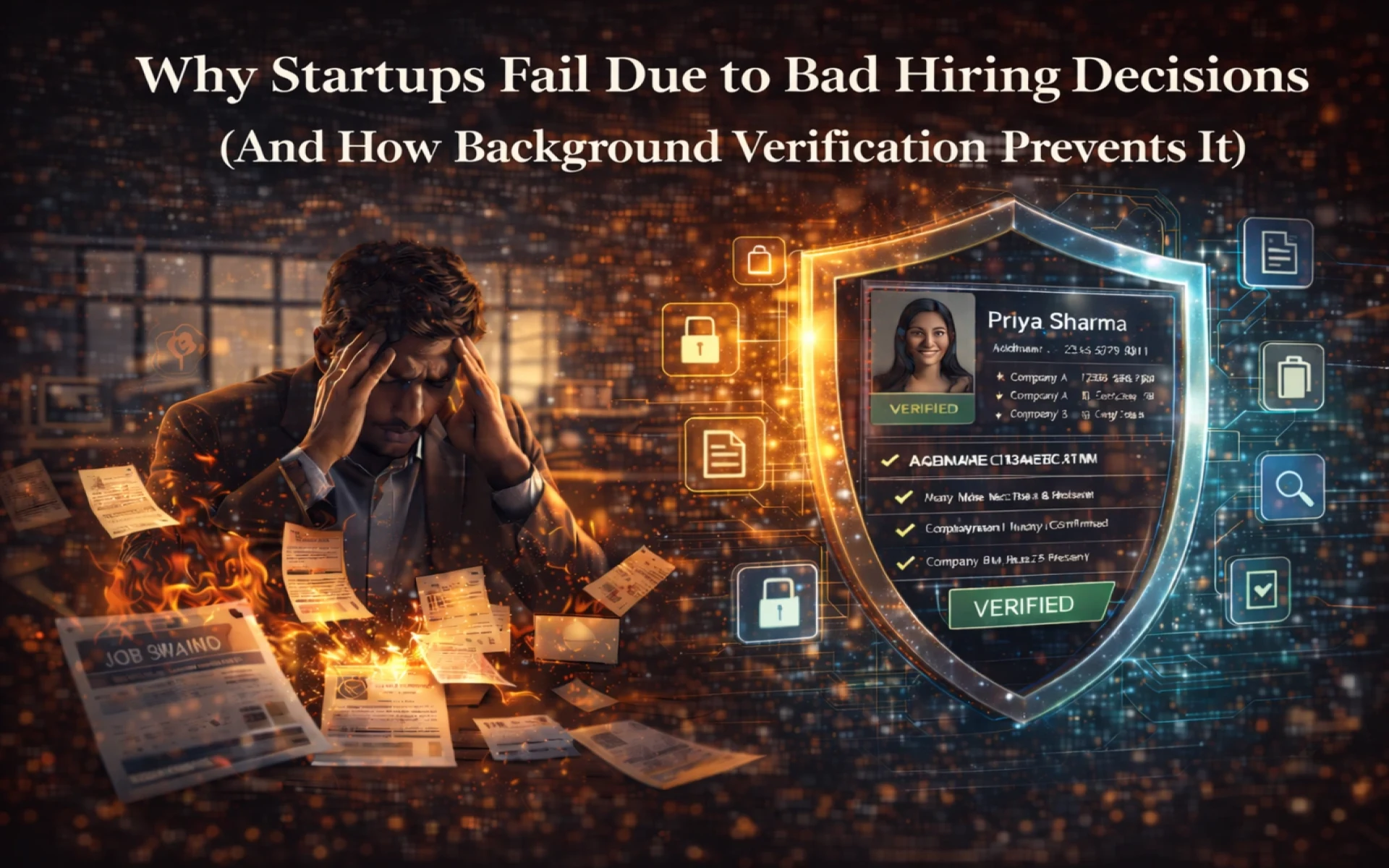
Startups rarely fail because of a single bad decision. More often, problems accumulate: the wrong strategy, missed deadlines, financial pressure, weak processes, and people decisions that gradually create bigger operational risks. Among these, hiring is one of the most underestimated.
In a small company, every employee can have an outsized impact. A poor hiring decision can affect product development, customer relationships, company culture, finances, data security, and even investor confidence. The smaller the team, the more significant the consequences of getting a critical hire wrong.
Background verification is often overlooked by founders focused on fundraising, product development, and growth. Yet verifying the people behind the business can help identify discrepancies in employment history, education, identity, credentials, and other relevant information before those risks become expensive problems.
This guide explores why hiring mistakes can be particularly costly for startups, the risks associated with unverified hiring, and how a structured background verification process can help startups build stronger teams without unnecessarily slowing down recruitment.
Why Every Hire Matters More in a Startup
In a large organisation, a weak hire may be absorbed by established processes, larger teams, and multiple layers of oversight. Startups usually operate differently. Teams are smaller, responsibilities are broader, and individuals often have direct access to important systems, customers, finances, and business decisions.
That makes each hiring decision more consequential.
An early employee may influence product direction, establish team practices, manage critical customer relationships, or become responsible for sensitive information. If their experience or credentials have been misrepresented, the organisation may not discover the problem until significant time and resources have already been invested.
This is why startups benefit from treating verification as part of their hiring foundation rather than as an enterprise-only process.
The Real Cost of a Bad Hire
The financial impact of a bad hire goes well beyond salary.
A hiring mistake can consume management time, delay projects, increase recruitment costs, affect team morale, and require another hiring cycle. For a startup operating with limited resources, these indirect costs can be particularly significant.
Potential costs include:
- Salary and onboarding expenses
- Lost productivity and delayed milestones
- Additional recruitment and replacement costs
- Management and founder time spent addressing the issue
- Disruption to team collaboration
- Customer or project impact
- Potential compliance, security, or reputational consequences
The most significant cost may not appear on the payroll at all. It can be the momentum lost while the organisation identifies the problem, manages its consequences, and searches for a replacement.
How Unverified Hiring Creates Hidden Risk
Startup hiring often happens quickly. Founders may rely heavily on interviews, referrals, portfolios, recommendations, and a candidate's resume when making decisions.
These are useful inputs, but they do not independently establish that every claim on a candidate's profile is accurate.
Without verification, organisations may miss:
- Fabricated or exaggerated employment history
- Incorrect job titles or employment dates
- Misrepresented educational qualifications
- Identity discrepancies
- Undisclosed gaps or inconsistencies
- Relevant background concerns
- Conflicts that may affect a sensitive role
This does not mean every unverified candidate represents a risk. It means the organisation is making an important decision without independently validating information that may materially influence that decision.
Background verification adds an evidence-based layer to the hiring process.
Credential and Experience Fraud Can Be Costly
Startups sometimes hire specialists for areas where founders or existing teams may not have deep expertise. This can make it difficult to independently evaluate every claim about previous experience.
For example, a candidate may present extensive experience in cybersecurity, financial operations, engineering, compliance, or enterprise sales. If those claims are inaccurate, the problem may only become visible after the individual has already been given responsibility.
Employment and education verification can help confirm whether important qualifications and experience claims are supported by independent sources.
For startups, this can be particularly valuable when hiring for roles that directly influence:
- Product development
- Technology and infrastructure
- Finance
- Sales and customer relationships
- Compliance
- Data and security
- Leadership and strategic decision-making
Verification cannot determine whether someone will perform well in a role, but it can help establish whether key factual claims made during hiring are accurate.
Culture and Trust Start With Hiring
Startup culture develops quickly because teams are small and employees work closely together. Hiring decisions therefore influence more than immediate job performance.
A candidate whose qualifications or employment history have been materially misrepresented can create trust issues once discrepancies emerge. Likewise, failing to apply a consistent hiring process can create uncertainty about the standards used to build the team.
A structured verification process does not guarantee cultural fit or eliminate every hiring risk. What it can do is provide a consistent baseline for validating important candidate information.
That creates a stronger foundation for trust between the organisation and its employees.
Data Security and Sensitive Access
Startups often give employees significant access early because teams are lean. A single employee may have access to customer information, source code, financial systems, internal documents, cloud infrastructure, or administrative tools.
The level of verification should therefore reflect the nature of the role.
For example, a position with privileged access to production infrastructure may warrant a more comprehensive verification process than a role with limited access to company systems.
A risk-based approach can help startups focus their verification resources where they matter most.
Investor and Enterprise Customer Expectations
As startups grow, their stakeholders may begin asking more detailed questions about governance and risk management.
Investors, enterprise customers, strategic partners, and potential acquirers may want confidence that the company has appropriate controls around its workforce and sensitive information.
A documented background verification process can demonstrate that the organisation has established basic people-risk controls rather than relying entirely on informal hiring practices.
This becomes increasingly relevant when a startup:
- Enters enterprise contracts
- Handles sensitive customer data
- Expands into regulated industries
- Raises institutional funding
- Expands its workforce rapidly
- Prepares for acquisition or due diligence
Verification is therefore not only a hiring control. It can become part of the broader governance infrastructure of a growing company.
Background Verification Does Not Have to Slow Startup Hiring
Speed is one of the most common reasons founders hesitate to introduce structured verification.
The concern is understandable: startups often need to fill roles quickly, particularly before a product launch, funding milestone, or major expansion.
The solution is not necessarily to remove verification. Instead, startups can design a workflow where verification runs alongside the later stages of recruitment and onboarding, subject to the organisation's legal and policy requirements.
Technology can help automate document collection, verification workflows, status tracking, and routine checks while allowing exceptions to receive additional review.
The goal is simple:
Build verification into the hiring workflow rather than treating it as a separate administrative obstacle.
A short verification process upfront can be far less disruptive than discovering a serious discrepancy months after hiring.
Start With a Simple, Consistent Verification Framework
A startup does not need a complex enterprise compliance programme from its first day.
A practical baseline can include:
- Identity verification — Confirm that the candidate's identity information is consistent.
- Employment verification — Validate relevant employment history, dates, roles, and other agreed details.
- Education verification — Confirm qualifications where they are relevant to the role.
- Address verification — Where appropriate and lawful for the role and jurisdiction.
- Criminal or court-related checks — Where legally permissible, relevant, and proportionate to the role.
- Additional checks for sensitive positions — Apply enhanced verification where the role involves significant financial, operational, data, or system access.
The important point is consistency. The organisation should define what it verifies, when it verifies it, and how discrepancies are reviewed before the first wave of rapid hiring begins.
Verification Should Be Risk-Based
Not every role carries the same level of risk, so verification does not necessarily need to be identical for every position.
A useful approach is to consider:
Role → Access → Risk → Verification depth
A finance role with authority over company funds, an administrator with privileged infrastructure access, and an entry-level position with limited system access may warrant different verification requirements.
Risk-based screening allows startups to maintain appropriate controls without creating unnecessary friction for every candidate.
What Happens When a Discrepancy Is Found?
A discrepancy should not automatically be treated as proof of fraud.
There can be legitimate explanations for differences in employment dates, job titles, company names, education records, or other information. For example, a company may have changed its legal name, or an employer may maintain records differently from how the candidate described their role.
A responsible process should therefore:
- Document the discrepancy
- Verify the information through appropriate sources
- Give the candidate an opportunity to provide clarification where appropriate
- Assess whether the discrepancy is material to the hiring decision
- Apply the organisation's policy consistently
- Maintain an appropriate record of the decision
The objective is not simply to reject candidates. It is to make better-informed hiring decisions based on verified information.
Building a Verification Culture From the Start
One of the biggest advantages of introducing background verification early is that it becomes easier to scale.
A startup that establishes a clear process at ten employees does not have to build an entirely new framework at one hundred employees. The same principles can evolve alongside the organisation.
This includes:
- Defining standard verification packages
- Establishing role-based verification requirements
- Using documented consent and privacy processes
- Maintaining consistent decision criteria
- Tracking verification status
- Reviewing verification providers periodically
- Keeping appropriate records
- Updating policies as the company grows
The result is a hiring process that can become more structured without becoming unnecessarily bureaucratic.
How Background Verification Helps Startups Hire With Confidence
Background verification is not a substitute for interviews, reference checks, technical assessments, or founder judgement. It addresses a different question:
Are the important factual claims behind this hiring decision supported by evidence?
That distinction matters.
Interviews assess capabilities and fit. Technical assessments evaluate skills. References provide additional perspectives. Background verification independently validates selected aspects of a candidate's identity, history, credentials, and background.
Together, these controls provide a more complete picture than any single hiring method can provide.
Key Takeaways
- Every hire can have a significant impact when a startup operates with a small team.
- The cost of a bad hire extends beyond salary to productivity, management time, replacement costs, and business disruption.
- Resume and credential discrepancies can remain hidden when hiring relies only on interviews and references.
- Background verification provides an independent layer for validating important candidate information.
- Verification depth should reflect the responsibilities and access associated with the role.
- A consistent, risk-based process can help startups maintain hiring speed without eliminating important controls.
- Discrepancies should be investigated objectively rather than treated as automatic proof of misconduct.
- Establishing verification practices early makes them easier to scale as the company grows.
- Background verification works best alongside interviews, assessments, references, and other hiring controls.
Conclusion
For startups, hiring is more than filling an open position. Each new employee can influence the company's product, culture, customers, systems, finances, and future growth.
That makes informed hiring particularly important.
Background verification cannot guarantee that every hire will succeed, but it can help startups validate important claims before giving candidates access to the responsibilities and resources that matter most. When verification is designed around role-based risk, privacy, consistency, and timely decision-making, it becomes a practical part of startup hiring rather than an administrative burden.
The strongest approach is not to verify everything indiscriminately. It is to identify what matters for each role, verify those claims through appropriate sources, and combine the findings with the rest of the hiring process.
For a startup, every hire matters. Verification helps ensure that the facts behind the hiring decision are just as strong as the potential you see in the candidate.
Build fast. Hire thoughtfully. Verify what matters.
Hire right from day one. CaseXpert gives startups enterprise-grade verification that runs in parallel with onboarding and scales as you grow - so you protect culture, satisfy investor diligence and avoid the bad hire that derails momentum. Talk to our verification specialists or send an enquiry to get started.