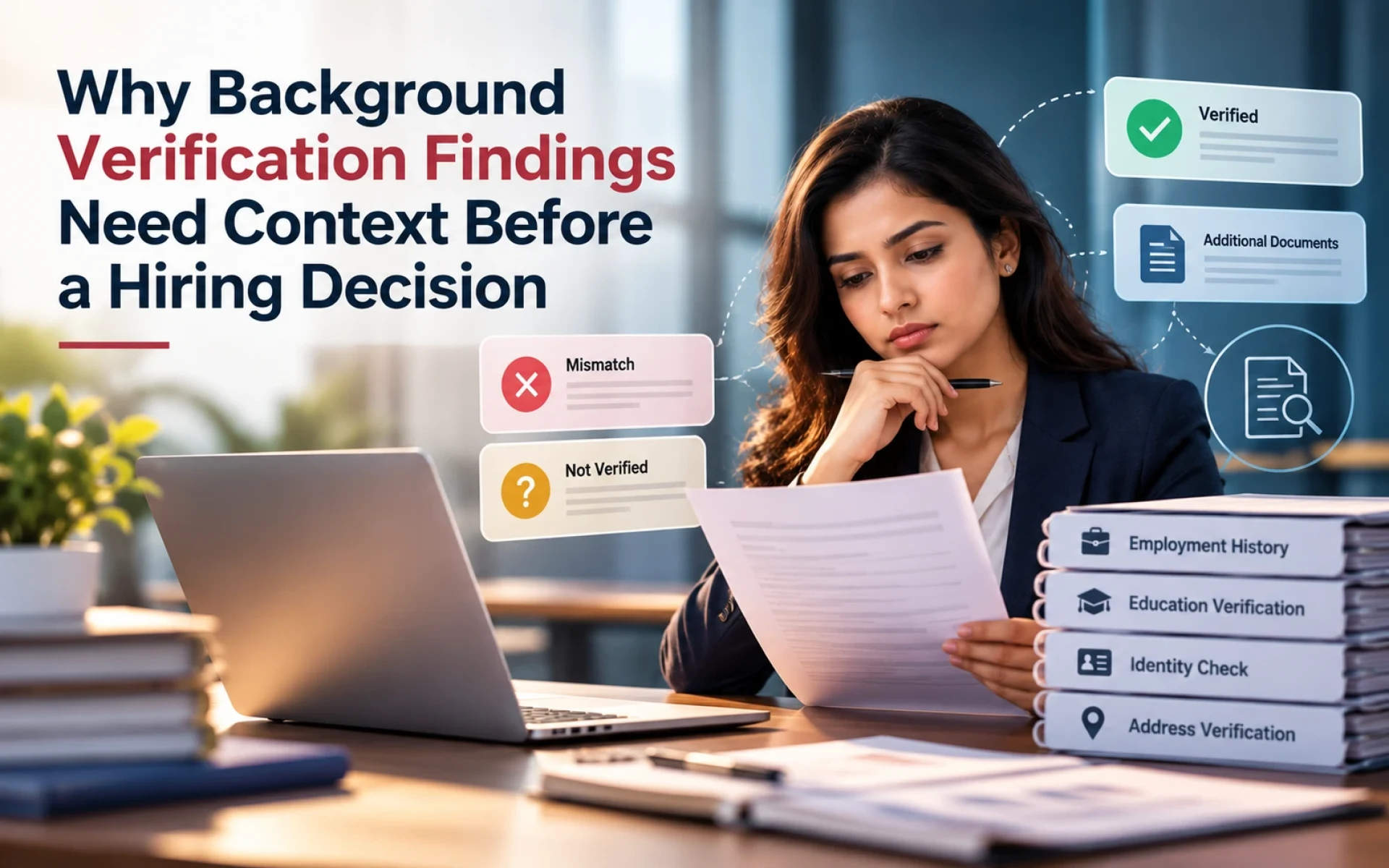
Not every background verification finding is a clear pass or fail. Many fall into a grey area — a date that does not quite match, a job title that differs slightly, or an address that cannot be immediately confirmed. How an organisation handles these discrepancies can determine whether its verification process is fair, accurate and defensible.
Handled poorly, a minor mismatch can result in an unfair decision and cause a qualified candidate to lose an opportunity. A structured approach, on the other hand, helps organisations distinguish genuine concerns from ordinary inconsistencies while giving candidates a fair opportunity to provide context.
This article explains how to handle background verification discrepancies professionally. It explores why discrepancies occur, how to investigate them, when a finding may represent a genuine concern, and why candidate clarification and proper documentation are essential to a fair verification process.
Why Discrepancies Are Common
Discrepancies can occur for many reasons and do not automatically indicate fraud or misrepresentation. Candidates may not remember exact employment dates, companies may change names or restructure, payroll entities may differ from commonly used company names, and records may contain outdated or inconsistent information.
For this reason, a discrepancy should generally be treated as something to investigate rather than an automatic negative conclusion.
Understanding how frequently legitimate inconsistencies occur is essential to handling verification fairly. Treating every mismatch as evidence of dishonesty can lead to incorrect decisions and unnecessary candidate rejection.
Separating Red Flags From Routine Inconsistencies
One of the most important parts of discrepancy handling is distinguishing a meaningful red flag from an administrative or routine inconsistency.
For example, an educational institution confirming that it never awarded the qualification claimed by a candidate may require serious attention. A minor difference in an employment date, however, could have a straightforward explanation.
Two questions can help guide the assessment:
- How significant is the discrepancy?
- How relevant is it to the role being considered?
The answer should be based on the evidence available rather than assumptions about the candidate's intent.
Investigating Before Reaching a Conclusion
A professional verification process investigates discrepancies before reaching a final conclusion. This may involve rechecking the original source, confirming that the candidate's information was entered correctly, or contacting the relevant institution or employer again.
Some discrepancies disappear after a second verification because they were caused by data-entry errors, outdated records or differences in how information is recorded.
Reaching a conclusion without adequate investigation can result in an inaccurate assessment and may unfairly affect a candidate.
Giving the Candidate an Opportunity to Respond
Candidates should have an opportunity to provide context when a potentially significant discrepancy is identified. They may be able to explain circumstances that are not visible in the verification report — such as a company name change, a difference in recorded dates, a name variation or an incorrect institutional record.
A structured process can include:
- Inform the candidate about the specific discrepancy.
- Ask for an explanation or relevant supporting documents.
- Review the information provided alongside the verification findings.
- Reassess the discrepancy based on the available evidence.
- Document the outcome and the reasoning behind it.
This approach improves both fairness and accuracy by ensuring that decisions are not based solely on incomplete information.
Assessing Relevance to the Role
Not every confirmed discrepancy has the same significance. The potential impact of a finding should be considered in the context of the role, the nature of the information involved and the organisation's verification policy.
For example, a discrepancy involving a qualification that is essential to a regulated position may require greater scrutiny than a minor administrative difference unrelated to the role.
A proportionate approach helps organisations focus attention on findings that genuinely matter while avoiding unnecessary rejection over issues that have little relevance to the position.
Documenting the Decision
Every significant discrepancy should have a clear record of how it was handled. Documentation should capture:
- What discrepancy was identified
- Which source provided the information
- What additional verification was performed
- What explanation or documentation the candidate provided
- How the finding was assessed
- What decision was ultimately reached
Good documentation creates an audit trail and helps demonstrate that decisions were based on a consistent and evidence-based process rather than an individual's assumptions.
Maintaining Consistency Across Candidates
Similar discrepancies should be handled according to the same standards. Applying one approach to one candidate and a completely different approach to another can create fairness, compliance and reputational concerns.
A documented discrepancy-handling framework helps HR teams maintain consistency across candidates, roles and hiring cycles.
Consistency does not mean treating every discrepancy identically. It means applying the same decision-making principles while considering the facts and context of each case.
How a Verification Partner Can Improve Discrepancy Handling
An experienced background verification partner can bring structure and context to discrepancy management. Verification specialists regularly encounter differences in employment records, education details, addresses and other candidate information.
Instead of presenting every mismatch as a simple pass-or-fail result, a professional verification process should provide sufficient context for HR teams to understand what was actually found and what remains unverified.
This can help organisations avoid two different types of mistakes: treating an innocent inconsistency as a serious concern or overlooking a discrepancy that genuinely requires further investigation.
The Cost of Getting Discrepancies Wrong
The consequences of poor discrepancy handling can work in both directions.
Treating an innocent mismatch as serious can cause an organisation to lose a qualified candidate, create a poor candidate experience and potentially damage its employer reputation. On the other hand, dismissing a meaningful discrepancy without adequate investigation can allow a genuine risk to go unnoticed.
This is why a structured, evidence-based process matters.
A disciplined approach — investigate, seek clarification, assess relevance and document the outcome — gives organisations a practical framework for making more consistent and defensible decisions.
Key Takeaways
- A discrepancy does not automatically indicate fraud or misrepresentation.
- Investigate significant findings before reaching a conclusion.
- Consider the size, nature and relevance of each discrepancy.
- Give candidates an opportunity to provide clarification and supporting information.
- Document the investigation and final decision.
- Apply consistent principles across candidates and roles.
- Use experienced verification partners to provide context around complex findings.
Conclusion
Handling background verification discrepancies professionally is an important part of building a fair, accurate and defensible verification process. The objective is not simply to identify differences but to understand what those differences mean.
Organisations that investigate before concluding, give candidates an opportunity to respond, assess findings in the context of the role and document their decisions can reduce both false concerns and missed risks.
With a structured process and an experienced verification partner, discrepancies become questions to resolve rather than automatic reasons for rejection.
A discrepancy is a question to investigate, not a verdict to pronounce.
Fair, Accurate Verification. CaseXpert investigates discrepancies with the context and care that protect both your organisation and the candidates you assess. Talk to our verification specialists or send an enquiry to get started.