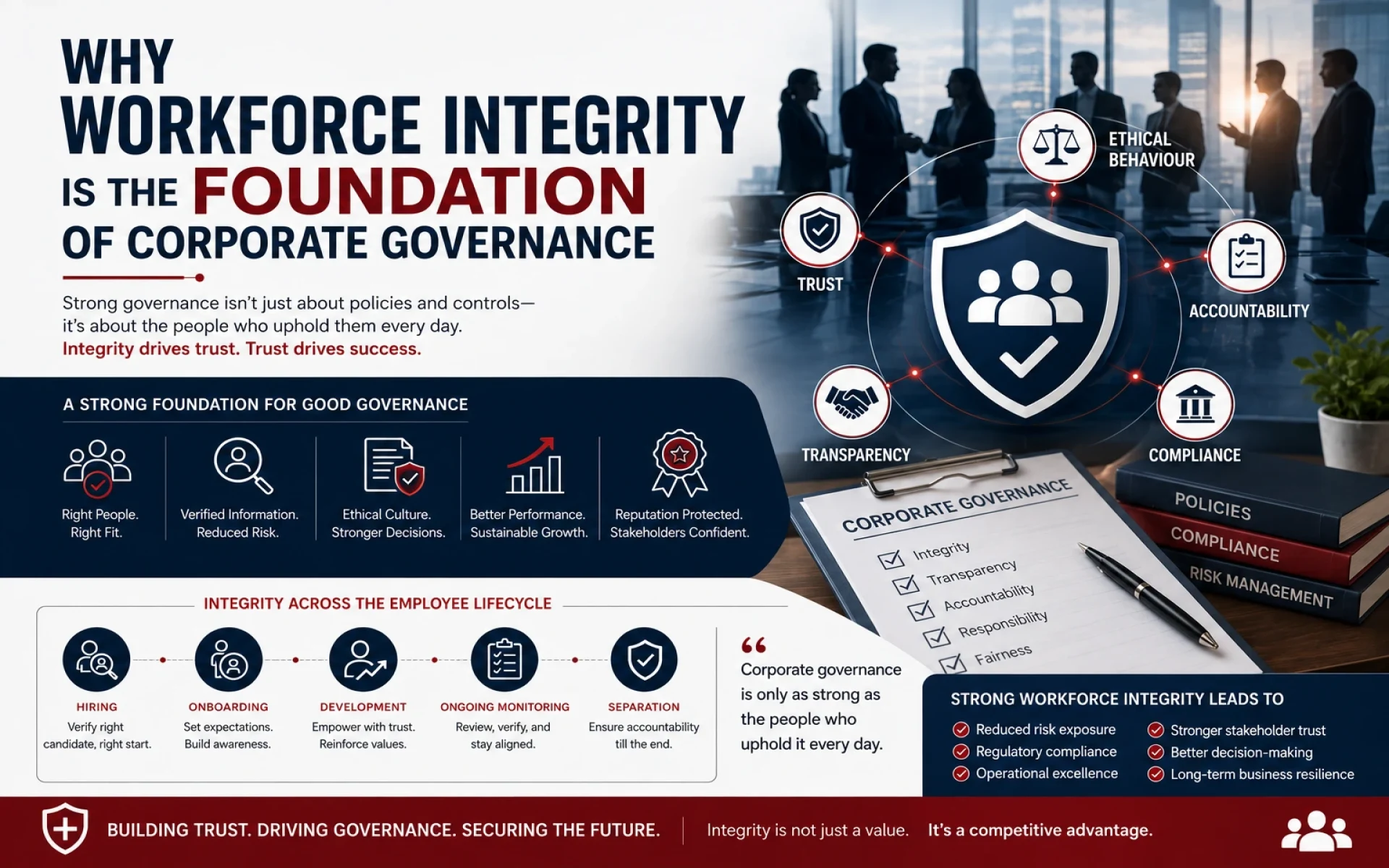
A background verification policy turns ad hoc screening into a consistent, structured, and defensible organisational practice. Without a defined policy, verification can vary from one hire to another depending on the recruiter, hiring manager, role, or time available. That inconsistency can create unnecessary risk and make it difficult to demonstrate that candidates were treated fairly.
A clear policy establishes the rules in advance. It defines who should be verified, which checks should be conducted, how candidate information should be handled, and how discrepancies should be reviewed. Most importantly, it gives HR teams a consistent framework for making verification decisions.
This guide explains how to build a background verification policy for your organisation, from defining its scope and selecting appropriate checks to handling adverse findings, protecting candidate data, assigning ownership, and keeping the policy current. The goal is to provide a practical framework that organisations in India can adapt to their own hiring and risk requirements.
Why a Written Background Verification Policy Matters
A written policy creates consistency at the point where hiring pressure can otherwise lead to shortcuts. When a team needs to fill a position quickly, verification may be delayed, reduced, or handled differently from one candidate to another. A predefined policy provides a clear standard to follow, even when timelines are tight.
It also improves accountability and transparency. If a candidate, client, auditor, or other stakeholder later asks how a verification decision was made, a documented policy provides a clear reference point. It demonstrates that the organisation followed an established process rather than relying on individual judgement alone.
A strong policy should therefore be practical enough for HR teams to follow consistently and flexible enough to accommodate legitimate differences between roles.
Define the Scope and Verification Responsibilities
The first step is deciding who should undergo background verification and how extensive the checks should be.
A risk-based approach is generally more practical than applying identical checks to every position. Organisations can establish different verification tiers based on factors such as access to financial information, sensitive data, critical systems, confidential information, or vulnerable individuals.
For example:
- Baseline verification: Identity, education, and employment checks for standard roles
- Enhanced verification: Additional checks for roles involving greater financial, operational, or data-related responsibility
- Specialised verification: Regulatory, professional licence, credential, or other role-specific checks where applicable
The policy should also define who is responsible for initiating verification, reviewing results, handling discrepancies, and approving exceptions.
Clearly assigning these responsibilities prevents confusion and ensures that the policy remains consistent across departments.
Decide Which Background Checks to Include
A good background verification policy should clearly identify the checks the organisation may conduct and explain when each check applies.
Depending on the organisation and role, these may include:
- Identity verification
- Address verification
- Education verification
- Employment verification
- Professional or credential verification
- Criminal record checks, where appropriate
- Reference checks
- Financial or credit-related checks for relevant roles
- Regulatory or licence verification for regulated positions
The policy should connect each check to the relevant verification tier or role requirement.
Avoid vague wording such as "appropriate background checks." Clearly defining the checks and the circumstances in which they apply reduces inconsistency and makes the process easier for HR teams, candidates, and verification partners to understand.
Build Consent and Data Protection Into the Process
Background verification involves personal information, making responsible data handling a core part of the policy.
The policy should establish how candidates are informed about verification, when appropriate consent is obtained, what information is collected, who can access it, how it is secured, and how long it is retained.
Key principles should include:
- Obtain appropriate candidate consent before conducting checks
- Collect information that is relevant to the stated verification purpose
- Restrict access to authorised personnel
- Protect verification records through appropriate security controls
- Establish clear retention and disposal practices
- Maintain appropriate documentation of the verification process
Organisations should also review their policy periodically to ensure that their practices remain aligned with applicable Indian data-protection and employment requirements.
Establish a Fair Process for Handling Adverse Findings
One of the most important sections of a background verification policy is the procedure for handling discrepancies or potentially adverse findings.
Not every discrepancy indicates misconduct. Differences in employment dates, name formats, documentation, or institutional records may have legitimate explanations. The policy should therefore establish a structured process for reviewing findings before any employment decision is made.
A practical process can include:
- Validate the finding to confirm that the information is accurate and relevant.
- Review the available evidence and identify whether the discrepancy has a reasonable explanation.
- Give the candidate an appropriate opportunity to respond or provide supporting information.
- Assess relevance to the role rather than treating every discrepancy as equally significant.
- Document the review and final decision along with the rationale.
This approach helps reduce the risk of decisions being based on incomplete information and creates a more transparent, consistent process.
Assign Clear Ownership
A policy is only effective when someone is responsible for implementing and maintaining it.
The organisation should clearly define who owns the verification programme and who is responsible for individual stages of the process. For example, HR may coordinate verification, while a designated senior reviewer or compliance function may handle complex or disputed findings.
The policy should clarify:
- Who initiates verification
- Who communicates with candidates
- Who reviews verification reports
- Who handles discrepancies or exceptions
- Who approves final actions
- Who maintains verification records
- Who owns and updates the policy
Clear ownership prevents the policy from becoming a document that exists on paper but is interpreted differently across teams.
Keep the Policy Current
A background verification policy should be treated as a living document rather than a one-time exercise.
Hiring models, organisational risks, technology, verification methods, and applicable requirements can change over time. An organisation may also introduce new roles, enter new markets, or begin hiring remotely, all of which can affect its verification requirements.
A periodic review should assess whether:
- Verification tiers still reflect the organisation's risk profile
- Existing checks remain relevant to current roles
- Data-handling practices remain appropriate
- Responsibilities are still clearly assigned
- The documented policy matches actual hiring practices
- Applicable legal or regulatory requirements have changed
An annual review can provide a useful baseline, with additional reviews whenever there is a significant change to the organisation or its verification framework.
Working With a Background Verification Partner
A well-designed policy establishes what the organisation expects from its verification process, but consistent execution is equally important.
A capable background verification partner can help organisations apply defined checks consistently, manage verification workflows, maintain documentation, and provide structured reports. This can be particularly valuable for organisations handling high hiring volumes or distributed workforces.
When evaluating a verification partner, organisations should consider factors such as verification depth, turnaround times, data protection practices, reporting quality, geographic coverage, technology capabilities, and the partner's ability to support the organisation's verification policy.
The goal is not simply to outsource checks, but to ensure that the standards defined in the policy are followed consistently for every relevant hire.
Key Takeaways
- A written background verification policy creates a consistent and structured screening process.
- Define verification requirements according to role, responsibility, and risk.
- Clearly specify which background checks apply to different verification tiers.
- Build candidate consent and responsible data handling into the process.
- Establish a fair and documented process for reviewing discrepancies.
- Assign clear ownership for verification, decision-making, records, and policy updates.
- Review the policy regularly to ensure it reflects current risks and requirements.
- Choose verification partners that can reliably execute the standards defined by your organisation.
Conclusion
Building a background verification policy helps organisations transform screening from an inconsistent, person-dependent activity into a structured and repeatable process. A well-designed policy defines who should be verified, which checks apply, how candidate information is handled, how discrepancies are reviewed, and who is responsible for each stage.
The strongest policies are practical, risk-based, clearly documented, and regularly reviewed. They provide HR teams with a consistent framework while giving candidates greater transparency about how verification is conducted.
With the right policy and reliable execution, background verification becomes more than a pre-employment formality. It becomes an important part of responsible hiring, risk management, and organisational governance.
A strong verification policy turns good intentions into consistent practice—so every hire is reviewed against a clear, fair, and documented standard.
Build Your Policy. CaseXpert helps organisations build and operate background verification policies that are fair, compliant and consistently applied. Talk to our verification specialists or send an enquiry to get started.