As hiring in India becomes increasingly digital, decentralized, and volume-driven, organizations face greater exposure to risks such as fraudulent profiles, inaccurate qualifications, misrepresented employment histories, and identity-related discrepancies.
Organizations are no longer evaluating candidates only on skills and experience. They are also considering trust, compliance, workplace safety, and workforce risk.
This is where structured Background Verification (BGV) checks play an important role.
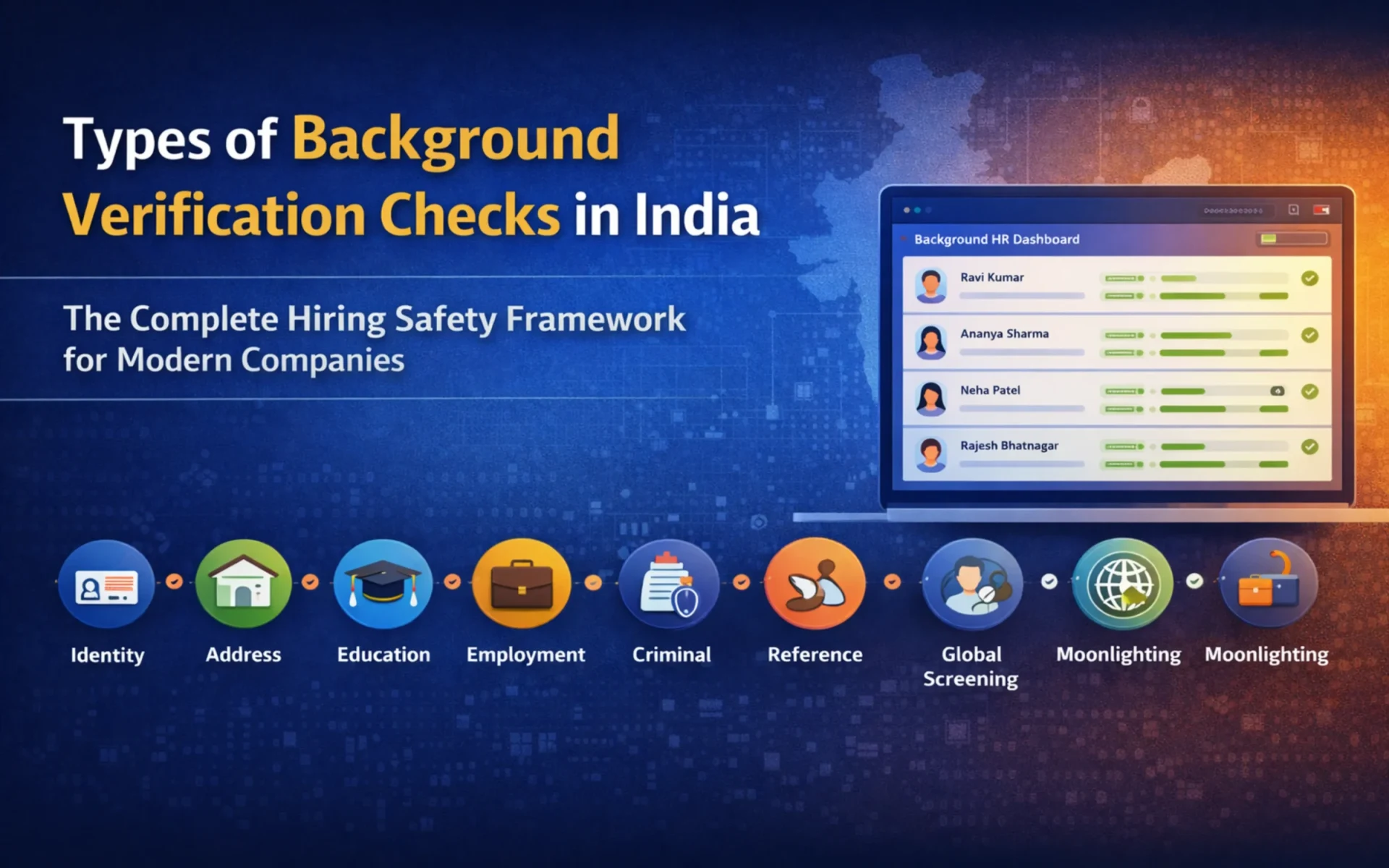
Rather than relying on a single verification step, modern organizations can combine multiple checks based on the requirements and risk profile of a particular role. Each verification layer addresses a different area of potential risk, helping employers build a more comprehensive and consistent hiring framework.
Identity Verification: Establishing Personal Authenticity
Identity verification is often the starting point of a background verification process. Its purpose is to establish that the individual being considered for employment is the same person represented by the information and documents submitted during hiring.
Depending on the organization's requirements, verification may involve documents or information such as PAN, Aadhaar, passport, or other officially recognized identity documents, subject to applicable requirements and consent.
Identity verification can help organizations identify identity mismatches, impersonation attempts, duplicate identities, and potentially manipulated documentation.
Address Verification: Confirming Residential Information
Address verification is used to validate the residential information provided by a candidate.
Depending on the verification provider, location, and role requirements, this may be conducted through digital methods, database checks, document validation, or physical field verification.
Address verification can provide an additional layer of candidate traceability and may be particularly relevant for roles involving field operations, customer visits, access to physical premises, or other location-sensitive responsibilities.
Education Verification: Confirming Academic Credentials
Education verification helps employers determine whether the degrees, diplomas, certifications, or other academic credentials provided by a candidate can be validated through appropriate sources.
Depending on the institution and verification process, information such as the qualification, institution, course, and year of completion may be checked.
This check can be particularly relevant for positions where specific educational qualifications or professional certifications are important to the role.
Employment Verification: Validating Professional History
Employment verification validates information provided about a candidate's previous employment.
Depending on the organization's requirements, checks may include:
- Previous employer
- Designation or job title
- Employment period
- Location or department
- Reason for separation, where available and appropriate
- Other employment-related information relevant to the role
Employment verification can help identify discrepancies such as overstated experience, inaccurate employment dates, or potentially fabricated employment records.
Criminal and Court-Record Checks: Assessing Relevant Legal Risk
Criminal and court-record checks may be conducted where they are relevant to the position and permitted under applicable laws and processes.
These checks can involve searching appropriate court or public-record sources for information that may be relevant to an employer's defined screening criteria.
A record or name match should not automatically be treated as proof of wrongdoing. Potential matches need to be reviewed carefully to distinguish the candidate from other individuals with similar identifying information and to account for incomplete or inaccurate records.
Organizations should also ensure that the use of such information is consistent with applicable legal, privacy, and employment requirements.
Reference Verification: Adding Professional Context
Reference verification involves contacting professional references, such as former managers or supervisors, to validate aspects of a candidate's professional conduct and working history.
Depending on the organization's process, references may provide information about areas such as:
- Professional conduct
- Reliability
- Responsibilities handled
- Work performance
- Team interaction
- Employment context
Reference checks complement documentary verification by providing additional professional context that may not be available from formal records alone.
Global Database and Compliance Screening: Supporting International Risk Management
Organizations operating across borders or working with regulated industries may conduct global compliance screening where appropriate.
Such screening can include relevant sanctions, watchlists, regulatory databases, or other risk databases maintained by recognized authorities and providers.
This can be particularly relevant for organizations involved in international transactions, financial services, regulated activities, or roles with specific compliance requirements.
The scope of screening should be determined according to the role, jurisdiction, applicable regulations, and organization's compliance policies.
Drug and Health Screening: Role-Specific Considerations
Some organizations may conduct drug or health-related screening for specific roles where there is a legitimate occupational safety or regulatory requirement.
This may be relevant in certain sectors such as manufacturing, transportation, construction, healthcare, or safety-sensitive operations.
However, health information is sensitive personal information, and such screening should not be treated as a standard requirement for every employee. Organizations should establish a clear, lawful, and role-appropriate basis for conducting these checks and handle the resulting information appropriately.
Moonlighting and Employment Overlap Verification
The growth of remote and hybrid employment has increased organizational attention toward potential employment overlaps and conflicts of interest.
Where permitted and relevant to the organization's employment policies, moonlighting or employment-overlap checks may be used to identify situations such as:
- Concurrent employment
- Undisclosed professional engagements
- Potential conflicts of interest
- Overlapping employment periods
- Violations of applicable employment policies
Any finding should be reviewed in the context of the organization's employment terms and applicable law rather than being treated automatically as misconduct.
Building a Role-Based BGV Framework
Not every employee requires the same set of background checks.
A more effective approach is to build role-based verification packages according to the responsibilities, access levels, regulatory requirements, and potential risks associated with each position.
For example:
| Role Type | Potentially Relevant Checks |
|---|---|
| IT / Technology | Identity, education, employment, address, compliance screening |
| BFSI / Fintech | Identity, employment, address, education, relevant compliance checks |
| Healthcare | Identity, education, employment, professional credentials, role-specific health checks |
| Logistics / Field Operations | Identity, address, employment, relevant legal checks |
| Senior Leadership | Identity, education, employment, references, compliance screening |
| Gig / Platform Workers | Identity, address, role-specific employment and legal checks |
The exact combination should be determined by the employer based on the role, business requirements, applicable regulations, and internal risk policies.
This approach helps organizations avoid both under-screening, which may leave important risks unidentified, and over-screening, which may introduce unnecessary cost, complexity, or privacy concerns.
Why a Structured BGV Framework Matters
A background verification program is most effective when it is consistent, documented, and proportionate to the risks associated with the role.
A structured framework can help organizations:
- Verify information provided by candidates
- Identify material discrepancies
- Standardize screening processes
- Maintain verification records
- Support compliance and audit requirements
- Improve visibility across hiring workflows
- Make more informed employment decisions
BGV does not eliminate every hiring risk. Instead, it provides organizations with additional information that can support a more informed and consistent hiring process.
Why Companies Choose CaseXpert
CaseXpert provides technology-driven background verification solutions designed for modern businesses in India.
The platform enables HR and compliance teams to manage relevant verification checks through structured workflows, centralized case tracking, and compliance-focused reporting.
With PAN-India coverage and technology-enabled verification processes, CaseXpert helps organizations build role-based BGV frameworks, monitor verification progress, and maintain organized verification records across their hiring workflows.
Final Thought
Background verification in India has evolved from basic document checking into a broader workforce-risk management process.
From identity, address, education, and employment verification to criminal and court-record checks, reference verification, compliance screening, and role-specific checks, organizations can combine different verification layers according to their hiring requirements.